EOLIOS, expert in the smoke-control process
Through CFD simulation we study all the phenomena that govern making a building safe in the event of fire — from smoke propagation to the visibility of the evacuation routes.
Studies carried out
- Visibility through smoke
- Maximum air temperature
- People evacuation
Phenomena
- Smoke propagation through spaces
- Radiant temperature of the walls
- Temperature & velocity profiles
Design
- Fire scenario based on the risk
- Accounting for wind effects
- Optimization of the smoke control systems
Fire safety and design of smoke control systems
Ensuring occupant safety
It is imperative to design the installations with adequate occupant safety and compliance with fire-safety rules. Our studies help architects and engineers to simulate fire and smoke propagation in order to design smoke control systems for buildings, metros and other public-access facilities.
The aim is to assess and understand the air-flow profile and smoke propagation over time within the space concerned during a fire. The study also highlights possible design improvements: control of air-flow patterns, identification of dead-air pockets, assessment of the mean age of air, sizing of the fans and air velocities in the building. It is possible to assess the performance of the smoke control system using a CFD analysis, and to study smoke movement, temperature and the visibility profile while taking into account various fire scenarios.
In parallel, we may carry out people-evacuation studies so as to strengthen the relevance of the chosen evacuation scenarios.
We carry out:
- Regulatory calculation report;
- Fire and smoke-extraction simulations;
- Transient calculation of smoke distribution;
- Transient temperature calculations;
- Optimization of the regulatory, technical and organizational fire protection.
Optimizing fire protection and smoke control
For complex buildings, the existing guidelines and regulations are sometimes too general to reliably assess the interactions between a fire and the development of smoke gases. It can therefore happen that a technical solution cannot be fully validated by regulatory provisions such as IT246, and that an unfavourable opinion is issued by the inspection body even though the smoke control system is functional.
When creating a smoke-control concept, we use calculation methods that take into account, in particular, the interaction between:
- the ventilation of the room and the location of the fire;
- the smoke fire and the supply air;
- the fire smoke and the extracted air;
- the thermal and ambient pressure;
- the impact of an unfavourable wind;
- the start-up time of the mechanical systems.
Numerical simulation makes it possible to compute the smoke, temperature and pressure curve as a function of time:
- the height of the smoke layer (clear height);
- the temperature distribution in the spaces;
- the concentration of the smoke gases;
- the temporal and spatial evolution of the smoke-gas propagation;
- the visibility study through the smoke.
CFD simulation applies to complex building and space models: it models smoke release, temperature and the pressure curve over time. We are thus able to justify the smoke-control design for complex buildings and large atriums.
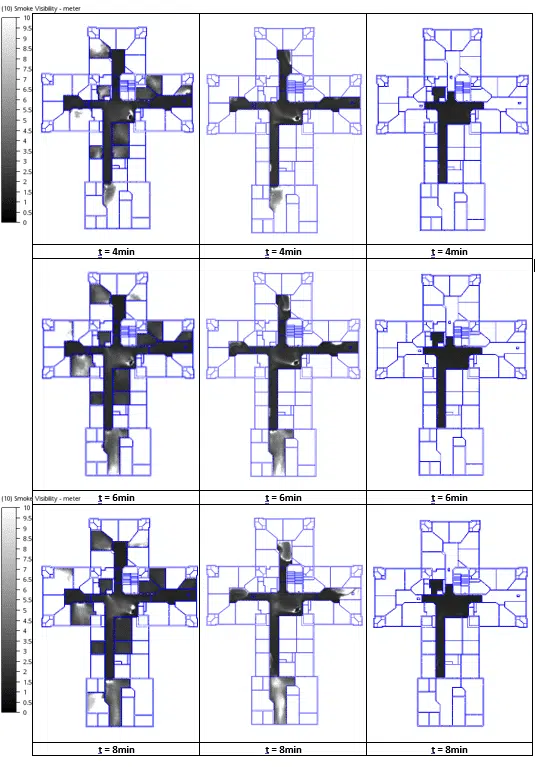
Modelling visibility through smoke
The visibility capacity through smoke defines the distance at which an evacuation sign can be seen from a smoke-filled environment. Our studies determine this distance based on the resulting air flow, the type of fire source, the location of the fire and the properties of the heat load.
This information helps designers to determine the location of exit signs in enclosed environments and to check that the escape routes remain perfectly usable. When smoke fills a room, the visibility of the signs indicating the exits is vital for a safe evacuation.
We provide the justifications required by inspection bodies
Thanks to fire and smoke-extraction simulations, we determine at an early stage whether the smoke control systems and the various natural-ventilation openings are compliant. We analyse the smoke pockets in trapped areas and make structural and technical suggestions to keep the escape routes free of smoke. Using videos, we illustrate the propagation of the smoke gases and agree on the necessary measures in consultation with everyone involved in the design.
We organize the discussions with the inspection bodies so as to justify the design with respect to an interpretation of the standard. The many years of experience gained on large projects are particularly advantageous in this context.
Know-how: dynamic modelling of people evacuation