Wind in the urban environment
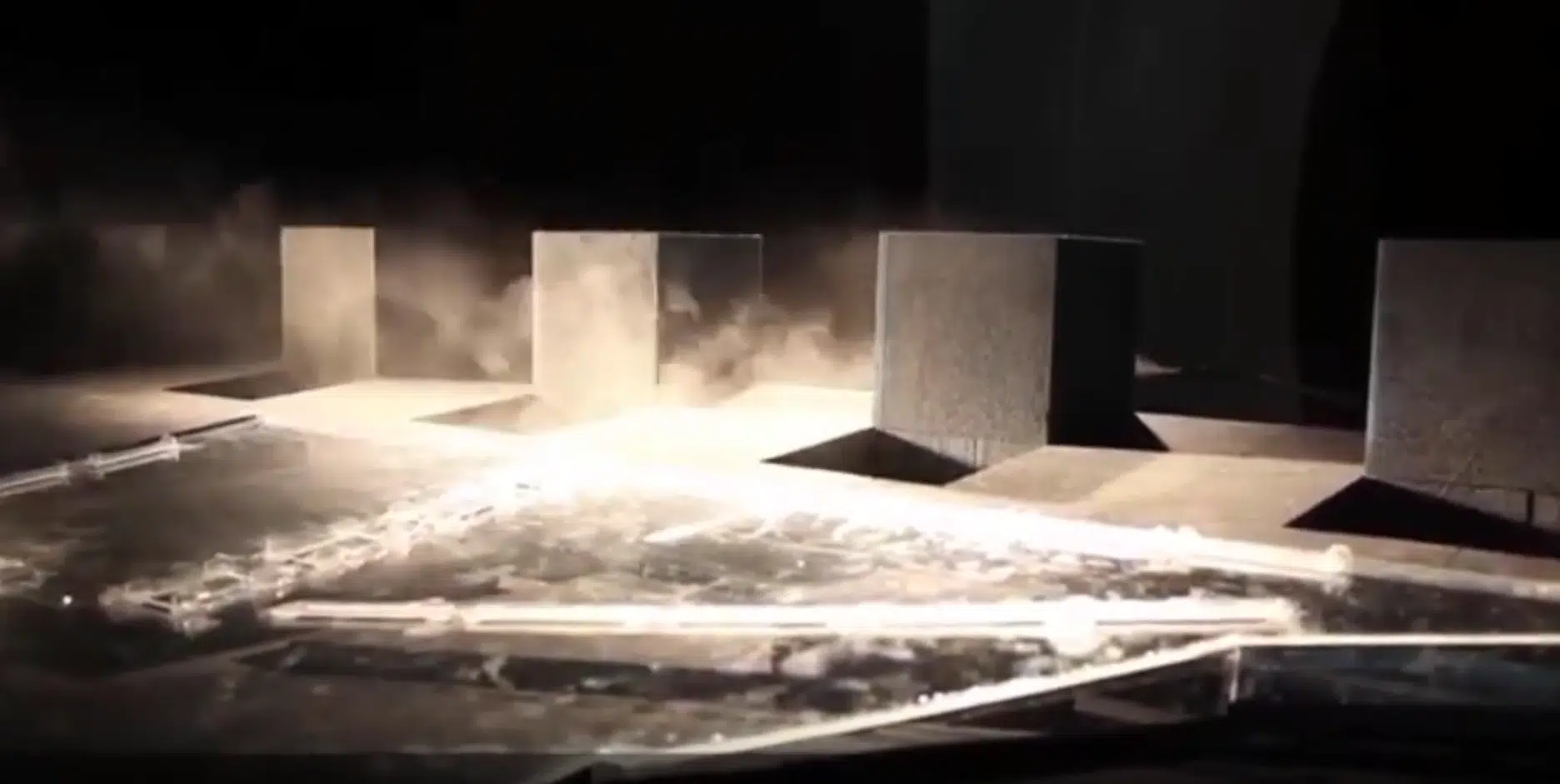
As it approaches the ground, the wind meets a major obstacle: the city. Buildings, streets and squares deflect, accelerate and slow the flow, creating a complex aerodynamic environment.
Far from being uniform, the wind at ground level results from the interaction between the atmospheric wind profile (which increases with height) and the roughness of the urban fabric. Where a plain offers a regular flow, a dense city generates overspeed zones, vortices and calm zones, sometimes only a few metres apart.
These variations have very concrete consequences: pedestrian discomfort on squares and forecourts, danger at the foot of towers, dispersion of pollutants and odours, but also wind loads on façades and structures. Understanding these effects from the design stage is essential for pleasant and safe urban spaces.
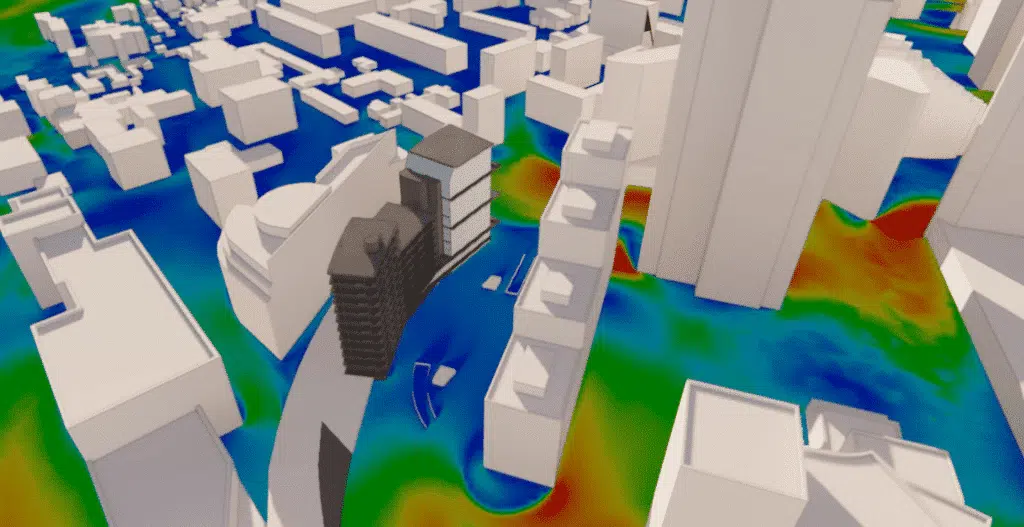
CFD simulation (Computational Fluid Dynamics) makes it possible to faithfully reproduce the wind flow around buildings and to map these phenomena. Before any study, a climate analysis of the site (wind rose, speeds, frequencies by direction) is carried out to apply the right boundary conditions and obtain representative results.
Venturi effect and channelling effect
The Venturi effect
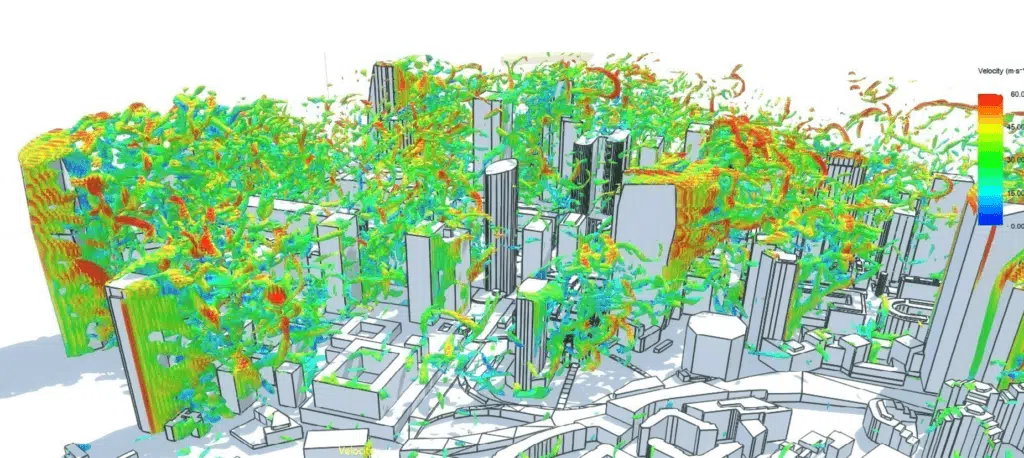
The Venturi effect is undoubtedly the best-known urban phenomenon. When two buildings are close together, the cross-section available to the wind shrinks: by conservation of flow rate, the air must accelerate to pass through the constriction. Between the two structures, the wind can then reach speeds well above those of the incident wind.
This phenomenon is particularly marked in dense business districts (such as La Défense), where the height and density of buildings create strong overspeeds at ground level. These zones must absolutely be taken into account for the comfort and safety of users (forecourts, terraces, building entrances).
The channelling effect (tunnel effect)
The channelling effect, or tunnel effect, appears when the wind rushes into a street or urban corridor aligned with its dominant direction. The flow is then concentrated and guided along the whole length of the street, where it keeps — or even increases — its speed, unable to escape sideways.
Straight streets, covered passages and lines of buildings are the most favourable configurations. The orientation of the built fabric relative to the prevailing winds is therefore a decisive design parameter for limiting these windy corridors.
Corner effect and wake effect
The corner effect
At a building's sharp edges, the flow cannot get around the obstacle without separating: localised overspeeds and vortices then form at the corners. This is the corner effect: intense gusts appear right at the corners of buildings, exactly where pedestrians often walk.
This effect explains why it is common to feel a sudden gust when turning the corner of a large building, while the rest of the façade stays relatively sheltered. Rounded shapes or windbreak devices help to mitigate this phenomenon.
The wake effect
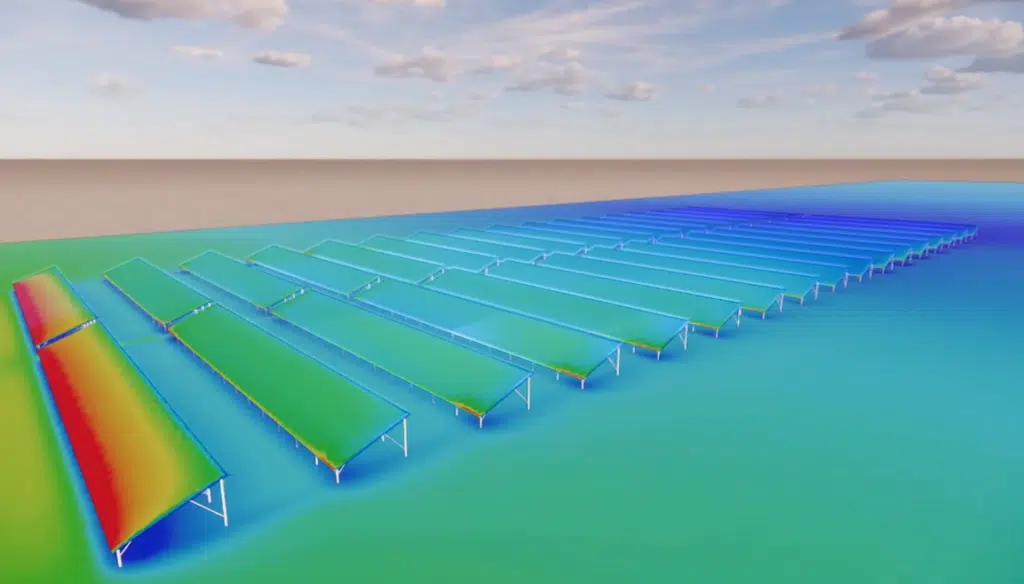
Behind a building, the air does not close back immediately: a wake zone is created, marked by recirculation and vortices. This zone is generally calmer in mean speed, but also more turbulent and unstable: gusts there are irregular.
The wake influences the comfort of downstream spaces, but also the dispersion of smoke, odours and pollutants: a discharge caught in a recirculation zone can stagnate or be brought back down to the ground instead of being carried away. This is a key point of air-quality studies in the city.
The downwash of high-rise buildings
Since the wind is faster at altitude than at ground level, a tower (high-rise building) intercepts a powerful flow over its whole height. Part of this flow, striking the façade, is driven downwards along the building: this is the downwash effect.
This downward current brings to the ground speeds characteristic of altitude, far higher than the local wind: at the foot of towers, it often combines with the corner effect and the Venturi effect to create particularly windy zones, sometimes dangerous for pedestrians.
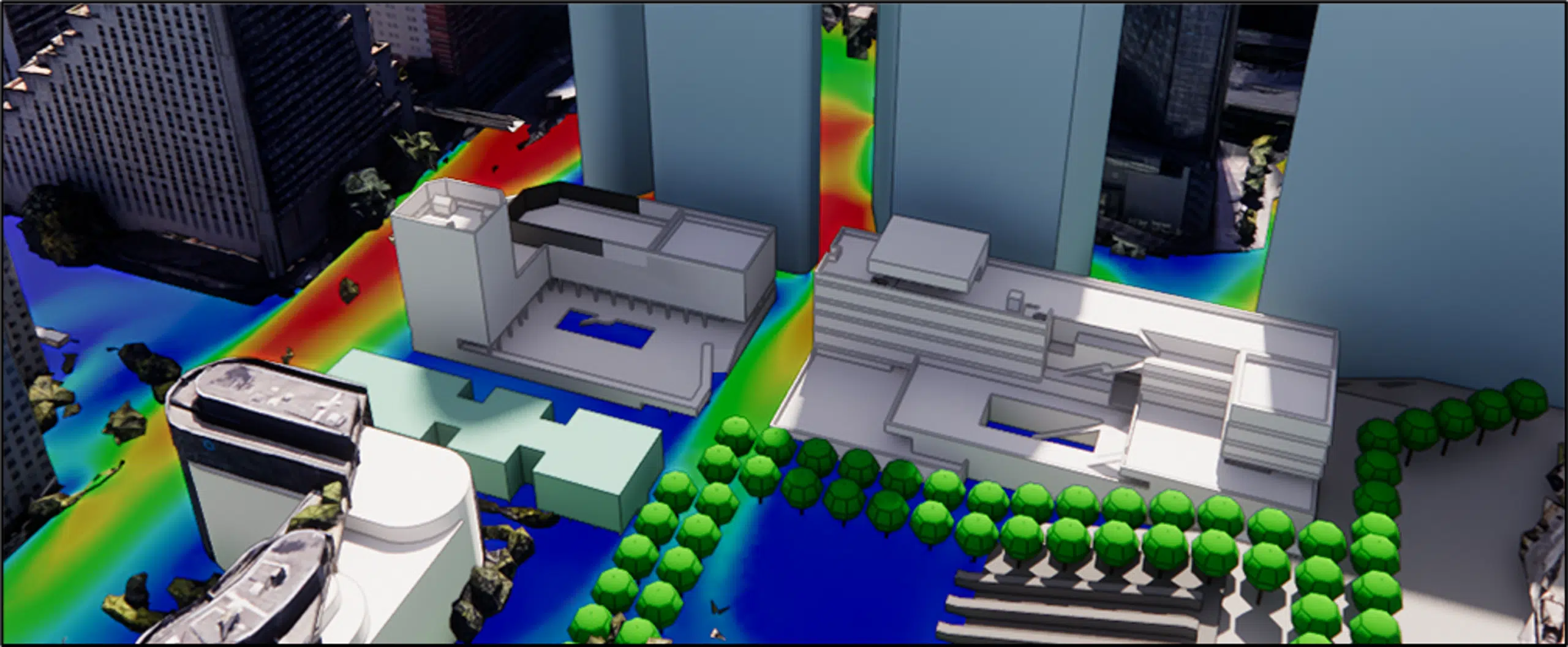
Controlling downwash relies on the architectural form (setbacks, podiums, canopies, flow redirection) and on ground-level features (awnings, vegetation, screens). By studying high-rises with CFD from the design stage, the mean speeds can be converted into gust speeds at various heights and the critical zones identified — including for the safety of façade-maintenance cradles.
Comfort, safety and the contribution of CFD simulation
All these effects — Venturi, channelling, corner, wake, downwash — combine to shape the aerodynamic microclimate of a district. Their direct consequence concerns pedestrian comfort (the ability to sit, walk and stand without discomfort) and safety (risk of falling, of objects being carried off, of doors that are hard to operate).
To qualify these zones, engineers rely on wind-comfort criteria (London, Lawson, Davenport, NEN 8100) that associate a threshold speed and a frequency of exceedance with each activity. CFD simulation makes it possible to map these criteria across the whole site and to compare layout variants.
London, Lawson, Davenport, NEN 8100 criteria and mapping: discover our dedicated paper.
Thanks to these studies, architects and developers can act from the design stage: orientation of the built fabric, shapes, setbacks, greening, windbreaks. EOLIOS supports these projects by turning the invisible phenomena of wind into clear maps and concrete decisions, for urban spaces that are more comfortable, safe and pleasant.