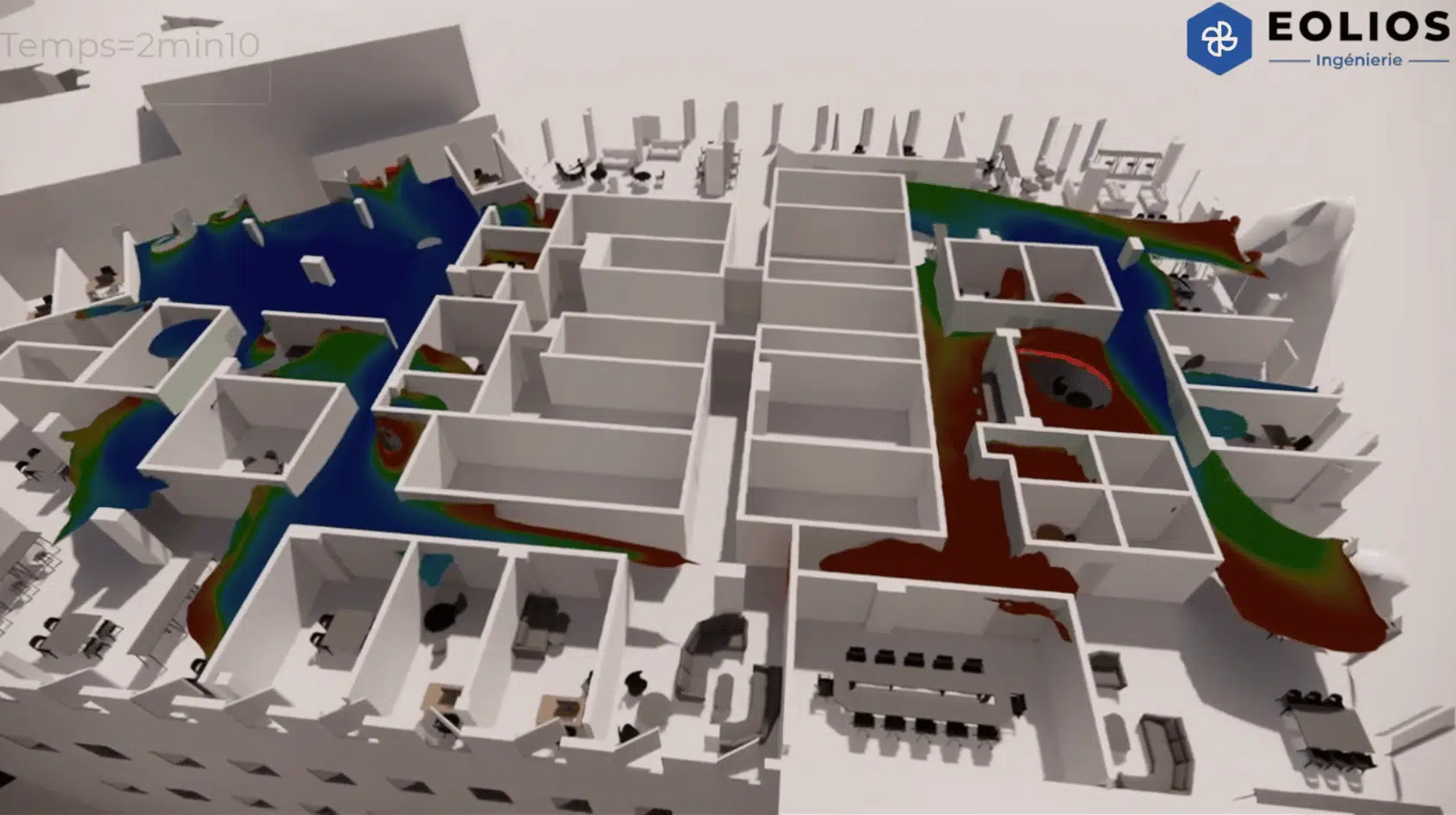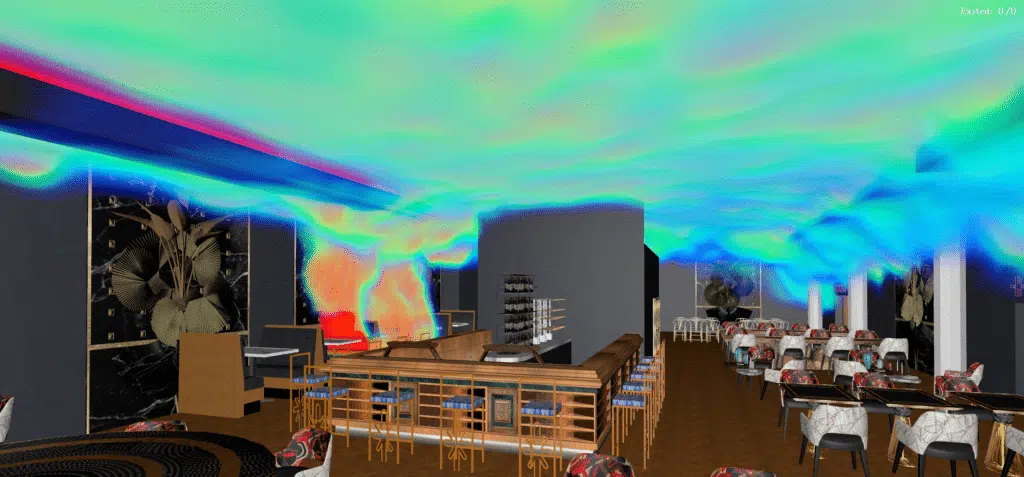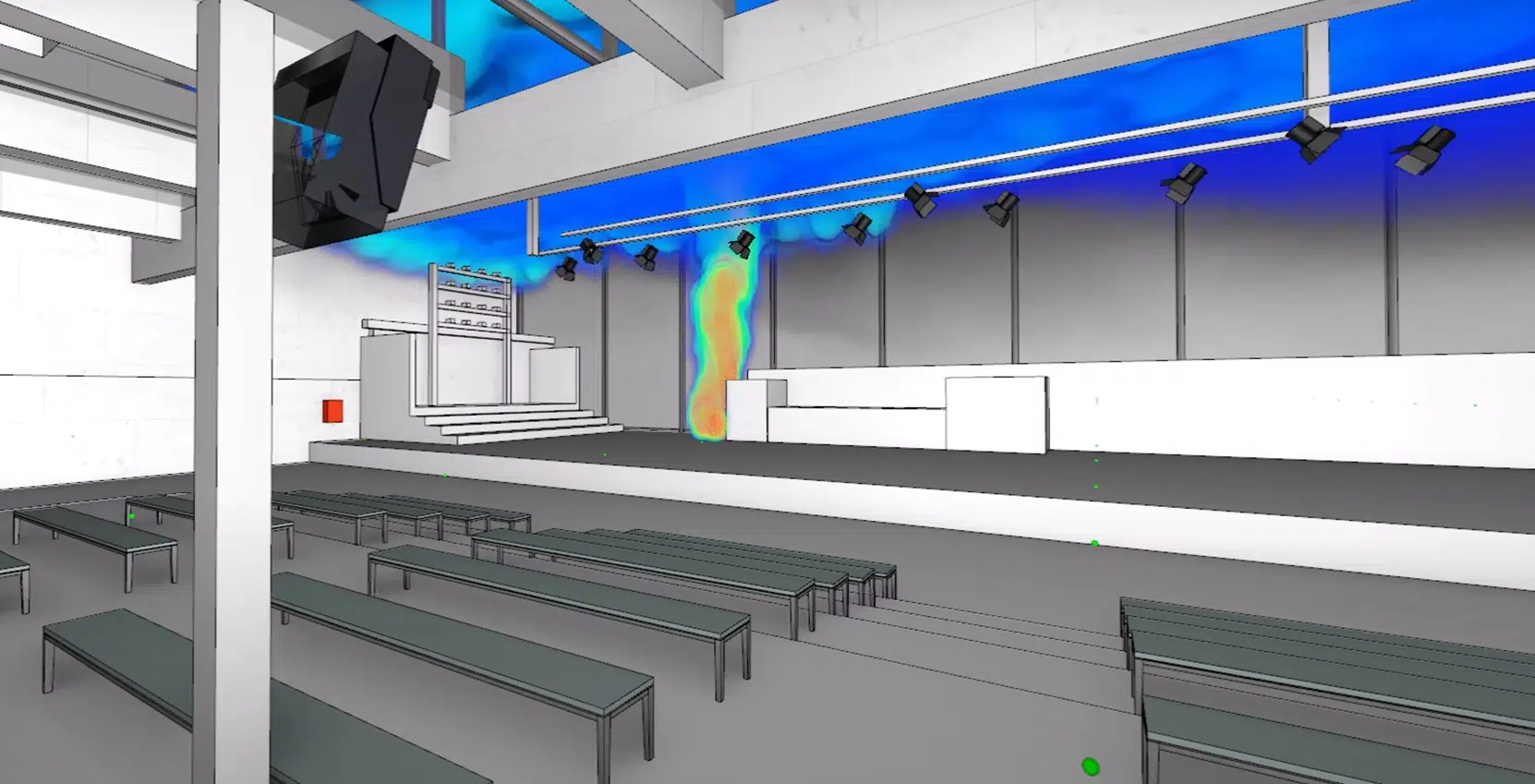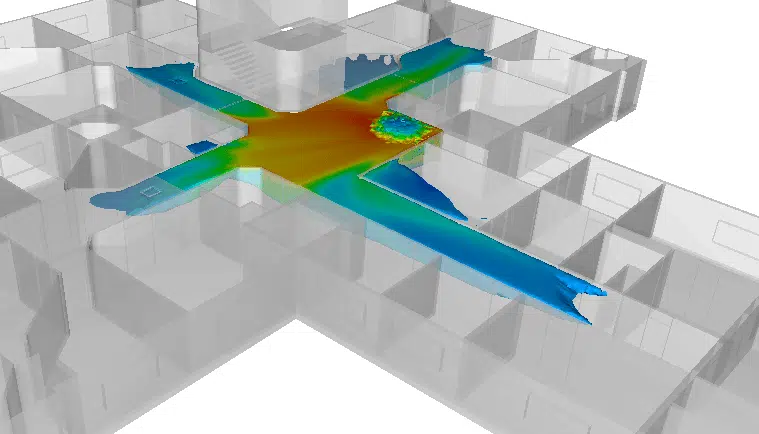
Fire safety engineering in a theatre: simulating a fire to optimise the extraction of smoke and combustion products and the evacuation of people.
EOLIOS's expertise in fluid mechanics enabled a rigorous study to ensure the site's safety in the event of fire: analysing potential risks, assessing existing measures and identifying risk areas and the additional measures to put in place.
Advanced modelling methods simulated fire behaviour across different scenarios, to assess the scale of potential damage and determine the impact zones. On this basis, EOLIOS recommended suitable detection and firefighting systems, along with improvements to ventilation and smoke extraction.
Computational fluid dynamics (CFD) ensures that escape routes stay clear and that smoke-extraction systems are designed effectively.
The essentials. For a theatre able to host 30 to 700 spectators, EOLIOS ran a fire safety engineering (FSE) study using CFD/FDS simulation. A 3D model of the site is used to simulate a fire start in the most unfavourable scenarios: heat and smoke propagation, visibility, obstruction of exits. The goal: to size effective smoke control and keep escape routes clear.
Theatres host 30 to 700 spectators depending on their size: it is essential to plan for the sudden evacuation of a large number of people. In a fire, smoke builds up and spreads, which can block escape routes (heat, fumes, poor visibility). The smoke-control study models smoke propagation to optimise its extraction and the evacuation of people in the best possible conditions.
Fire safety engineering assesses, by calculation, the behaviour of a real fire rather than applying only prescriptive rules. It simulates heat and smoke propagation to check that evacuation and emergency-services intervention remain possible, and to size the measures: smoke control, compartmentation, exits.
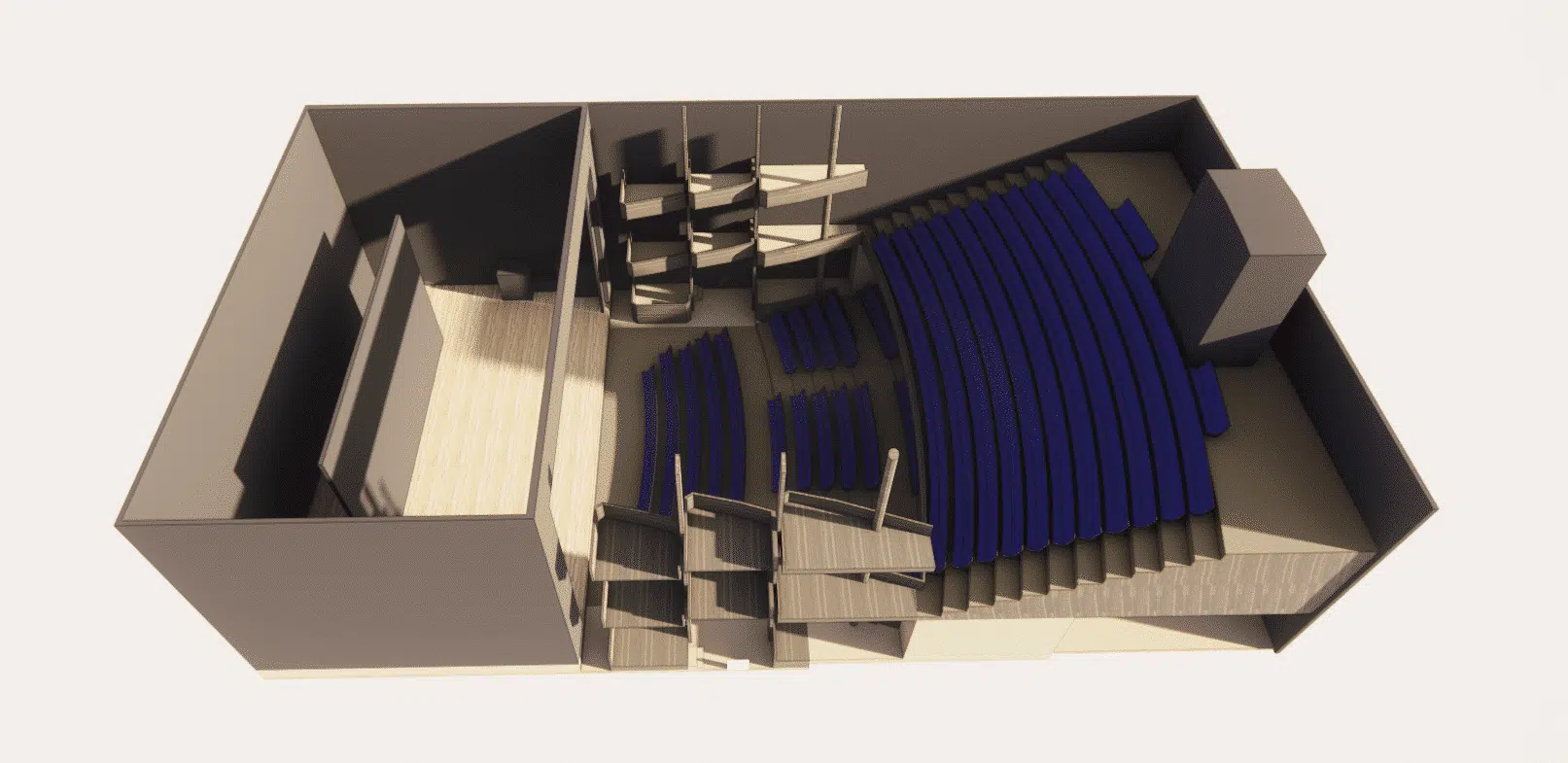
The entire site was reproduced in 3D software by EOLIOS engineers, from the 3D model of the building and its systems. This model is then used to run the CFD simulation for each scenario. The geometry is built to account for every element affecting the airflow of the volume, without overloading the model with irrelevant detail, so as to focus computing power on the sensitive areas.
Fire Dynamics Simulator is CFD software specialised in fires, developed by NIST. It solves fire-driven flows (hot smoke, buoyancy) and reproduces the time evolution of temperatures, air velocities and visibility.
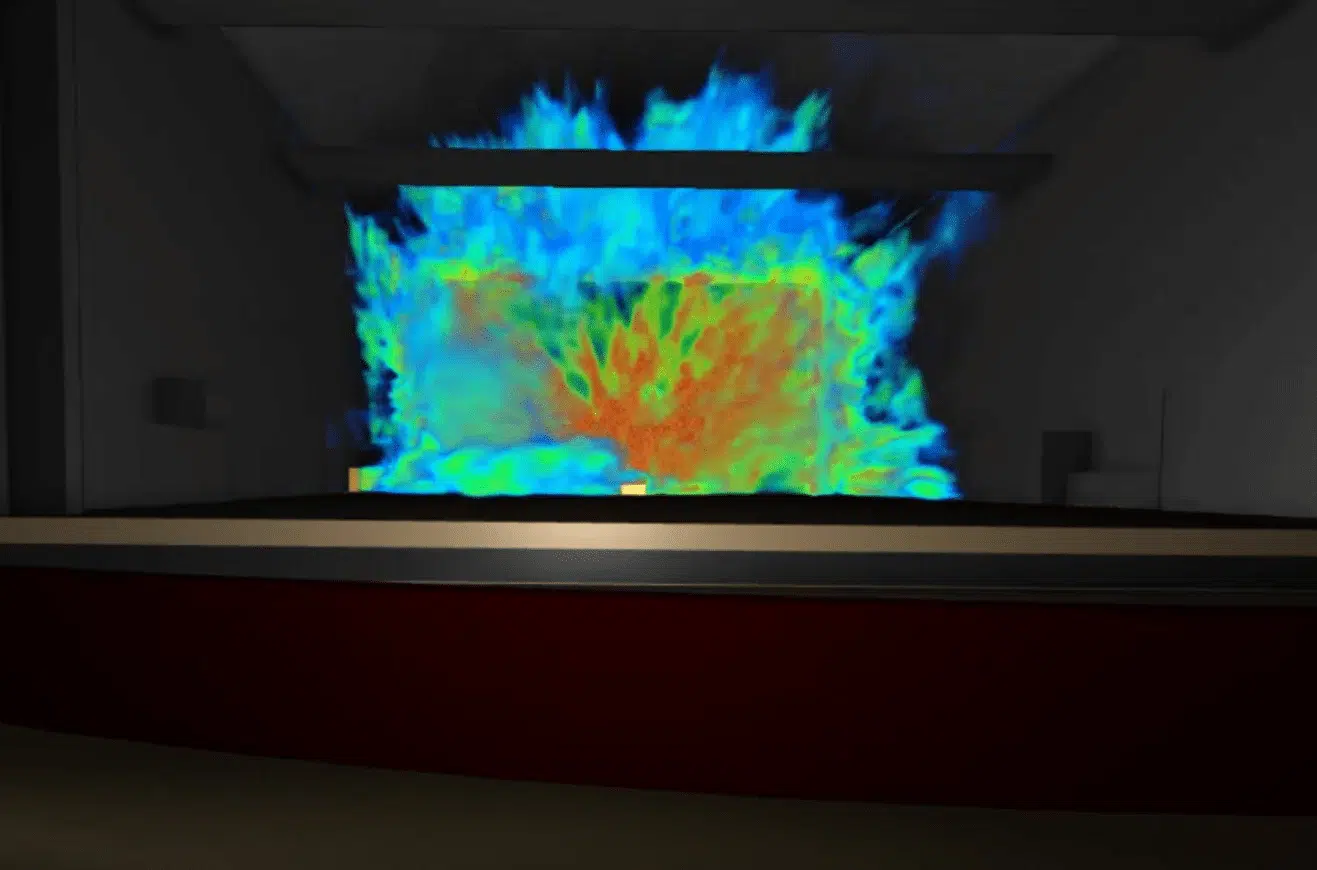
Fluid-simulation software does not predict the ignition of combustible objects: the combustion phenomenon is not modelled. The fire is represented by a volumetric heat model that accounts only for the thermal and toxic effects of combustion within a defined volume.
The heat release rate (fire power) is not constant (small flames, vigorous flames, extinction): preliminary studies determine its evolution over time and the emission rates of combustion products, which are model inputs. EOLIOS holds a database of smoke-generation conditions for common materials.
The heat release rate, or HRR, is the thermal power released by the fire over time. It grows from the first flames to full development then decreases at extinction; it is the main input that drives the production of smoke and heat in the simulation.
Since the precise location of a future fire is unpredictable, several scenarios are studied in the most unfavourable cases: maximising the smoke path to the exhaust, maximising detection time, delaying discovery, blocking an emergency exit, or promoting the build-up of heat and smoke. Each scenario defines the position and characterisation of the fire source and the elements affecting the fire's development.
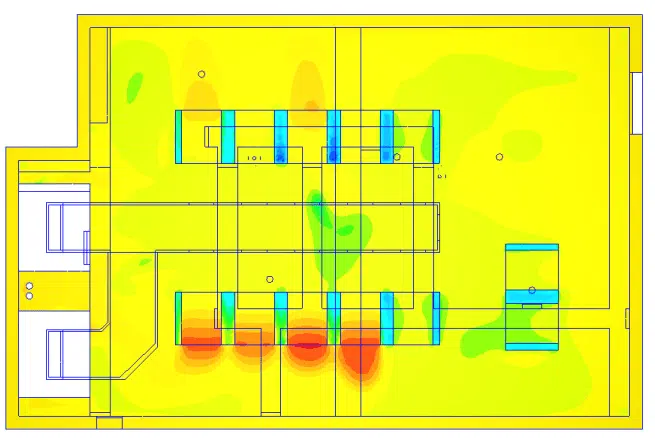
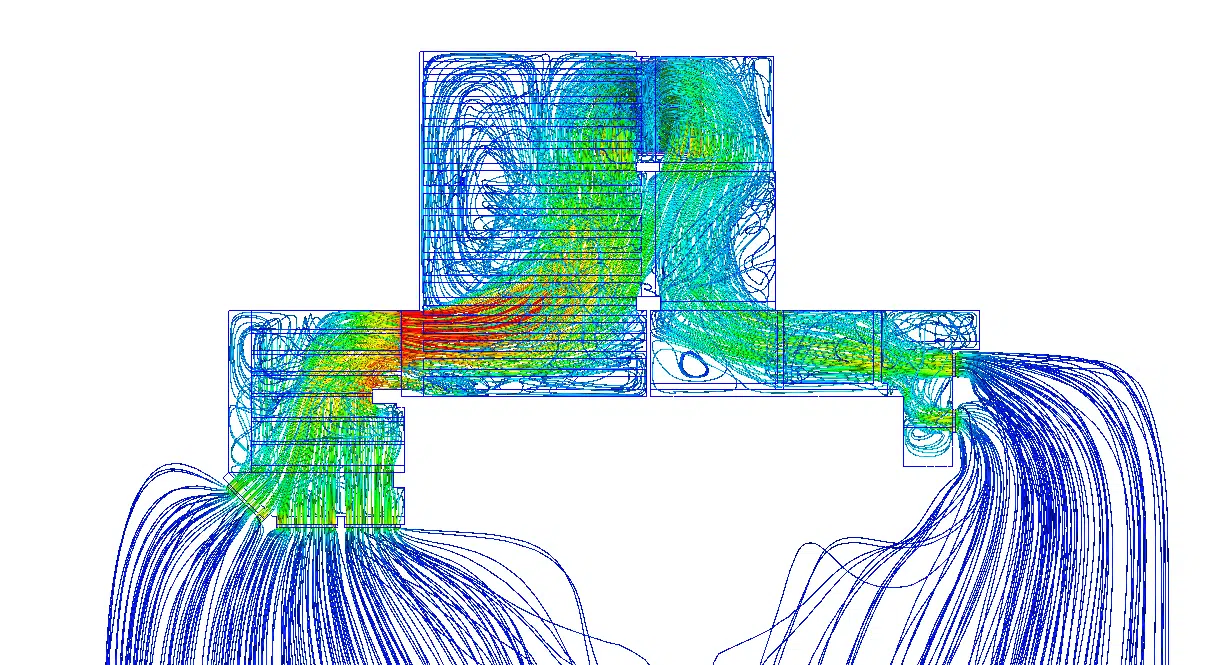
A CFD simulation is run for each scenario (boundary conditions, automatic mesh refined in the sensitive areas). The movement of heat and smoke — which follows the airflow generated by the fire — is studied, and the time after which each emergency exit would be obstructed is determined.
The results give insight into the thermal conditions and heat flux experienced during evacuation and firefighter intervention. EOLIOS proposes a new smoke-control system that takes into account people's safety, regulations and environmental conditions, together with layout proposals (emergency exits, fire doors) in light of smoke-propagation speed, temperatures and visibility.
Key takeaway. Since the location of a future fire is unpredictable, the robustness of a smoke-control design is judged on the most unfavourable scenarios, not on an average case. The simulation compares these cases to best place exhausts, fire doors and exits before works.
Theatre smoke control, fire modelling and evacuation scenarios.
A theatre hosts 30 to 700 spectators who must be evacuated quickly. In a fire, smoke can block the exits through heat, fumes and loss of visibility; the study models smoke propagation to size its extraction and the evacuation of people. For tall, high-volume spaces, see also our paper on smoke control in atriums (IT263).
No. Combustion is not modelled: the fire is represented by a volumetric heat model that accounts only for its thermal and toxic effects within a defined volume.
It is the thermal power released by the fire over time. It grows from the first flames to full development then decreases at extinction; it is the main input that drives the production of smoke and heat.
Since the location of a future fire is unpredictable, the most unfavourable cases are studied: maximised smoke path, delayed detection, blocked exit or build-up of heat and smoke.
A new smoke-control system taking into account people's safety, regulations and environmental conditions, along with layout proposals (emergency exits, fire doors) according to smoke-propagation speed, temperatures and visibility.
Explore our expertise, projects and technical papers to go further than the FAQ.
CFD (FDS) simulation of a fire on a theatre stage: heat and smoke propagation, airflow speed and direction, concentration of combustion products and assessment of escape routes — to identify the safety measures ensuring a fast, safe evacuation.
The easiest way is to talk it through together. Our engineers will reply with an initial technical read.