The hazard of smoke
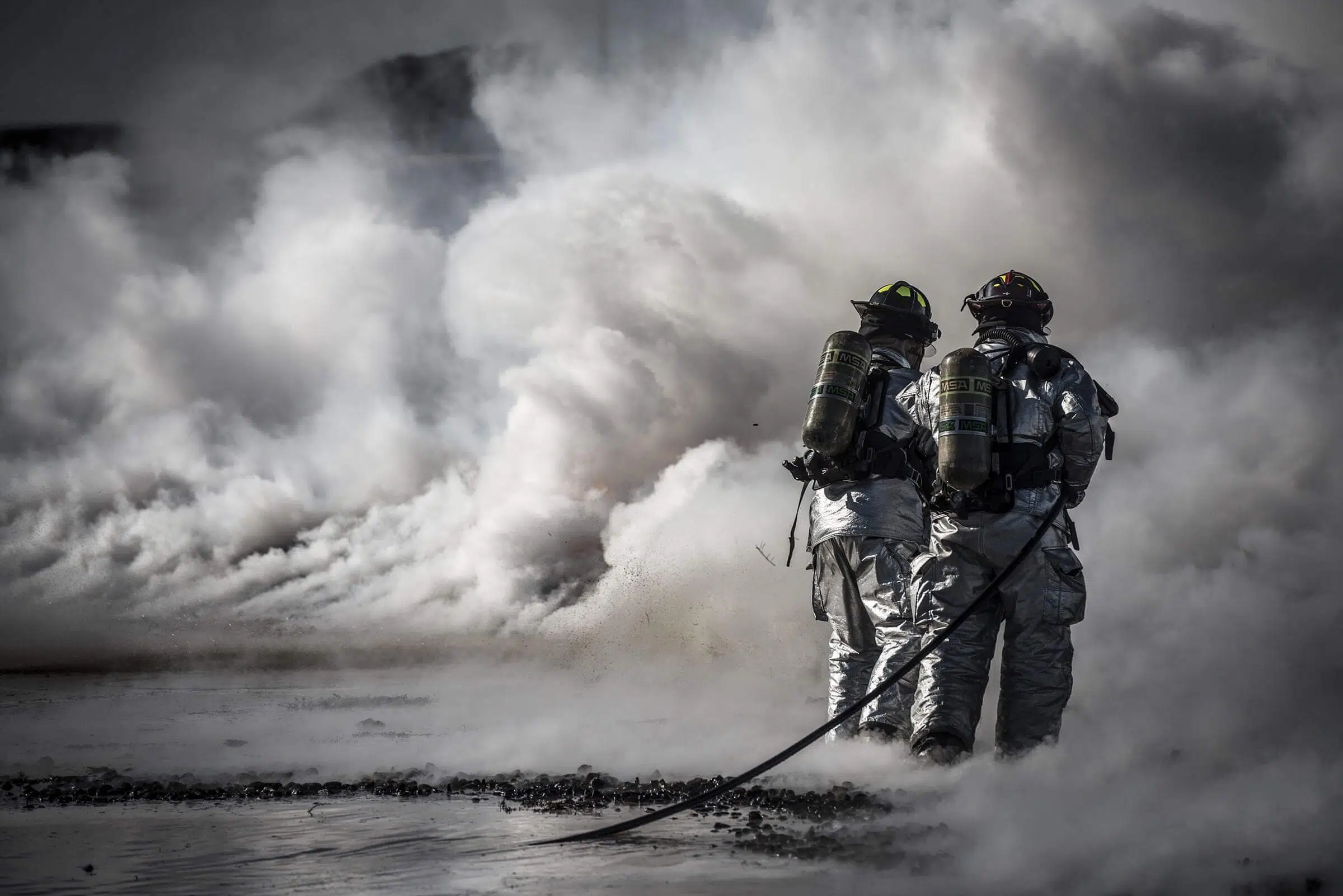
Since the 1980s, it has been established that 80% of deaths caused by a fire are due to the inhalation of toxic smoke. Three main hazards are distinguished: opacity, toxicity and temperature.
Hazards to people
Opacity
- Visibility reduced to under 4 m
- Loss of reference points & orientation
- Emergency exits impossible to find
Toxicity
- ≈ 140 hazardous compounds released
- Asphyxiant gases (CO, cyanides)
- Irritant gases (chlorine and derivatives)
Temperature
- Fatal to the alveoli > 120 °C
- Stratification of the hot smoke
- Get closer to the floor to survive
Opacity. When visibility drops below 4 metres, it becomes almost impossible to get one's bearings and find the emergency exits. In a state of panic, the occupant loses their bearings and acts as if trapped in a confined space, losing all sense of orientation; if the person is not extracted quickly, the situation can become fatal.
Toxicity. A fire releases around 140 hazardous compounds, sometimes fatal even after a short exposure — victims must be rescued within 30 minutes. The toxic gases divide into asphyxiant gases (cyanides, carbon oxides) which depress the central nervous system, and irritant gases (chlorine and derivatives) which damage the respiratory mucous membranes — among the most dangerous: carbon dioxide, carbon monoxide and nitrogen oxides. During a fire, the amount of oxygen drops: below 6%, fainting or even death occurs. The reduction in oxygen impairs motor coordination and the ability to move.
Temperature. The temperature can rise very rapidly and reach levels fatal to the lung alveoli above 120 °C. Smoke, being of low density, rises towards the ceiling and accumulates in layers of decreasing temperature — stratification. Given the convection phenomena, it is recommended to get closer to the floor, where temperatures are lower, the toxic compounds less concentrated and oxygen more present.
Hazards to property
Smoke plays an important role in the spread of the fire. Exposed to high temperatures in an oxygen-depleted environment, combustible materials decompose and produce combustible gases that feed the flames: this is pyrolysis. Smoke is also corrosive — it contains, in particular, hydrochloric acid, dangerous for the building structures and the property located in the affected area.
The roles and objectives of smoke control
Extracting smoke to save lives
The greatest threat to a person caught in a fire is smoke poisoning. It is therefore crucial to evacuate the smoke from the affected building: this is the role of smoke control. During a fire, smoke and heat remain trapped inside the building, preventing occupants from getting out safely. Smoke control aims to evacuate part of the smoke to create a clear-air zone beneath the smoke layer.
The benefits are many: it facilitates the evacuation of occupants by maintaining visibility and fresh air; it limits the spread of the fire by evacuating hot gases and particles; it allows firefighters to access the seat of the fire; and it reduces the risk of collapse of the building by limiting the temperature rise.
The constraints of smoke control
Limiting volumes and mastering stratification
To achieve these objectives, several constraints must be met. The first is to limit the volumes to be cleared of smoke through compartmentation — fire walls and fire doors — in order to reduce the spread. Large retail areas, which cannot be compartmented, are handled with smoke curtains that channel the smoke towards the extraction systems.
It is then necessary to respect the stratification by avoiding the turbulence that would send the hot smoke back towards the floor: the supply velocities must never exceed 5 m/s. For an effective sweep, the fresh-air inlets are located low down and the smoke outlets high up, avoiding any dead zone where a smoke pocket could stagnate. Finally, it is important to comply with the thermal regulations to ensure comfort without resorting to permanent openings to the outside.
The principles of smoke control
There are two main principles:
- Sweeping: circulating fresh air at the bottom of the volume to be cleared and extracting the smoke at the top — naturally or mechanically depending on the type of extraction;
- The pressure hierarchy: establishing a lower pressure in the affected volume than in the adjacent rooms, creating a balance that prevents the spread of smoke. This method, often used in high-rise buildings, requires mechanical smoke control.
The different smoke-control modes
Natural smoke control
This is the most common type: it uses roof vents or remote-controlled façade openings to evacuate the smoke, as well as doors or openings to bring in air. The controls must act simultaneously on the smoke outlets and the air inlets.
Mechanical / natural smoke control
A less frequent configuration, which uses a fan for the air supply when the volume to be cleared is semi-buried or hard to access. The air-inlet vents keep to a velocity below 5 m/s and the smoke is evacuated through roof-mounted vents.
Natural / mechanical smoke control
Here, extraction is provided by one or more fans, while the air inlets are achieved through remote-controlled doors or openings. The dimensions of the air inlets are calculated from the total extraction flow rate.
Mechanical / mechanical smoke control
This mode requires both supply and extraction fans. The velocity at the supply vents must not exceed 5 m/s to avoid de-stratifying the smoke, and the supply flow rate stays below the extraction flow rate — generally of the order of 0.6 times the extracted flow — in order to respect the pressure hierarchy.
The notion of smoke control engineering
The order of 22 March 2004 introduced smoke control engineering, used when strict application of the regulations is not possible — for example in listed historic-monument buildings, where certain modifications are impossible. This approach aims to simulate the evolution of the smoke during a fire and its control by natural and/or mechanical smoke-control systems.
These studies must be carried out by bodies recognized as competent by the Ministry of the Interior. They include a comprehensive presentation of the chosen assumptions, simulations demonstrating satisfactory smoke control, as well as a presentation of the results and conclusions on the effectiveness of the recommended systems.
In 2017, the Guide of good practice for smoke control engineering studies was published by the central laboratory of the Paris police prefecture. It clarifies the roles and responsibilities of the stakeholders, harmonizes the definitions, formalizes the process, defines imposed fire scenarios, harmonizes the acceptability criteria and establishes the methods for on-site smoke-control testing.