Airflow in production halls
Steelworks, aluminium smelter, rolling mill: EOLIOS helps manufacturers solve the specific air and heat-exchange challenges of heavy industry.
Model
- CFD modelling of processes
- Study of thermal radiation
- Design of bespoke systems
Clean up
- Tracking of pollutant extraction
- Air quality improvement
- Dust study
Optimise
- Operator comfort
- Thermal-shock risks
- Energy optimisation
Production halls impose very different requirements on ventilation depending on the type of process. In conventional heavy industry (rolling mills, steel construction), the challenge is often the collection and removal of smoke, dust and heat: local extract ventilation, combined with appropriate hall ventilation, ensures compliance with the minimum airborne-dust values. At welding stations, the flow velocities must not be too high so as not to blow away the shielding-gas atmosphere. In precision machine-tool halls, climatic stability ensures the dimensional accuracy of the products.
EOLIOS: mastery of thermo-airflow phenomena
The work of the airflow engineer belongs to the science of air circulation. Our engineers understand the phenomena specific to a steelworks: management of atmospheric pollutants (dust, toxic gases, smoke) and design of ventilation systems able to efficiently capture and carry these pollutants and the heat out of the building.
Large-scale CFD simulation for industries
Modelling and analysing airflows
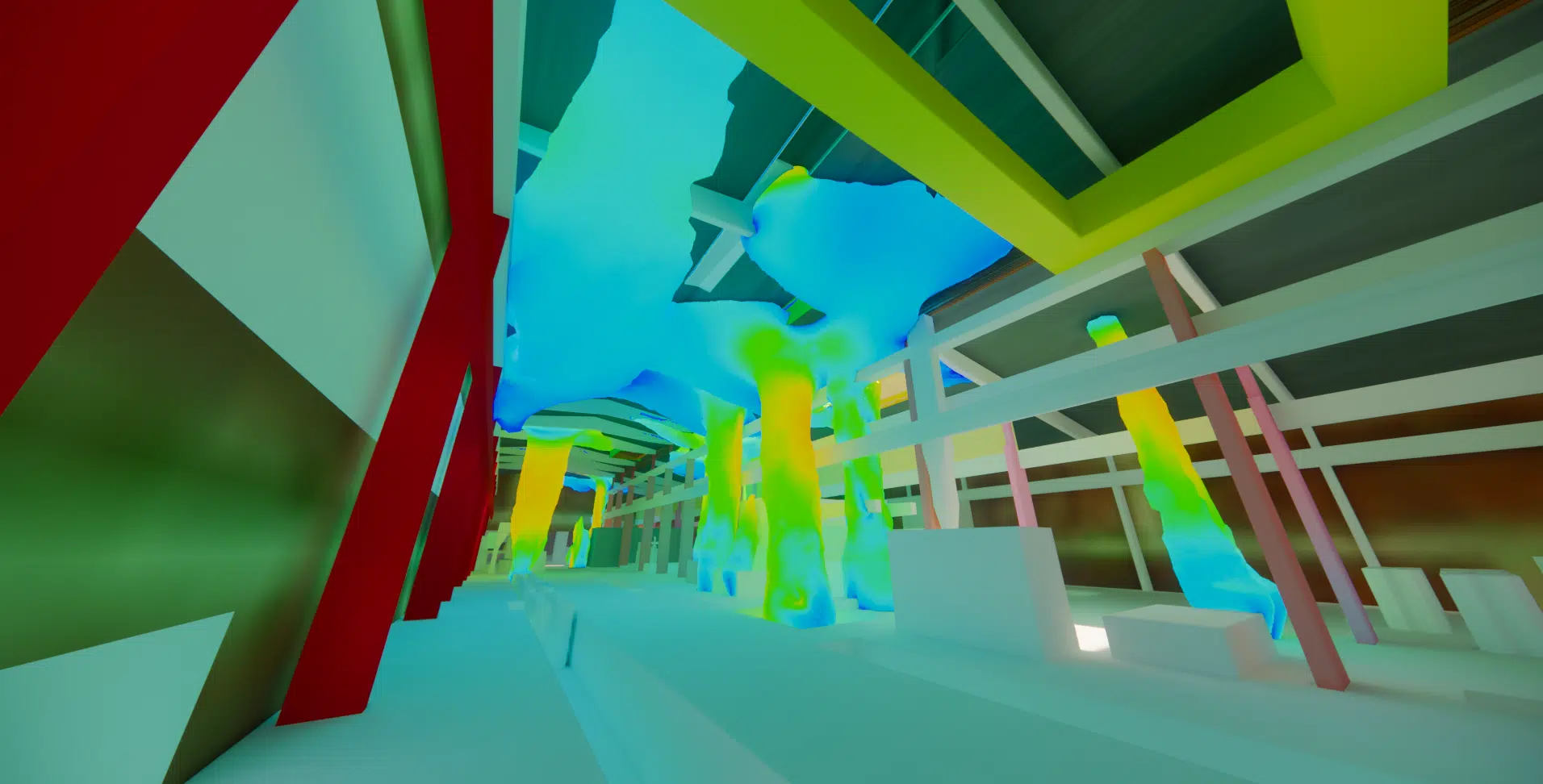
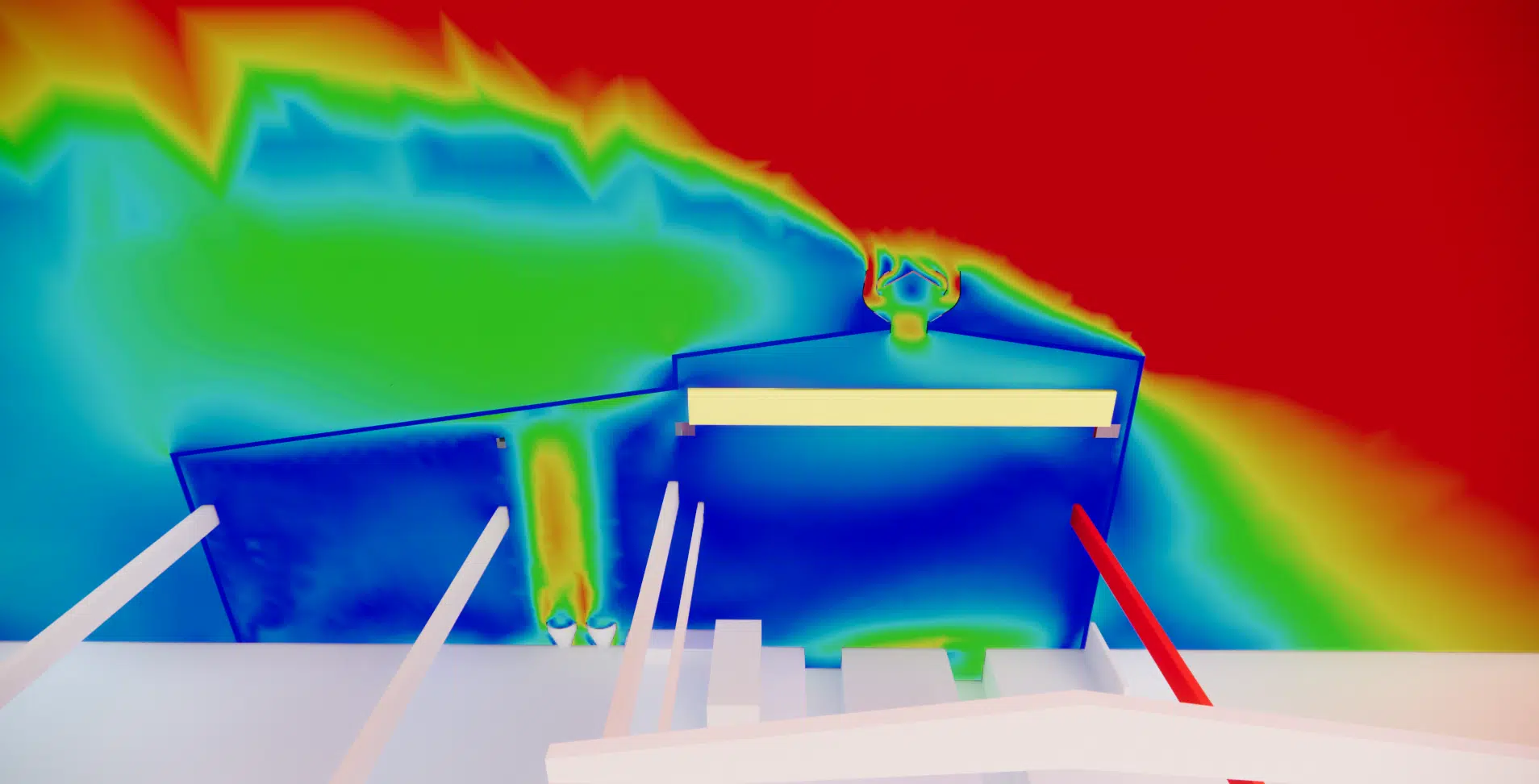
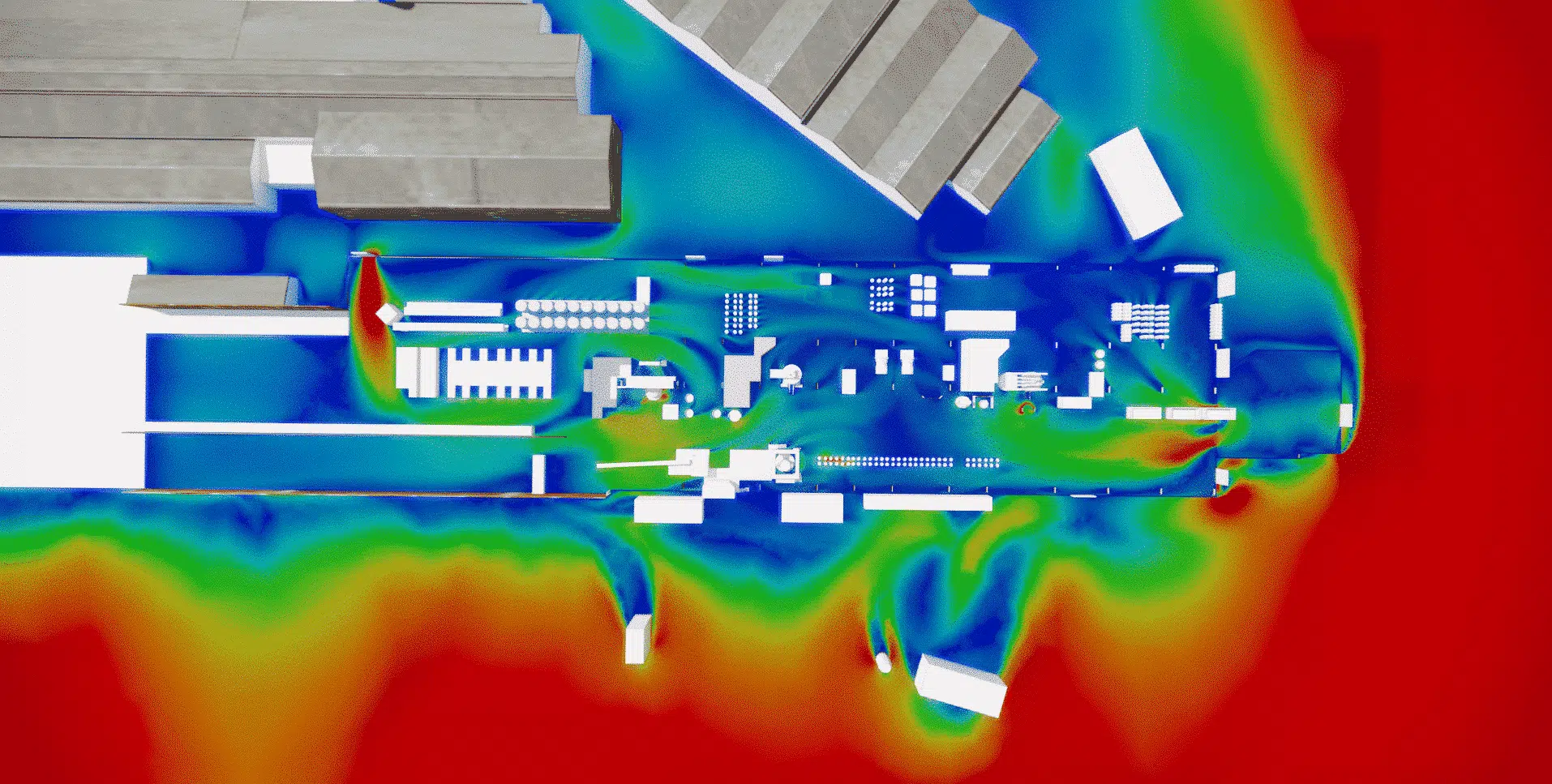
EOLIOS specialises in fluid mechanics and is recognised for its expertise in CFD simulation. We optimise airflows, improve natural ventilation, ensure workers' thermal comfort and reduce atmospheric pollution. CFD makes it possible to visualise flow rates, measure velocities and temperatures and detect air-circulation malfunctions, while incorporating the constraints specific to each facility.
Natural ventilation for industries
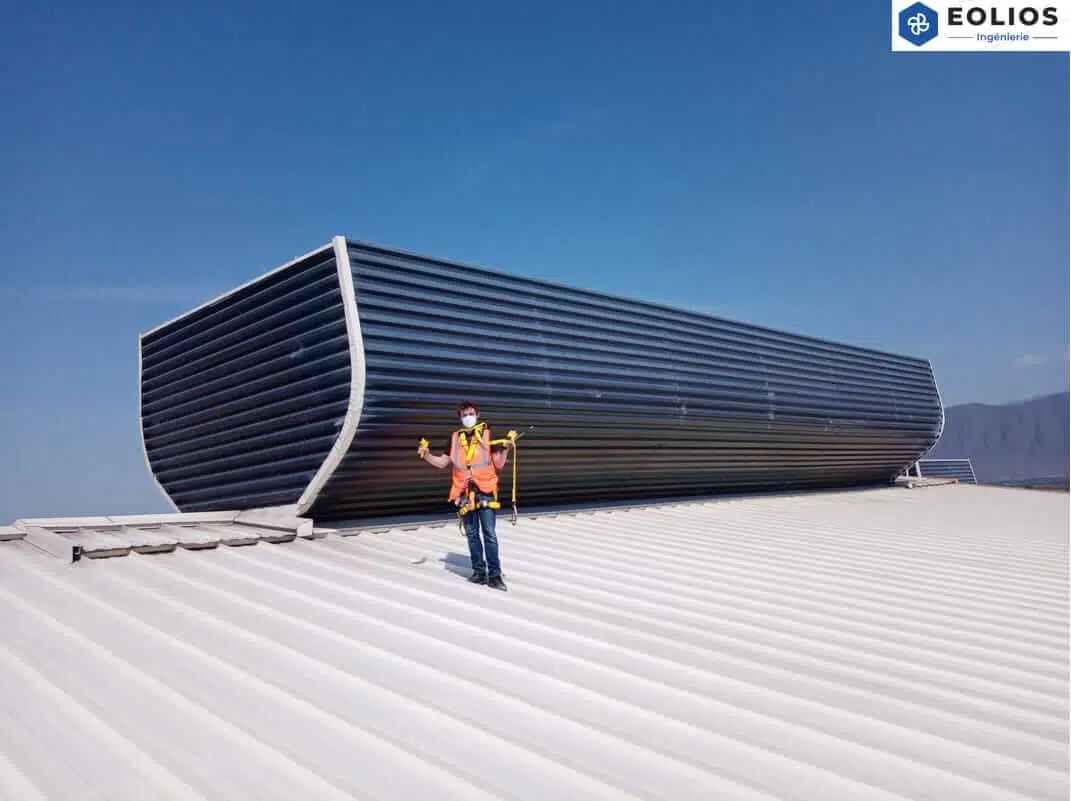
Natural ventilation is crucial: it regulates the temperature, removes smoke and toxic gases and ensures acceptable air quality. With CFD, we model and optimise the heat exchanges between the different parts of the steelworks to propose solutions suited to each case.
Learn more: sizing of industrial natural ventilation
Development of specific extraction systems
Extraction hoods capture smoke and gases at the source, above the most emissive zones; their design requires particular attention to ensure effective capture. CFD models the flows around the hood, analyses velocities and temperatures and adjusts the design. The exhaust chimneys must ensure an effective dispersion of the emissions: CFD analyses the flow rates, predicts the dispersion of pollutants and checks regulatory compliance. It finally optimises the positioning, flow rate, velocity and pressure of the extraction systems.
Learn more: sizing of industrial chimneys
Workers’ thermal comfort
In steelworks, thermal comfort is essential: high temperatures and strong airflows make conditions extreme. CFD finds the balance between the ventilation needed to remove heat and contaminants, and operator comfort. We recommend improvements to the layout of equipment and to the cooling or heating systems.
Reduction of atmospheric pollution
Often singled out for their greenhouse-gas and fine-particle emissions, production halls benefit from our CFD expertise to model and quantify these emissions, optimise the operation of chimneys, implement effective filtration systems and predict the dispersion of pollutants — both internal and external.
In brief: what does CFD simulation make possible?
- account for the localised heat sources and hazards and their effect on temperature and airflows;
- incorporate the influence of surface radiation and the convective flows in the workshops;
- track the pollutants emitted by a process up to its capture system;
- study and optimise extreme scenarios (failures, overheating…);
- analyse cold draughts over the processes;
- study the propagation of dust and fine particles.
CFD simulation for industrial production
CFD simulation of manufacturing processes
By integrating CFD into the design and optimisation of production processes, it is possible to improve the efficiency, quality and profitability of industrial activities. EOLIOS puts this expertise at the service of process optimisation and the achievement of economic and environmental objectives.
CFD simulation of processes
- Analysis of fluid flows: model the flows of liquids or gases, size ducts and equipment and minimise pressure drops;
- Optimisation of heat distribution: model the heat exchanges (cooling, heating, reaction) and correct the overheating zones;
- Improvement of combustion: optimise burners, combustion chambers and injection for efficient and clean combustion;
- Steel converters: study gas and liquid flow rates, heat transfers, reactions and phase separations;
- Cooling processes: model quenching and spray cooling for steels with controlled properties.
Expertise: study of fine dust and powders
Expertise: industrial digital twins (glassworks, steelworks, aluminium smelters)