Pressure-loss analysis through CFD
Our commitment to managing and optimising the pressure losses of industrial fluid systems rests on a deep understanding of multi-scale airflow.
Study
- Design, analysis, optimisation
- Velocity evolution
- Steady or transient regime
Size
- Installation optimisation
- Laminar or turbulent flow
- Extraction systems
Advise
- Fan selection
- Pressure-loss studies
- International projects
Industrial installations feature complex fluid-transport circuits incorporating geometric singularities — bends, section changes and control devices. These disruptive elements significantly alter the flow of fluids and trigger complex phenomena: phase separation, flow instability and changes of flow regime.
Left unmanaged, these disturbances considerably complicate the assessment of pressure losses and make systems less efficient and more costly to operate. Thanks to its sharp expertise and to computational fluid dynamics (CFD) techniques, EOLIOS delivers comprehensive analyses and tailor-made solutions that maximise energy efficiency, reduce costs and extend the lifetime of your installations.
Mastering pressure losses
Pressure losses — the drop in pressure of a fluid as it passes through a system — result from the complex, multifactorial interactions between the fluid and the duct walls. They fall into two broad categories: linear (regular) losses and singular losses.
Linear losses result from the continuous friction between the fluid and the walls, amplified by the fluid viscosity and the duct roughness. They vary with the flow profile — laminar, transitional or turbulent — each regime altering the balance of inertial and viscous forces.
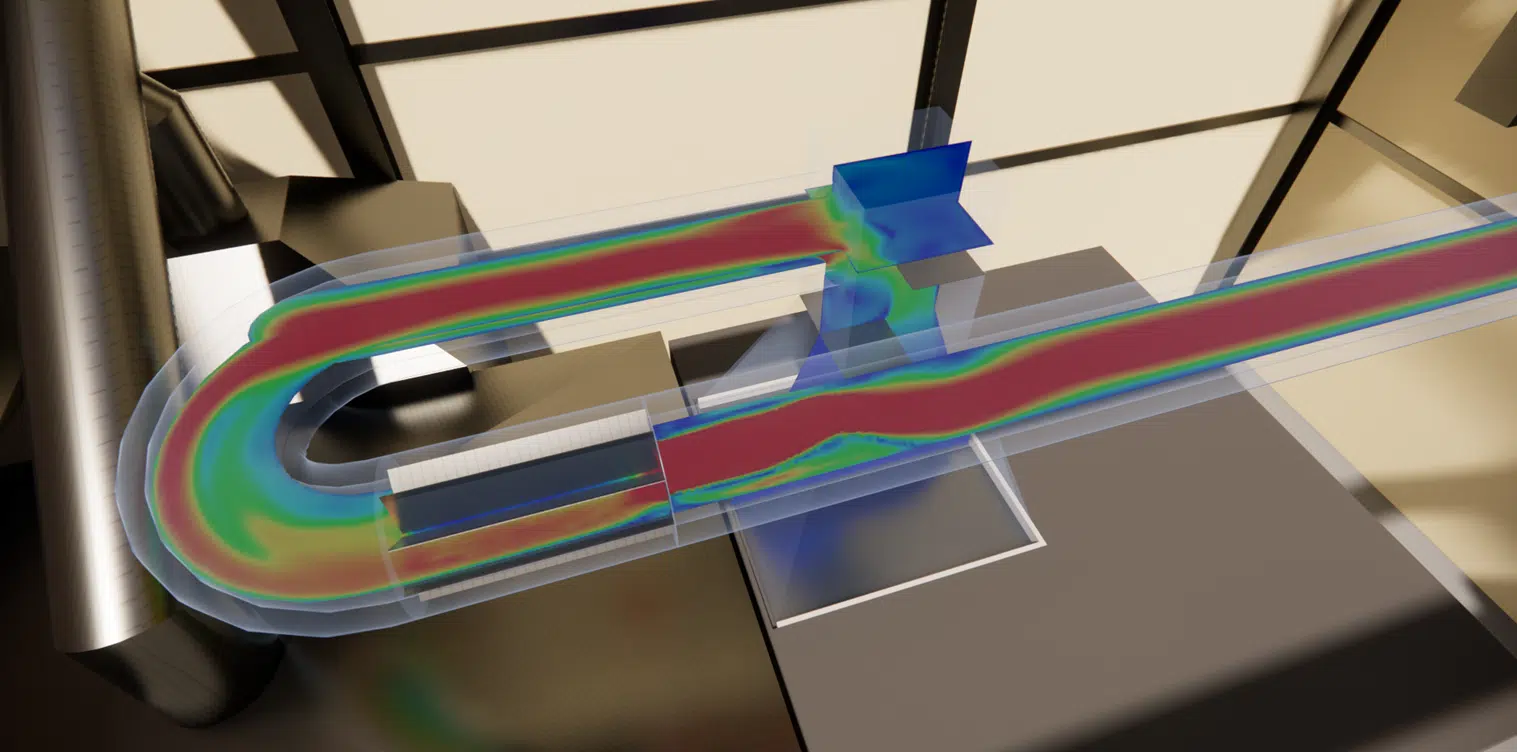
Singular losses, for their part, arise from the disturbances caused by structural singularities — bends, fittings, baffles — and by internal equipment such as expansion boxes or heat exchangers. These elements introduce immediate pressure variations and create vortex phenomena that exacerbate overall energy losses.
EOLIOS focuses on the detailed analysis of these phenomena using CFD to provide insights and practical solutions that minimise their impact on the overall efficiency of the system.
Advanced CFD simulation and modelling
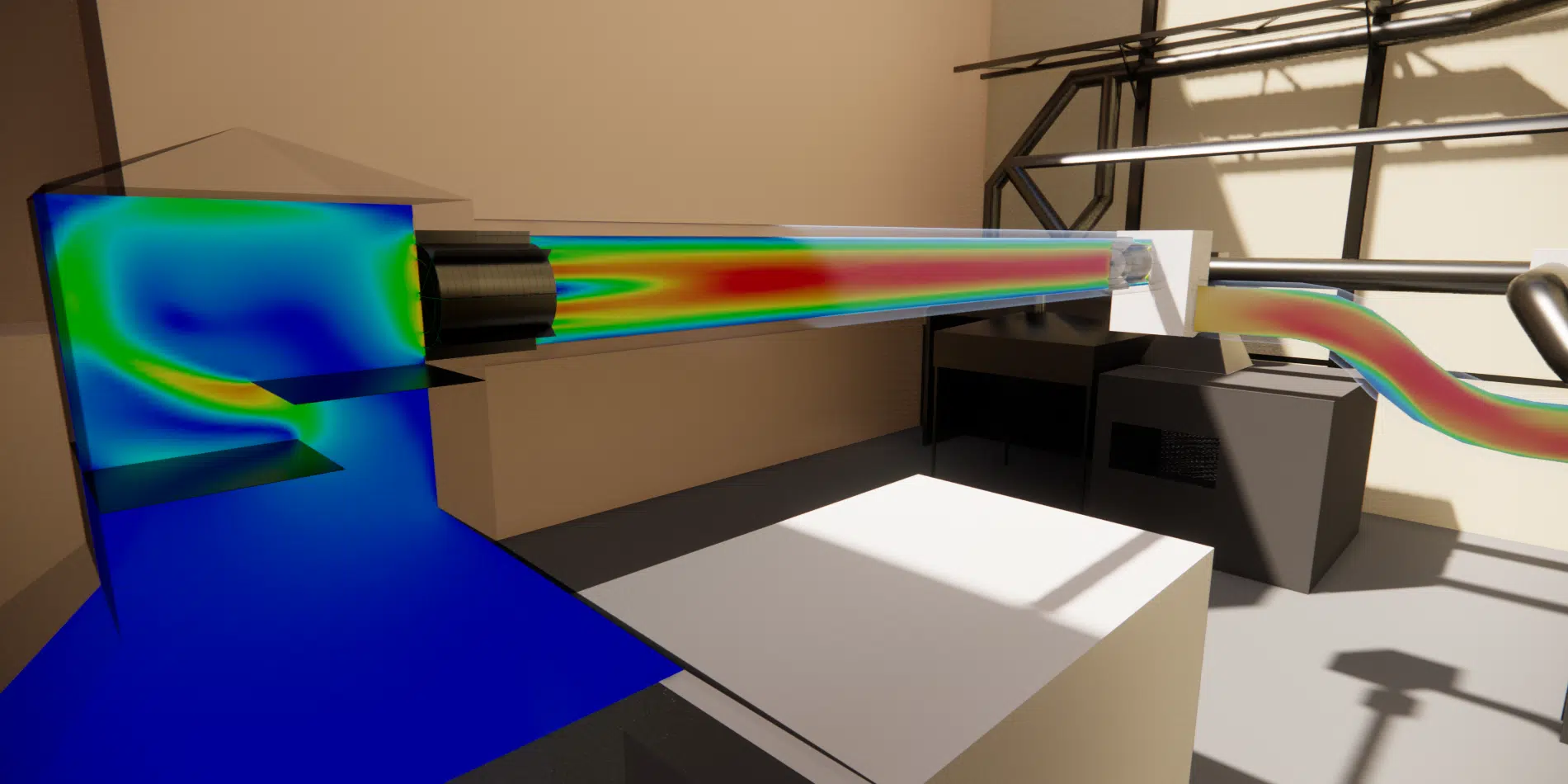
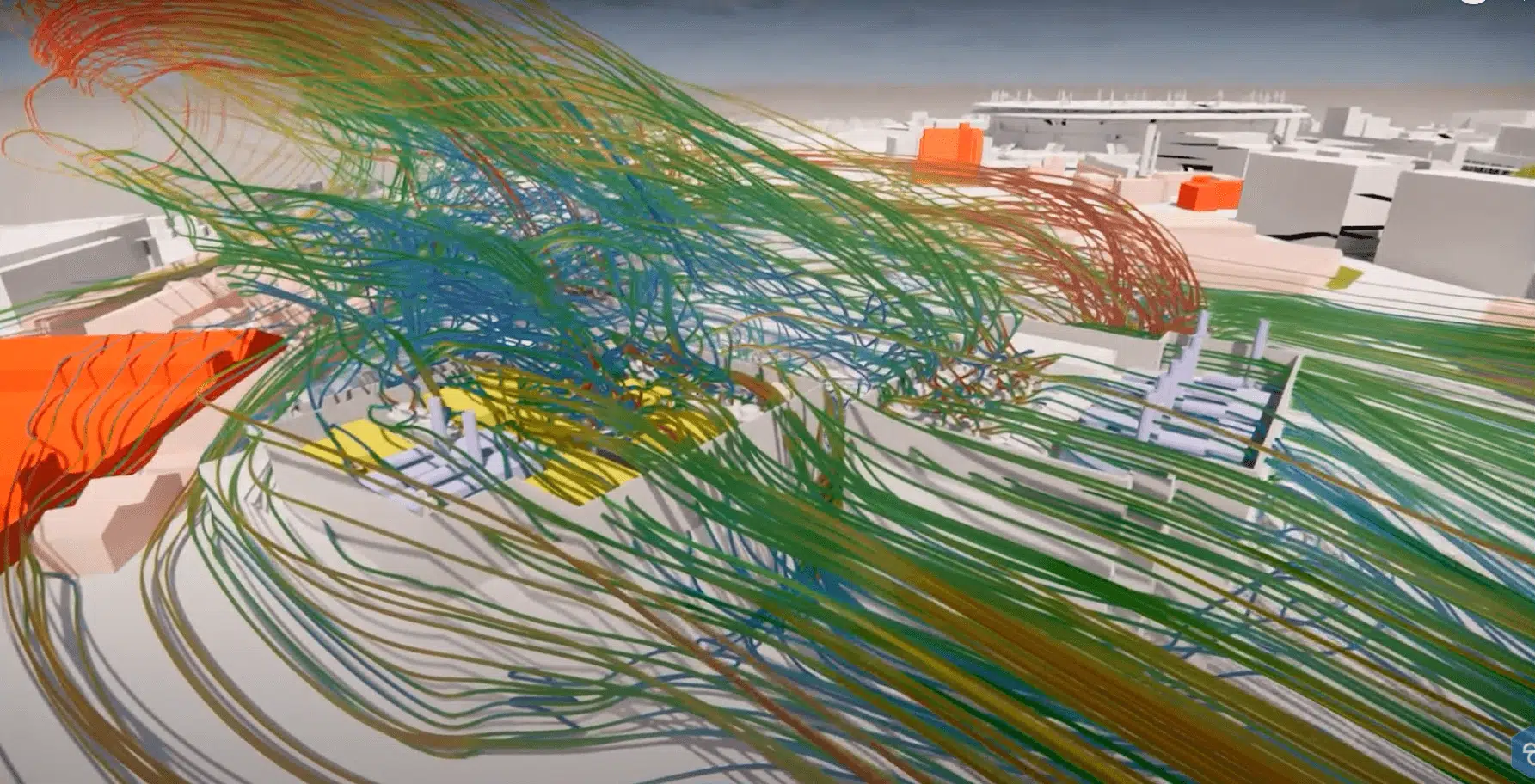
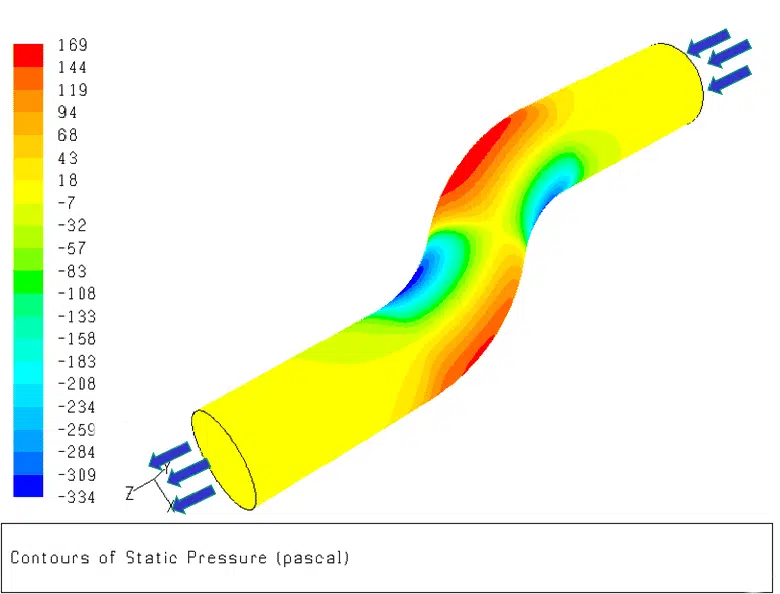
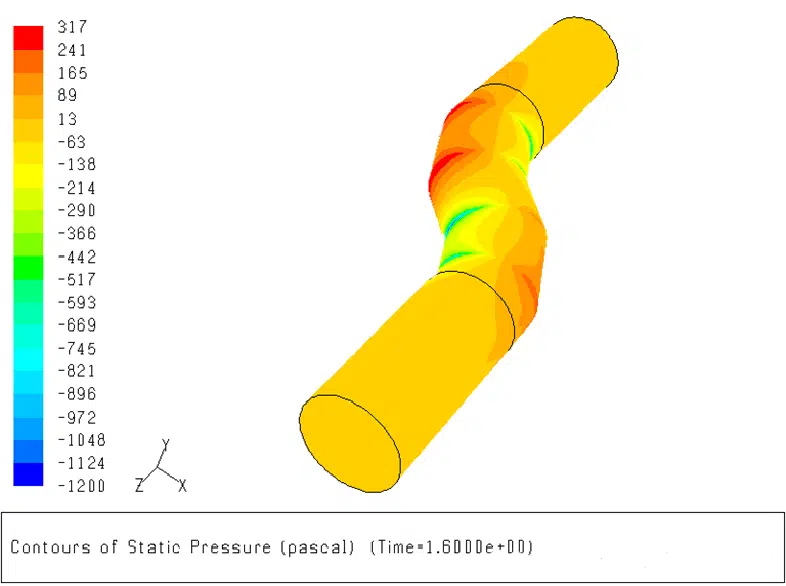
CFD simulation is an essential pillar of our methodological approach. By developing sophisticated 3D numerical models of your systems, EOLIOS creates realistic digital twins that reproduce the dynamic complexities of fluid flow under varying conditions and reveal the patterns of pressure distribution, the velocity profiles and the vortex structures within the duct networks.
By faithfully capturing the fluid-structure interactions, we identify the critical points where pressure losses and potential inefficiencies concentrate. This ability to predict and visualise incidents enables a proactive preventive strategy: testing different configurations, analysing the impact of structural changes and making informed decisions based on reliable, detailed data.
Precise methods for calculating pressure losses
Calculating pressure losses in CFD is a meticulous process. A detailed three-dimensional model of the infrastructure is first created, taking into account every aspect of the system: the network geometry, the material properties and the boundary conditions — inlet and outlet velocities, initial pressures.
Using advanced numerical algorithms, the CFD software divides the studied domain into a mesh of several thousand to millions of cells. In each cell the Navier-Stokes equations are solved, which govern the movement of fluids while accounting for the conservation of mass, momentum and energy; from this the pressure, velocity and direction at every point of the mesh are derived.
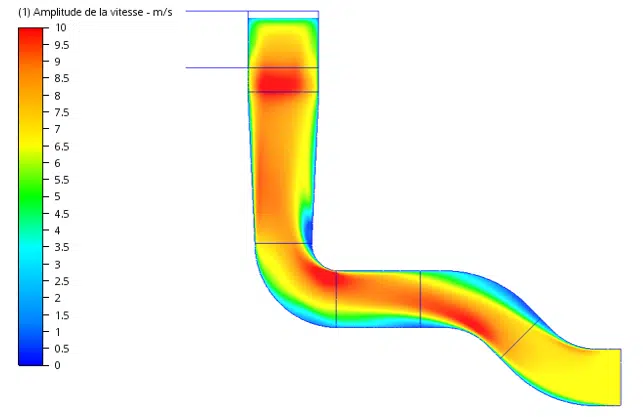
Pressure losses are determined by analysing the pressure gradients across the sections of the network. By assessing the upstream and downstream pressure of obstacles and observing the zones of turbulence or kinetic-velocity loss, our experts precisely quantify the energy losses. The k-ε or LES (Large Eddy Simulation) turbulence models capture the influence of small and large fluctuation scales on energy dissipation.
These calculations provide a rich, nuanced picture of the internal dynamics and enable a clear breakdown of linear and singular losses: assessing current inefficiencies, devising reduction strategies and confirming the robustness of new designs.
In this way, EOLIOS relies on these proven methods to guide the design and implementation of strategic operational improvements, ensuring greater efficiency and durability at every level of the studied infrastructure.
Optimisation strategies for fluid networks
In the environment of industrial fluid networks, each installation requires a tailor-made approach that accounts for its unique characteristics and performance requirements. EOLIOS works alongside your teams to develop optimisation recommendations focused on minimising pressure losses while maximising operational efficiency.
This customisation may include modifying the geometric dimensions of the ducts, changing the materials to optimise wall roughness and integrating innovative technologies that promote a smoother, more stable flow.
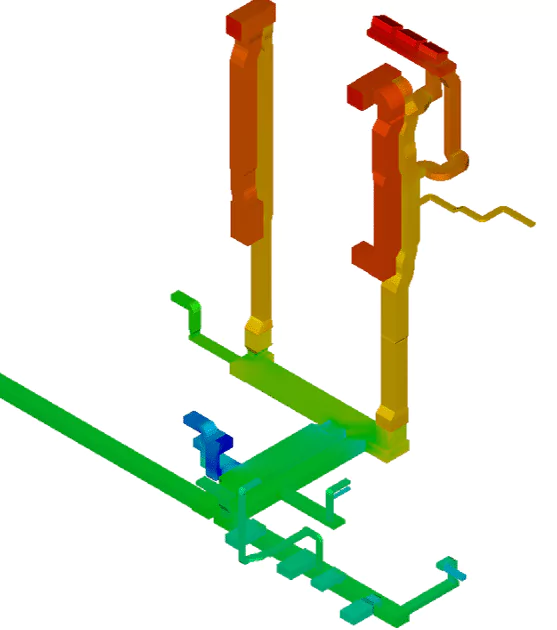
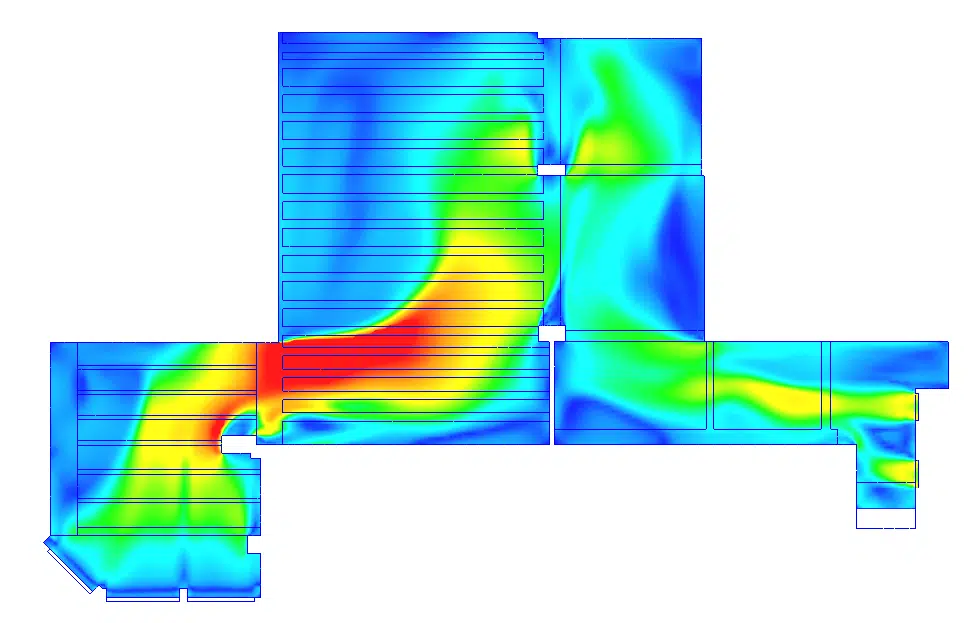
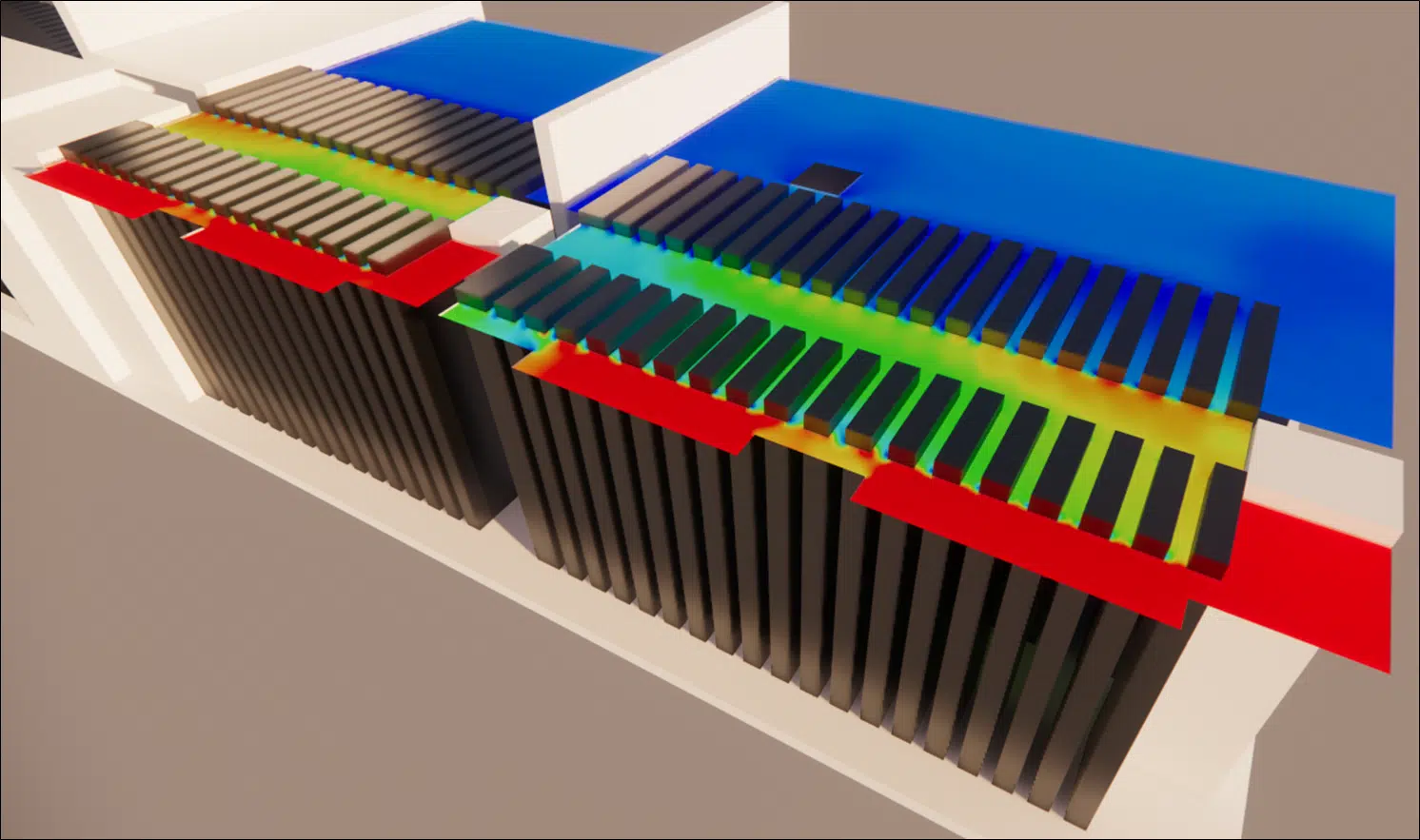
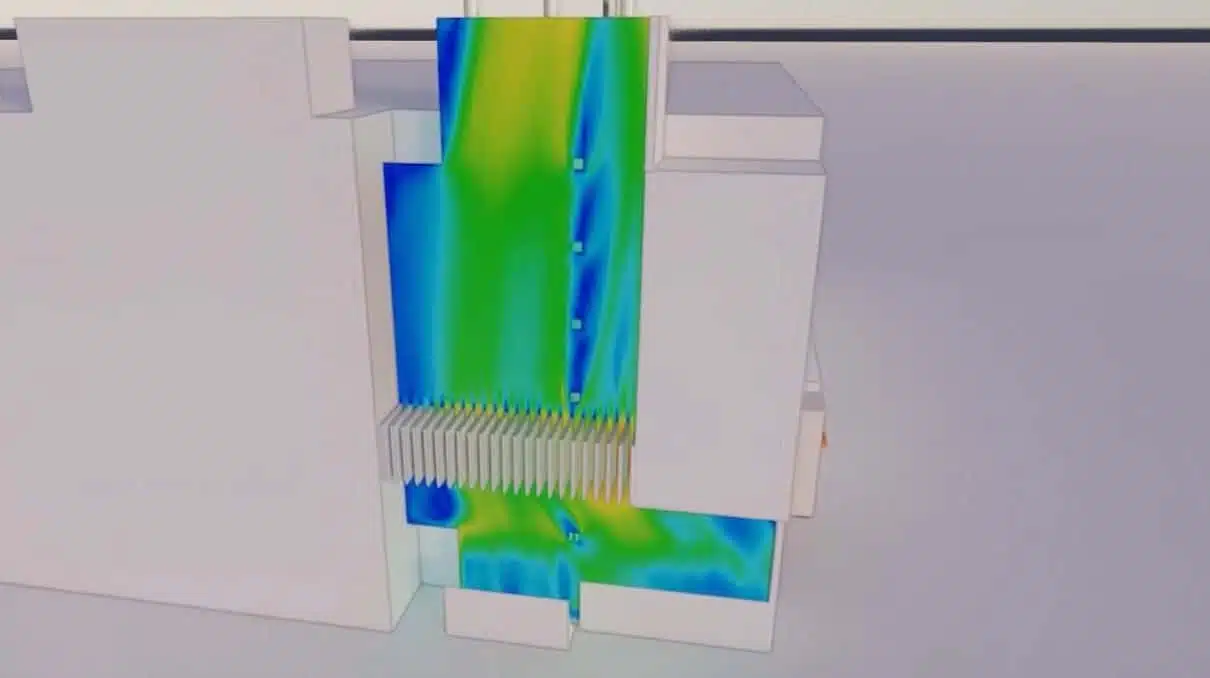
We analyse the current configurations to assess improvement opportunities and implement refined structural adjustments designed to increase energy efficiency and reduce costs. This solution-oriented approach guarantees immediate reductions in inefficiencies and establishes a solid foundation for sustainable development and increased operational performance over the long term.
Innovative solutions for contemporary challenges
In a rapidly changing industrial world, EOLIOS remains attentive to technological innovations and the growing requirements for sustainability, integrating these new technologies into its solutions to meet contemporary challenges.
State-of-the-art CFD simulations, combined with deep expertise in multi-scale airflow, make it possible to reconfigure your infrastructure so that it meets not only today's efficiency expectations but also the future imperatives of environmental compliance — turning challenges into opportunities for performance and sustainability.