
CFD study of the external thermal and airflow exchanges of a data center in Meudon: generator plumes and control of the short-circuiting of the rooftop dry coolers.
EOLIOS used CFD modelling to study the external thermal and airflow exchanges of a data center in Meudon. The study made it possible to understand and optimise the cooling of the high-density IT equipment, with recommendations to improve the airflow under specific wind conditions.
The essentials. External CFD study of a data center in Meudon, built on a digital twin reproducing the site and its surroundings within a 400 m radius. The most unfavourable conditions retained are an outdoor temperature of 40 °C and a 4 m/s wind. At the intake of the rooftop systems the temperature stays generally below 45 °C. A short-circuiting of the dry coolers was identified, but it remains very localised and does not compromise the durability of the installations. An airflow check is recommended for a north-easterly wind.
EOLIOS Engineering, one of the European leaders in data center CFD modelling, brought its expertise to the understanding and modelling of the external thermal and airflow exchanges, in connection with the heat release of the generators and the rooftop systems.
In very large-scale data centers, cooling systems able to keep pace with the evolution of IT are required because of the growing density of the equipment (more than 10 kW per rack). This heat is removed by a series of cooling systems arranged in high concentration on the roof.
This study examines the exhaust plume of a series of generators. The aim: to improve the air mixing of the rooftop dry coolers of the technical rooms housing the generators, in order to ensure that the thermal exhaust does not contaminate the supply air through short-circuiting. A short-circuit causes a power loss of the dry coolers, hence a temperature rise in the data halls and a risk of failure.
To this end, our engineers simulated by numerical CFD calculation the thermal-airflow behaviour of the various phenomena occurring outside the model.
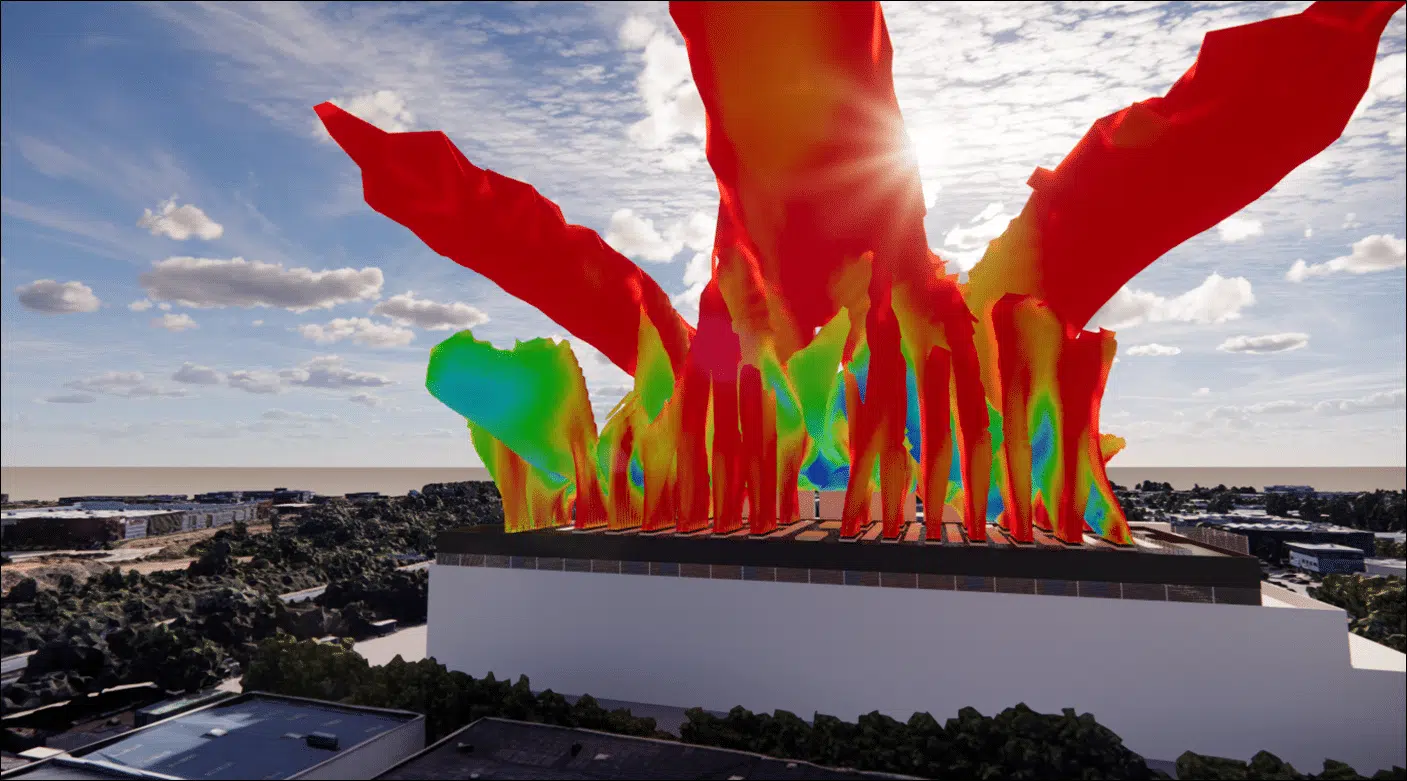
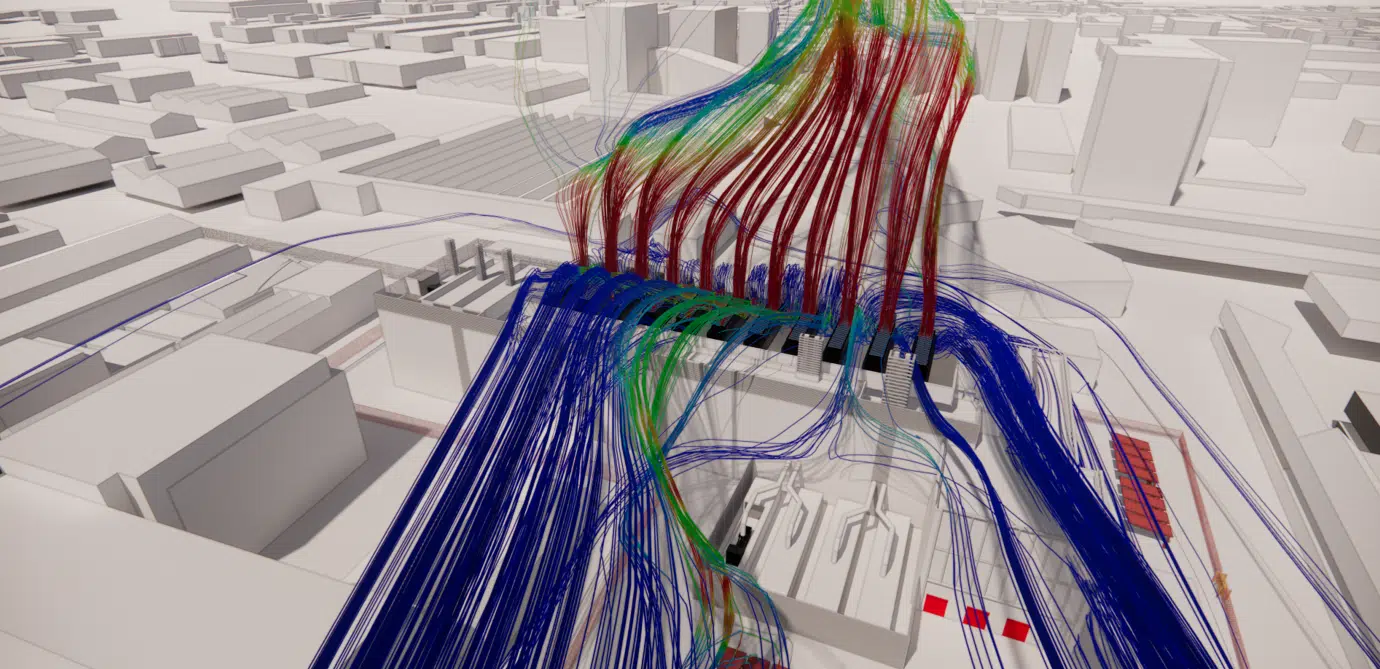
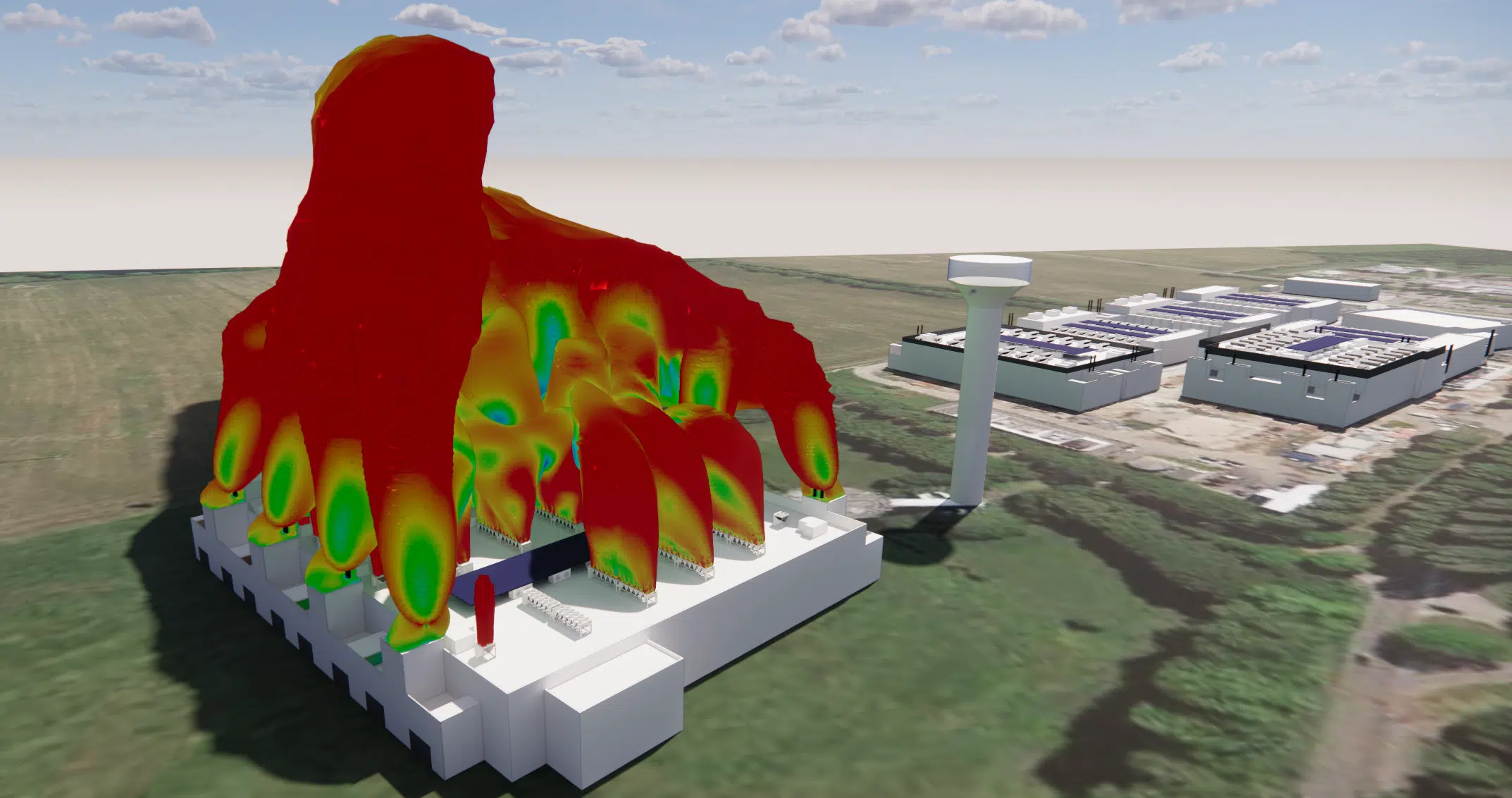
Volume of hot air rejected by a source (generator, stack, dry cooler) that rises and deforms under the effect of its buoyancy and the wind. Its trajectory governs the risk of re-ingestion by neighbouring systems.
A multitude of parameters was taken into account by our experts:
the radiant wall temperatures and the thermal draught of the processes;
the wind pressure and the internal resistance to vertical air flow;
the location and flow resistance of the envelope openings;
the local terrain, the impact of the built environment on the wind and the mechanical systems mixing air around the processes.
A weather study was carried out to determine the usual climatic conditions around the site. It revealed that the wind is steady throughout the year, with a dominant south-westerly direction and occasional episodes of north-easterly origin.
The study was carried out for an outdoor temperature of 40 °C and winds of 4 m/s, the most prevalent speed on site and the most unfavourable: it is liable to push the generator plume back towards the rooftop systems.
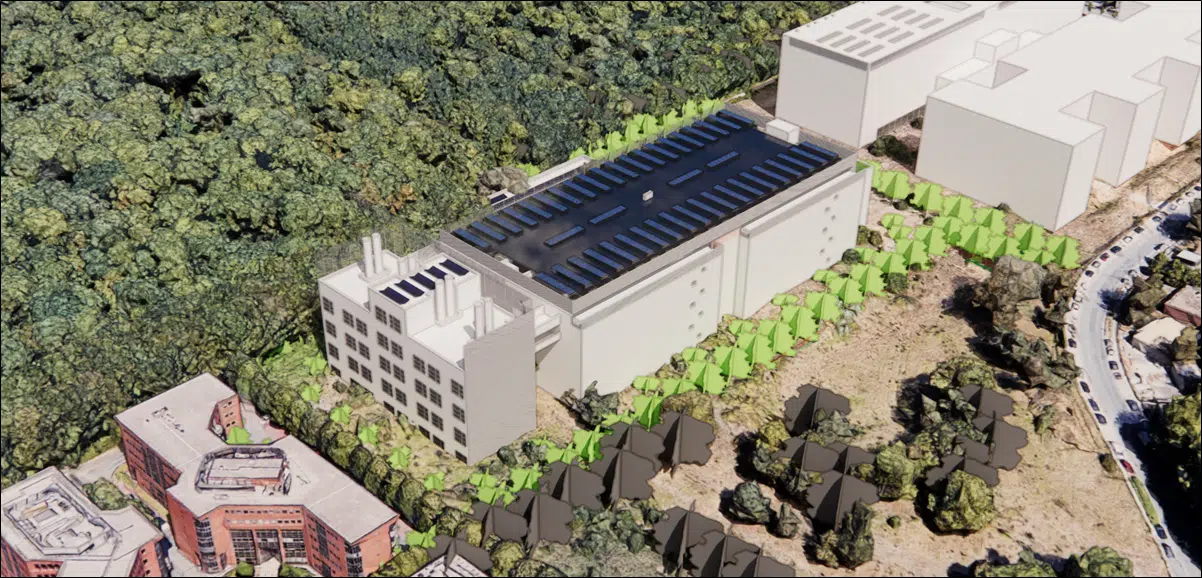
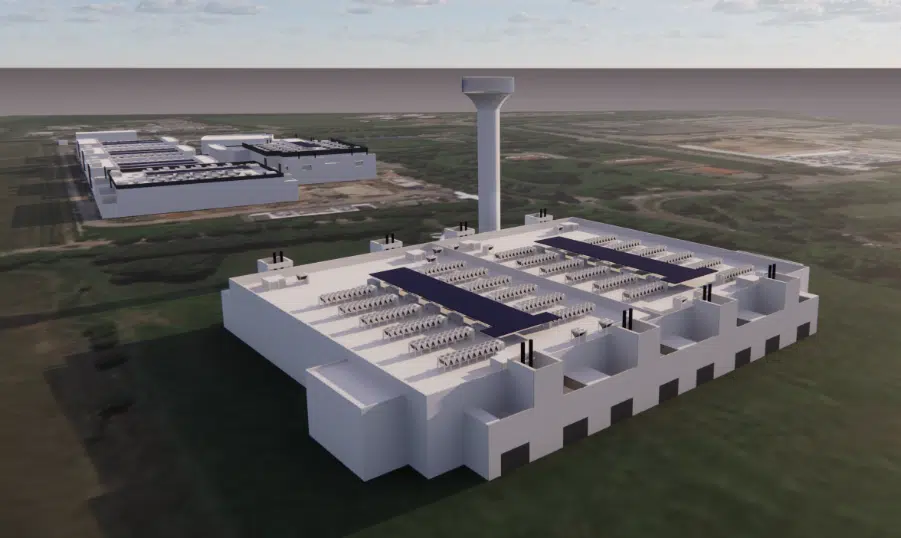
The digital twin reproduces the simplified geometry of the site and its surroundings within a 400 m radius, to analyse more finely how the thermal plume evolves depending on wind orientation. It is part of a design-improvement process: the zones of over-temperature at intake led to an update of the model by the EOLIOS engineers.
Virtual replica of the data center and its environment, fed by the equipment datasheets. It makes it possible to replay various wind and load scenarios without acting on the real installation.
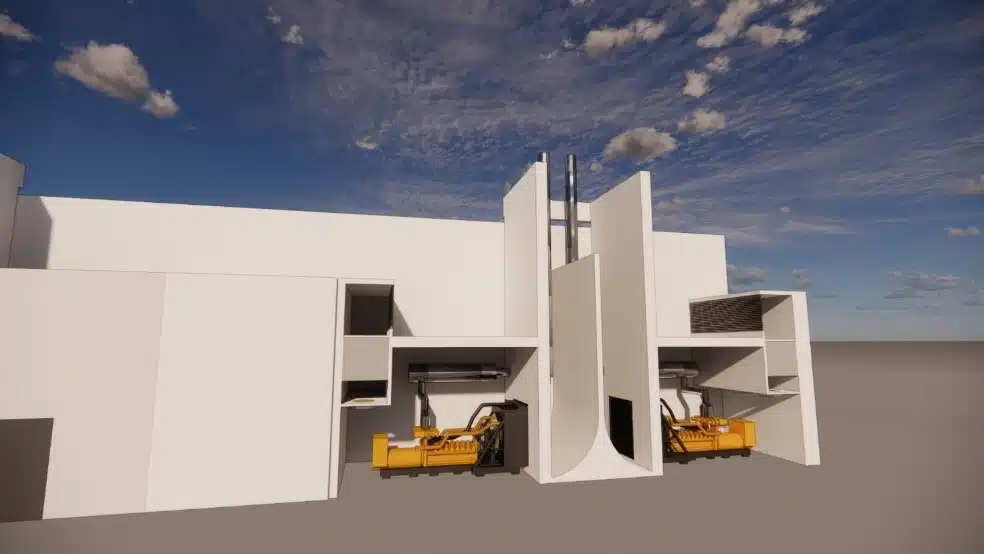
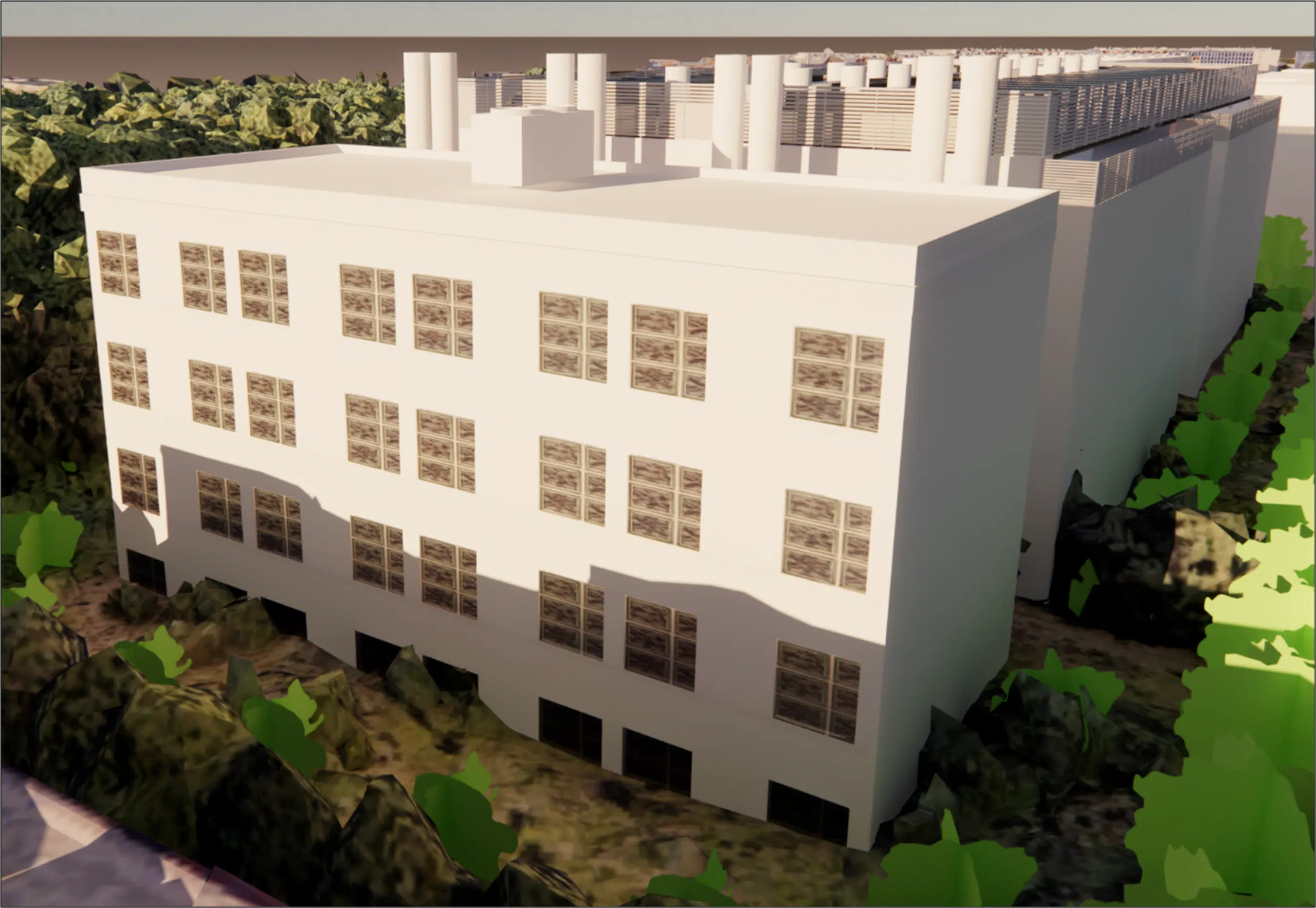
The digital twin includes the generators, the substation, the stacks and the rooftop dry coolers. Mechanical louvres are installed around the roof and the generators.
The generators are installed in bespoke concrete rooms integrating the technical equipment. Stacks modelled on the roof discharge the engine exhaust gases, which are harmful to the environment and to health.
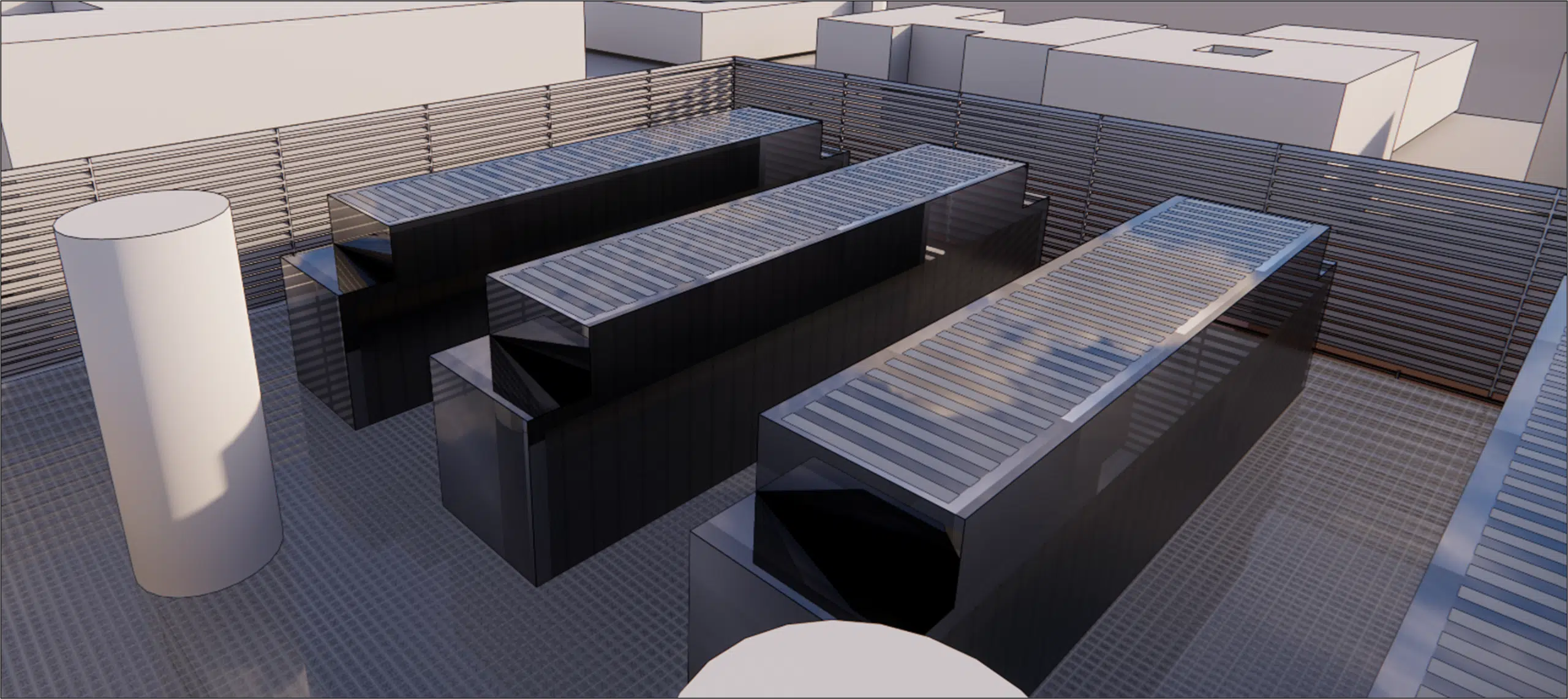
The dry coolers installed on the roof dissipate the heat released in the data halls. They are fitted with silencers, whose covering was taken into account in the airflow modelling.
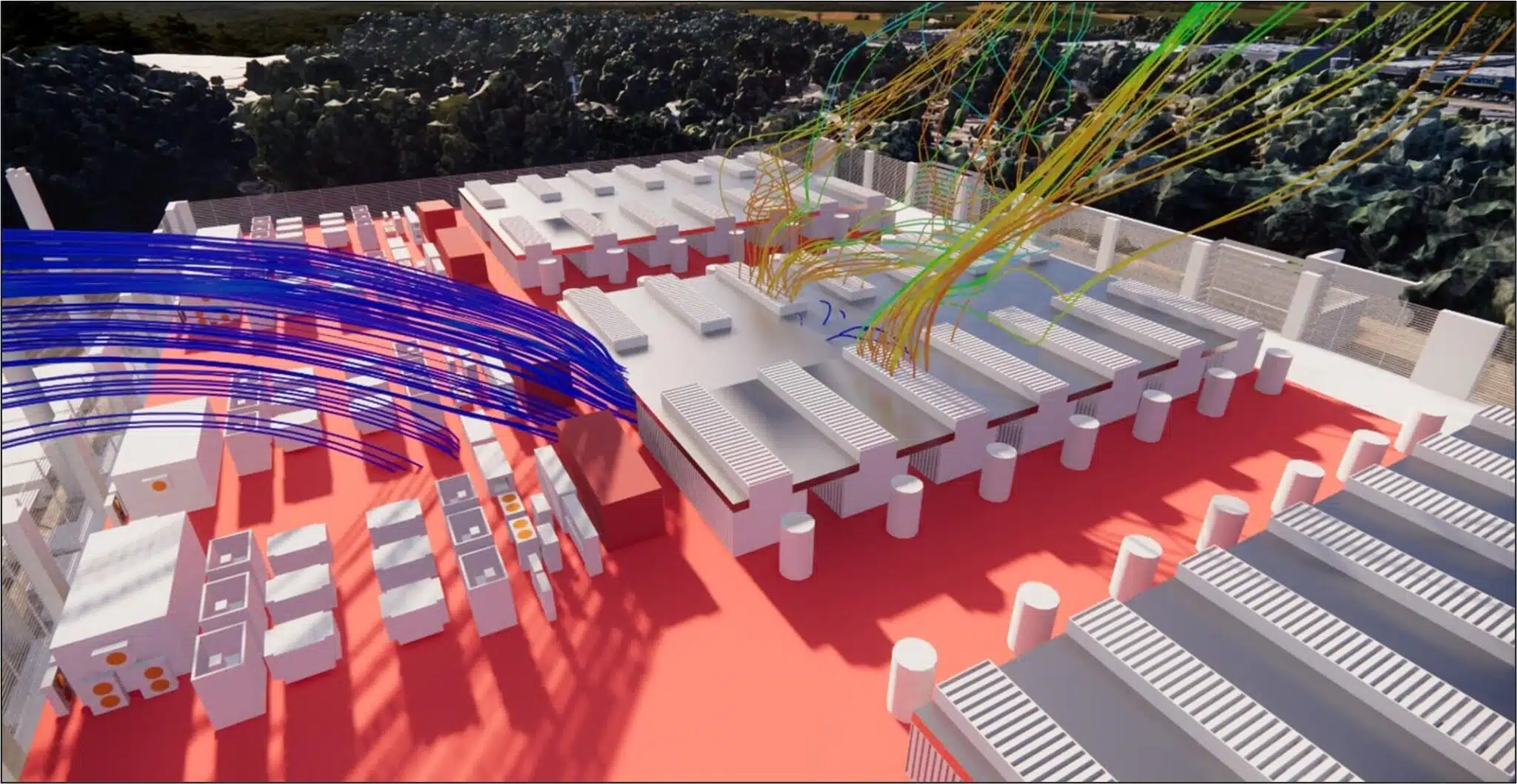
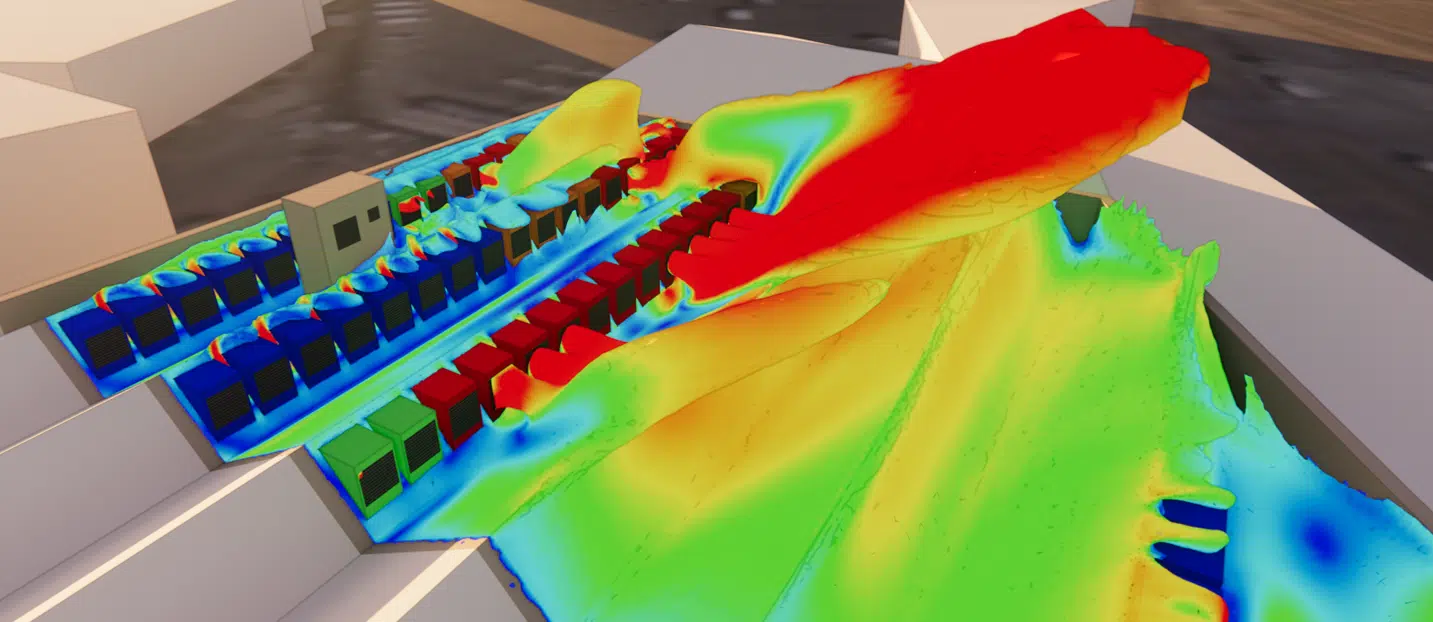
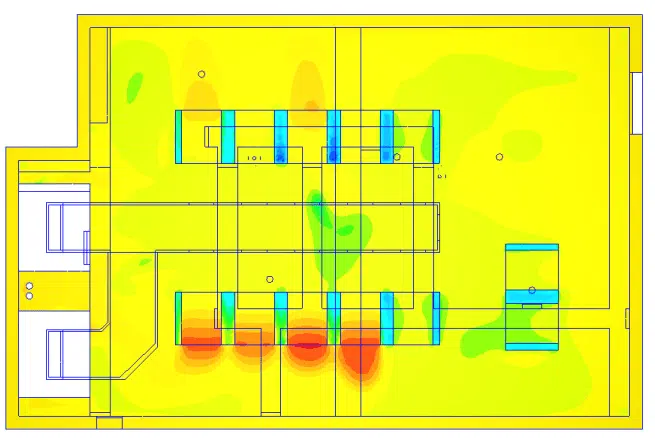
The CFD simulation shows that the temperature stays generally below 45 °C. Higher zones were identified, attributable to the short-circuiting of the northern dry coolers onto the southern ones when the wind comes from the north-east, and vice versa in a south-westerly wind.
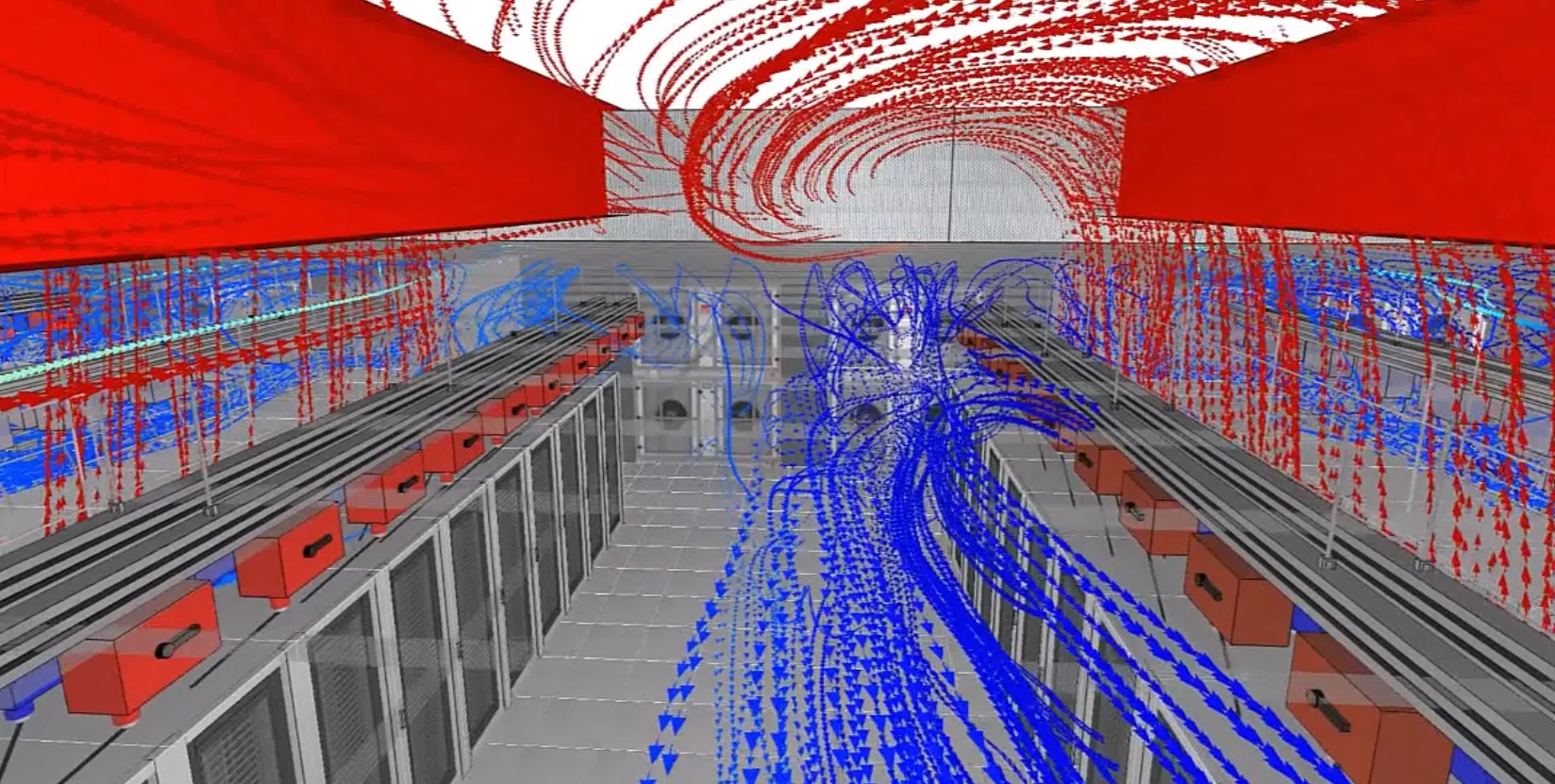
Re-ingestion, by the dry coolers, of part of the hot air they have just rejected. The air slips back under the covering through the open ends of the row, which raises the intake temperature and reduces the cooling power.
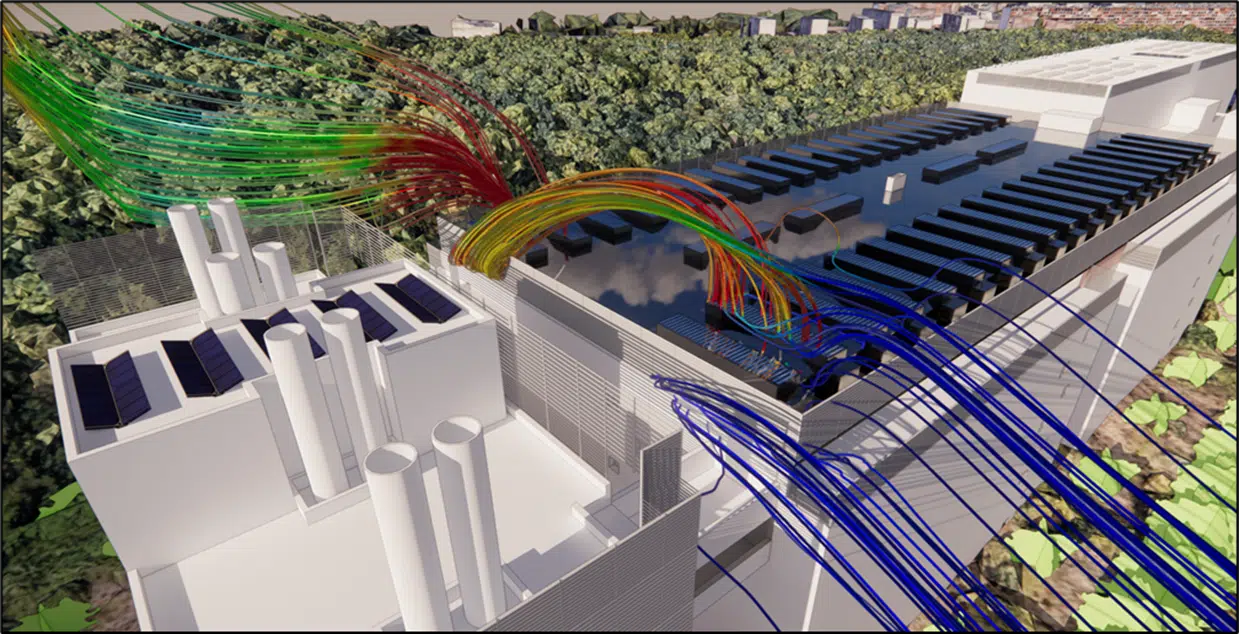
This rise nevertheless stays very localised: it only appears at the dry cooler closest to the generators and remains below the temperature target.
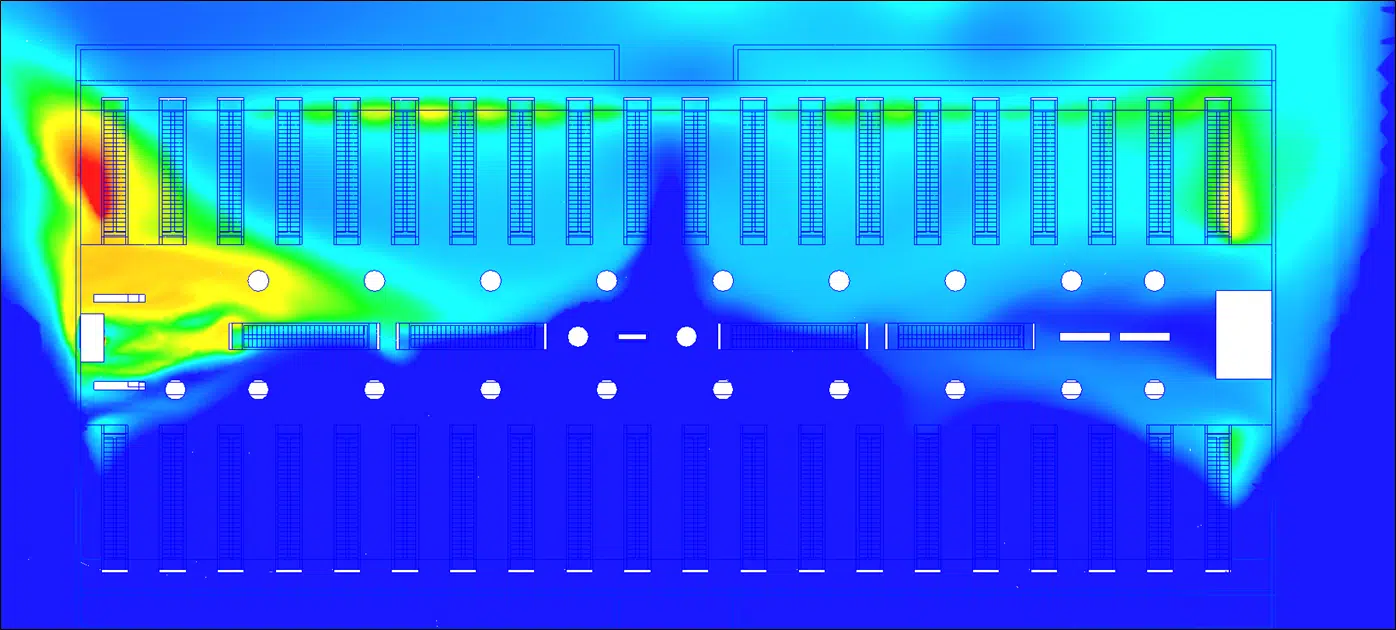
The numerical simulation also confirmed that the thermal plumes of the generators, the exhaust stacks, the intake and discharge grilles and the transformer substation do not pose a problem for the rooftop systems.
The study highlights that the high density of rooftop installations causes short-circuit phenomena, producing a local rise in air temperature. This phenomenon does not, however, endanger the durability of the installations.
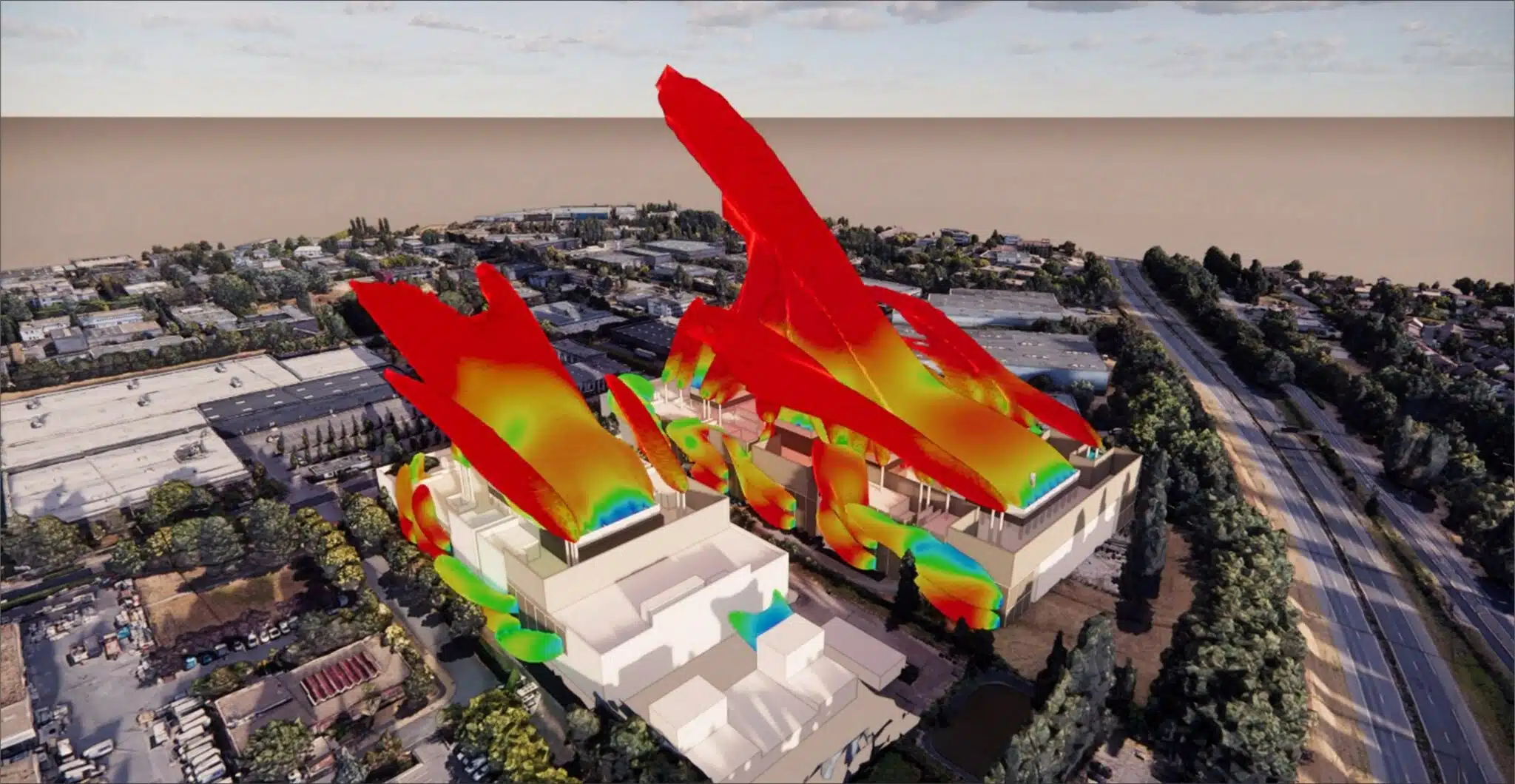
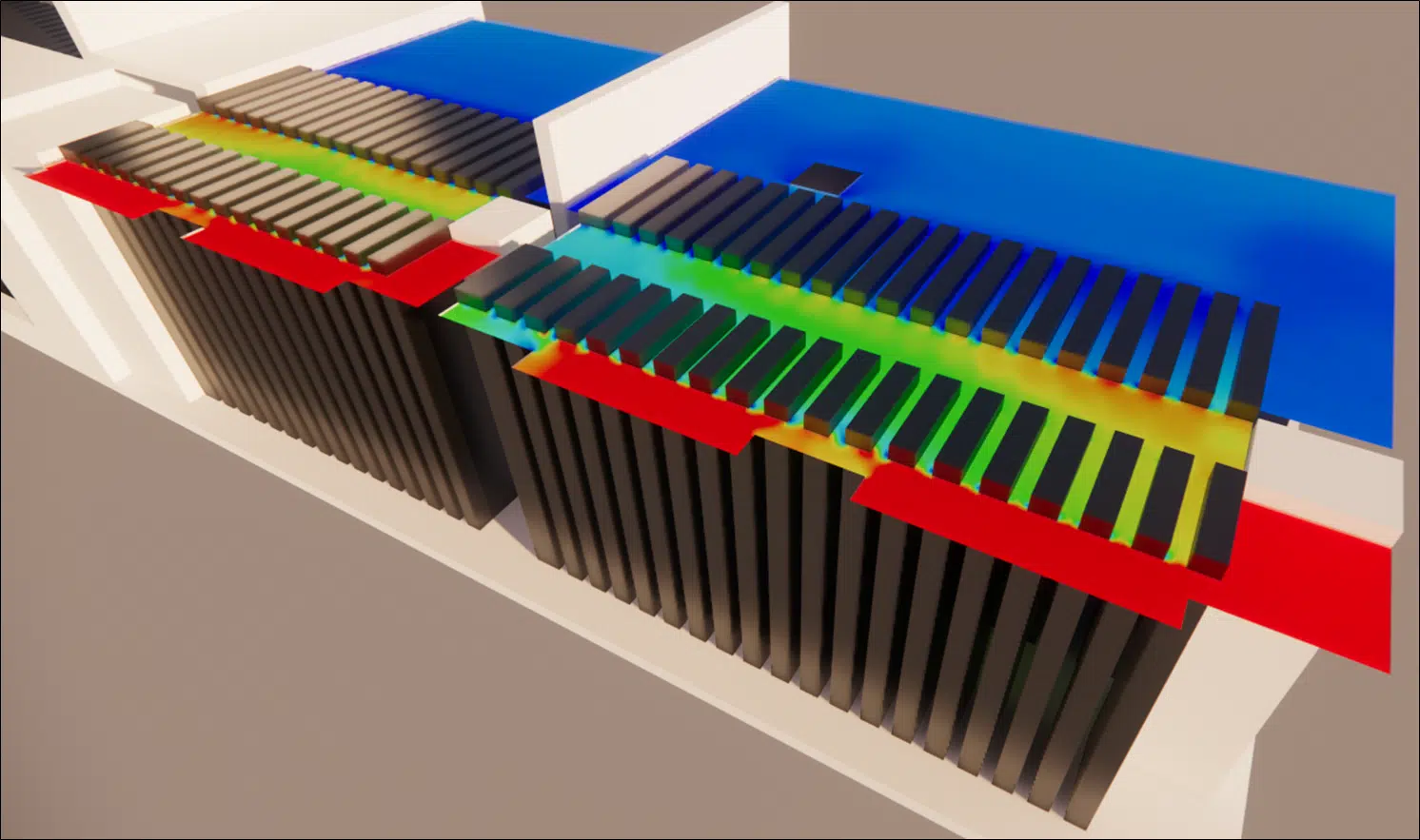
The EOLIOS engineers also produced an approximate model of PA13. Its main thermal-airflow characteristics revealed significant short-circuit problems, liable to compromise the durability of the installations: there the generator plumes are re-ingested to a significant extent by the rooftop dry coolers.
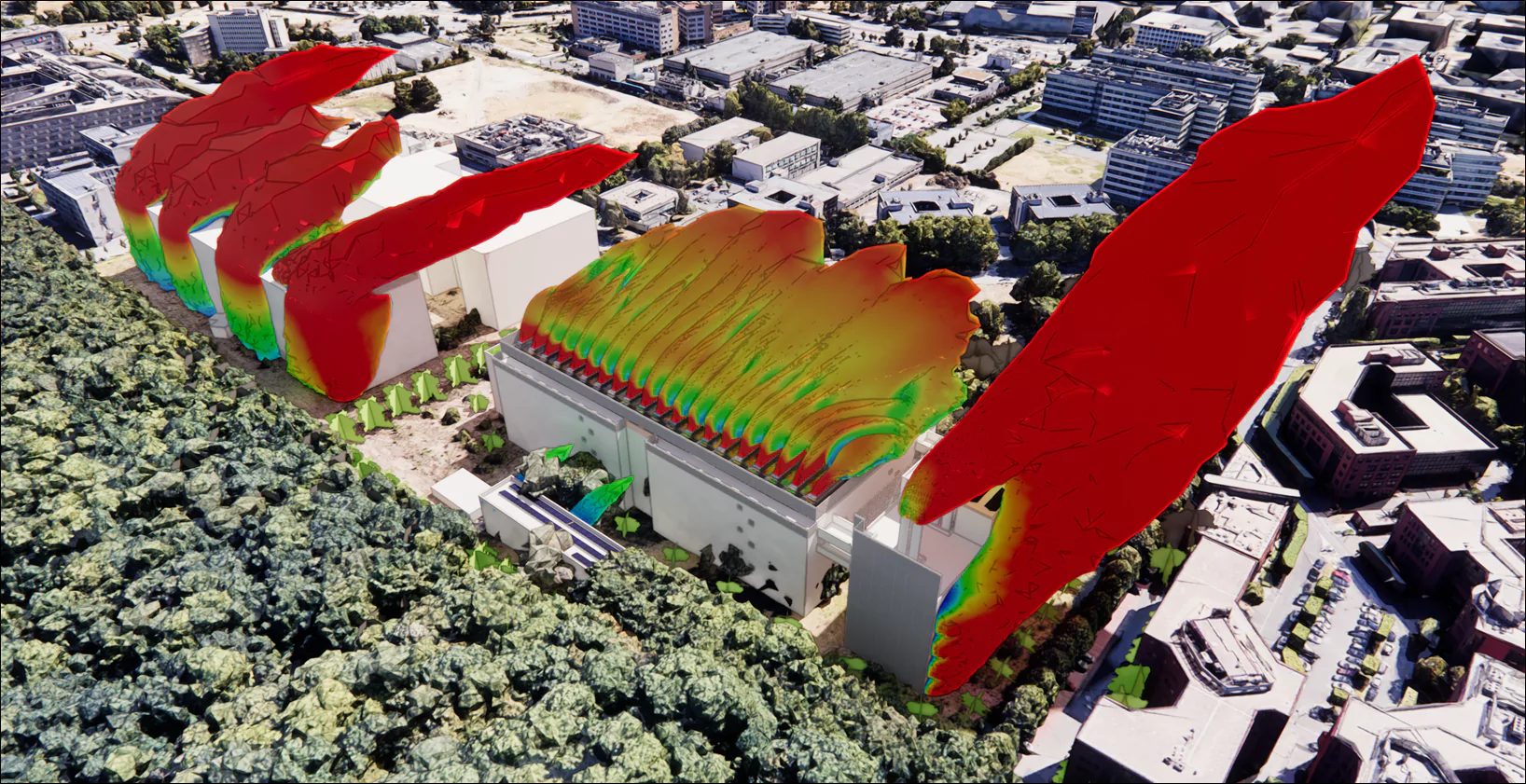
Key takeaway. On PA 22 the short-circuit stays localised and has no effect on durability. The denser PA13 model, by contrast, shows critical recirculation. The density of rooftop equipment is therefore the decisive factor, and an ambient air that can reach 40 °C makes it essential to anticipate these phenomena from the design stage.
We recommend carrying out an airflow check of this data center for a north-easterly wind.
The conclusions of the study made it possible to identify these issues and to propose suitable solutions to the design teams. CFD simulation makes it possible to analyse, verify and correct potential errors from the design stage: a fast, precise method that saves time and costs while guaranteeing concrete, reliable results. Integrating CFD from the design phase is the guarantee of avoiding future problems.
Know-how: external CFD simulation for data centersShort-circuiting, weather conditions and the contribution of simulation: answers to the questions raised by operators and design teams.
Part of the hot air rejected by a row of dry coolers slips back under the covering through the open ends of the row and is then drawn in again by the systems of the same row. The intake temperature rises and the cooling power drops, an issue close to the one studied on our generator pressure-loss project.
The wind is steady throughout the year with a dominant south-westerly direction and occasional north-easterly episodes. The study was carried out for an outdoor temperature of 40 °C and a 4 m/s wind, the most prevalent and most unfavourable speed because it pushes the generator plume back towards the rooftop systems.
No. On PA 22 the overheating stays very localised, limited to the dry cooler closest to the generators, and the temperature remains below the target. A denser model such as PA13 does, however, show significant short-circuits liable to compromise the durability of the installations.
The digital twin reproduces the geometry of the site and its surroundings within a 400 m radius in order to capture the influence of the terrain, the built environment and the prevailing winds on how the thermal plumes evolve depending on their orientation.
CFD simulation makes it possible to analyse, verify and correct potential errors from the design stage. Fast and precise, it saves time and costs while guaranteeing reliable results before construction.
Explore our expertise, projects and technical papers to go further than the FAQ.
External CFD study of the PA 22 data center in Meudon: impact of the generators and rooftop cooling systems. The numerical simulation modelled the thermal-airflow phenomena to analyse and improve the ventilation of the dry coolers. The weather analysis shows a dominant south-westerly wind with occasional north-easterly episodes. The temperature stays generally below the target, with local over-temperature zones due to short-circuiting between dry coolers, without seriously affecting the durability of the installations.
 Digital twinData center study – Data Hall and UPS rooms
 Smoke controlSmoke-control engineering in a data center
 HyperscaleExternal & internal CFD – Hyperscale Data Center
 OptimisationCFD optimisation – Data Center
 InternalData Center – DC28 – Internal
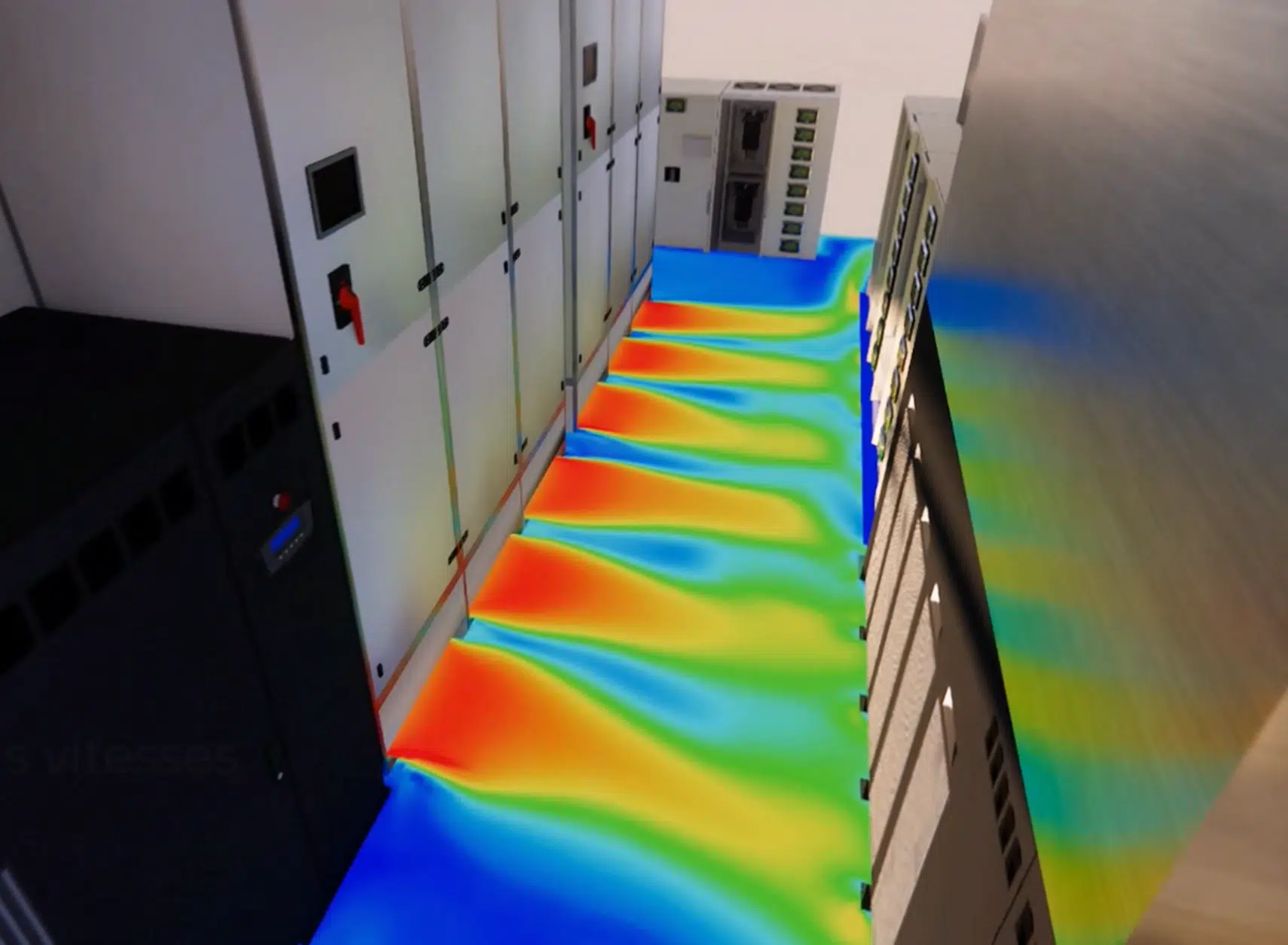 Technical roomsTechnical rooms – Data Center
 CoolingCooling optimisation – Data Center
 ExternalData Centers – DC15.1 & DC15.2 – External
 GeneratorPressure-loss study – Generator – Data center
 ExternalData Center – Paris
 FireData Center – NOVEC gas
 InternalData center – DC17 – Internal
 ExternalData center – D14 – External
 ExternalData center – DC25 & DC26 – External
 InternalData Center – DC10 – Internal
 InternalData center – DC25 – Internal
ExternalData Center – DC25 & DC26 – External
InternalData center – DC25 – Internal
ExternalData Center – DC25 & DC26 – External