Analysis of internal airflows in data centers
Data centers are environments with very high energy density — several hundred kW on a few m². The cooling system becomes a central element of the energy strategy, often representing more than 30% of the site's consumption.
Diagnosis
- PUE in real & projected conditions
- Energy analysis of the cooling
- Thermal losses & oversizing
Optimisation
- HVAC: chillers, AHUs, fan-coil units
- Interactions flow / cooling / IT load
- Scenarios (free cooling, containment, redundancy)
Valorisation
- Detection of over-consumption zones
- Targeted improvements
- Energy performance & certification
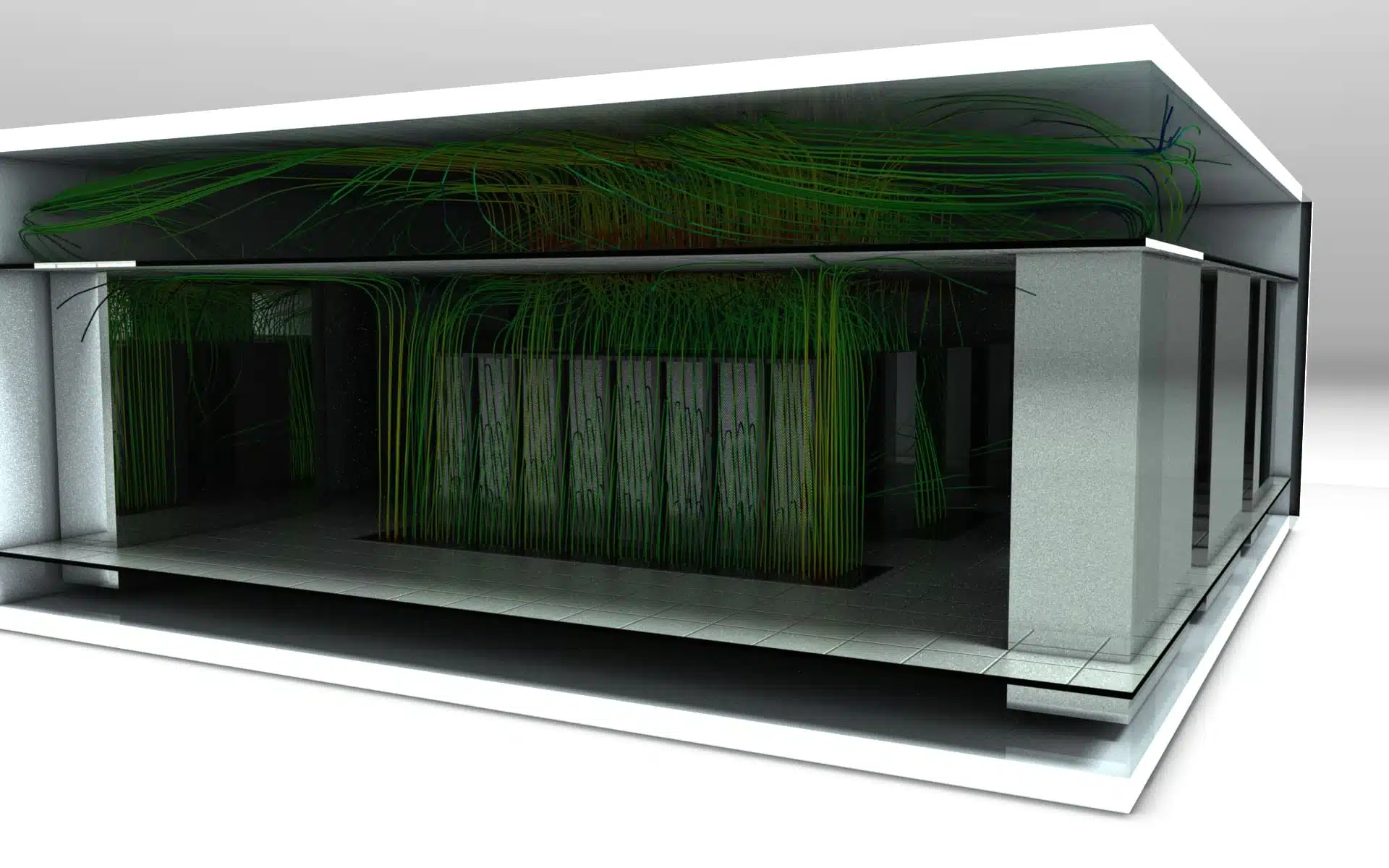
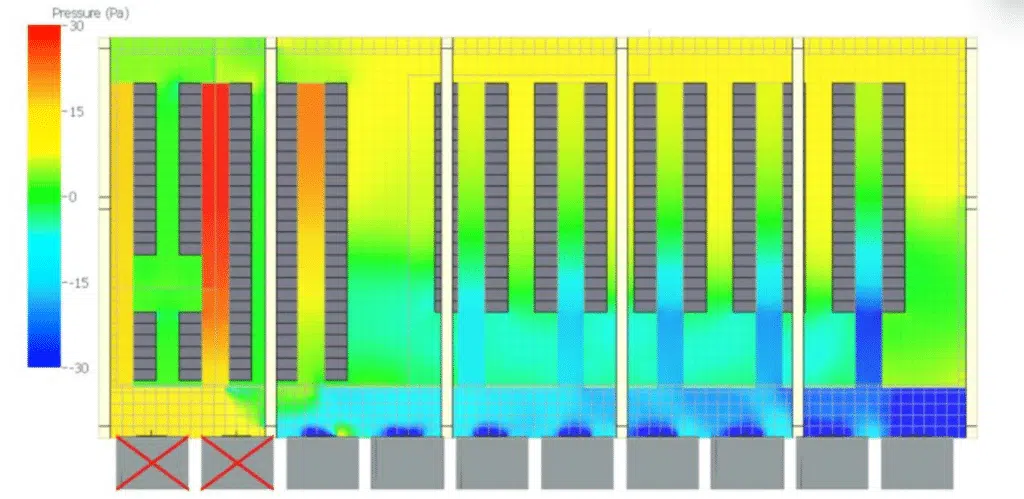
Our CFD studies virtually reproduce the behaviour of the airflows and temperatures throughout the data center. This dynamic 3D modelling makes visible what is not: overheating zones, pressure imbalances, hot-air recirculation, preferential or stagnant paths — all phenomena that degrade thermal efficiency and increase the risk of a hardware incident.
Optimising the ventilation and the equipment
CFD studies provide concrete elements to optimise existing installations or guide the design of new rooms:
- optimal positioning of the perforated tiles according to the real thermal needs of each cabinet;
- validation of the hot and cold aisles, identifying the mixing or short-circuit zones;
- effectiveness of the containment systems, quantified on the server-inlet temperature;
- control of the CRAC/CRAH adjusted to the local load, the temperature gradients and the pressure losses.
Reducing thermal losses through containment
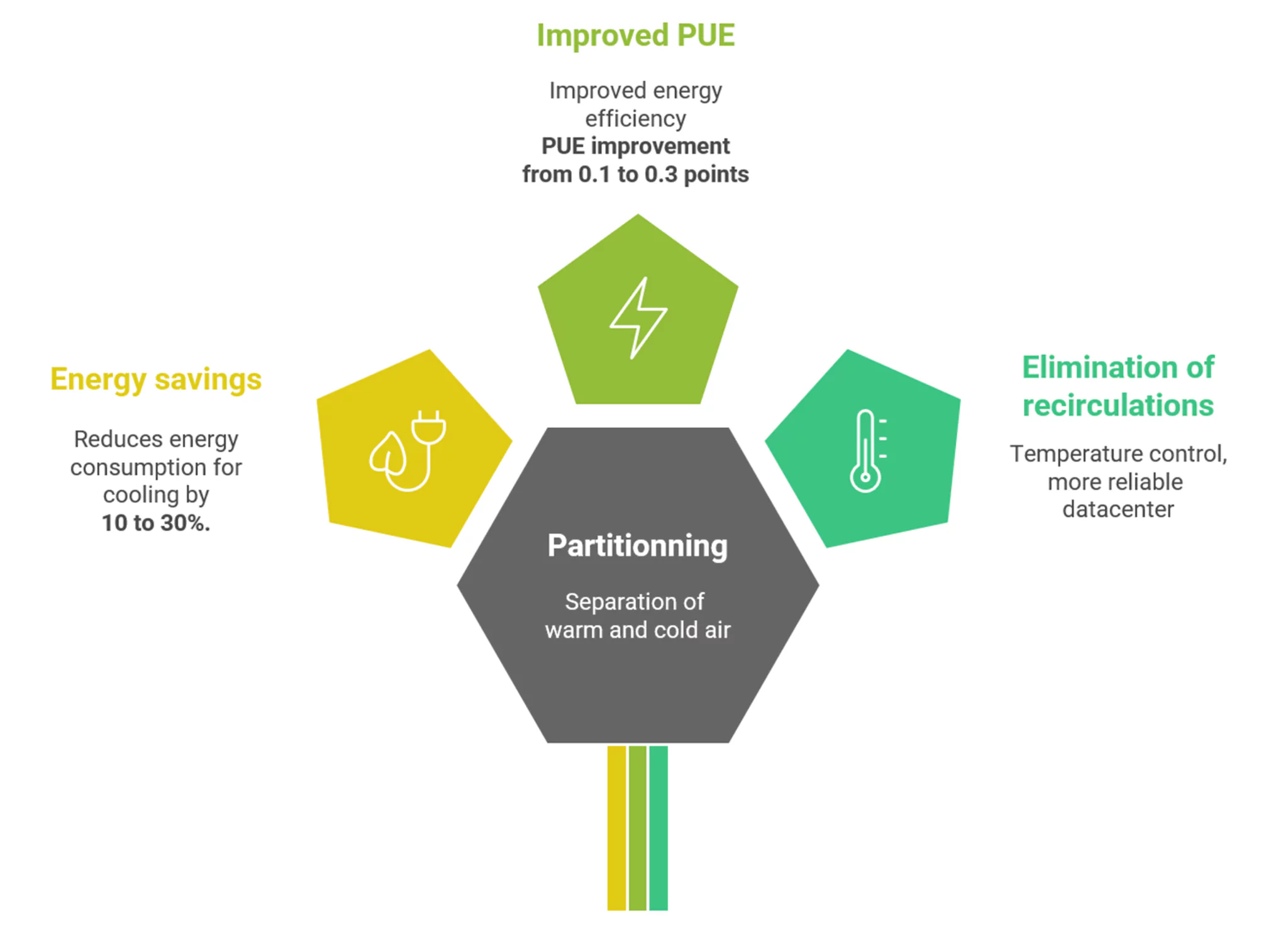
Energy efficiency relies on a clear separation between the cold air supplied and the hot air extracted. Setting up effective partitioning typically brings an improvement of 0.1 to 0.3 PUE points. When the separation is imperfect, recirculation and mixing reduce cooling efficiency by 20 to 40%: the cold air is poorly used or prematurely warmed, and the systems over-consume to compensate.
Our CFD studies precisely visualise these critical zones — recirculation in the cold aisles, leaks through the tiles, cold airflow bypassing the cabinets. EOLIOS supports the design and validation of the containment devices: with or without a raised floor, in a hot or cold aisle, several configurations are assessed to measure their impact on the equipment-inlet temperature and the behaviour of the flows.
Dynamic load adjustment & ESC valorisation
Simulation of evolving thermal loads
Data centers are not static: densification, server consolidation and new technologies constantly change the loads. EOLIOS models the current state and projected scenarios (cabinet densification, partial activation of a room, localised load increase) to validate the correct sizing of the cooling and guarantee performance against future changes.
This dynamic vision enables intelligent control: adapting the ventilation and cooling power to the real needs in real time, avoiding excess cooling at low activity and guaranteeing thermal comfort at load peaks — hence lower consumption and a longer system lifespan.
Turning energy efficiency into a financial lever (ESC)
The Energy Savings Certificate (ESC) scheme makes it possible to fund consumption-reduction actions, provided the savings are rigorously demonstrated. EOLIOS supports the design, justification and valorisation of eligible projects: improved containment, setpoint adjustment, repositioning of cooling equipment, ventilation reconfiguration. Each project is the subject of a detailed before/after energy analysis and traceable technical reports, maximising your chances of obtaining the ESC subsidy.
Towards an optimised PUE
Improving the PUE (Power Usage Effectiveness) is the central indicator of energy optimisation. By refining the air distribution, limiting the over-cooled zones and eliminating the heat pockets, the simulations achieve a greater uniformity of temperatures in the cold aisles — which makes it possible to reduce the safety margins and precisely modulate the cooling power. The results are delivered as visual maps, comparative scenarios and clear indicators, directly usable to make choices objective and justify investments.
Innovation EOLIOS — surconsommations en rooftop
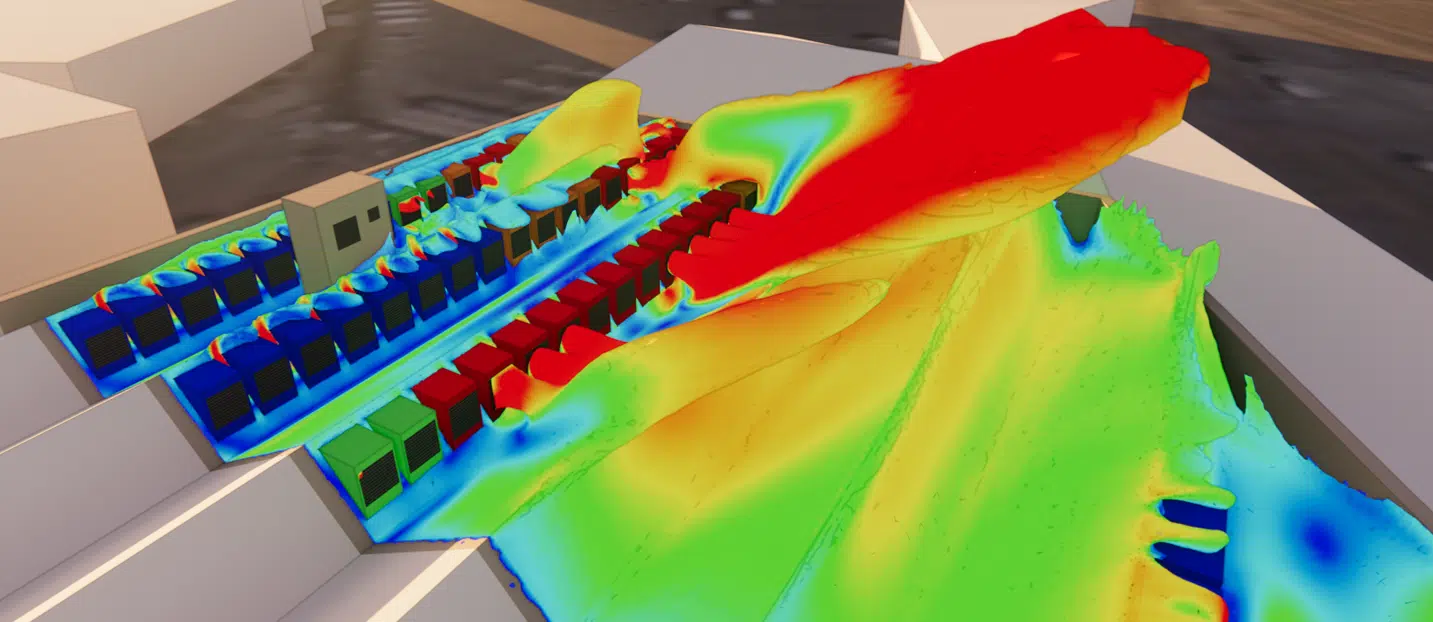
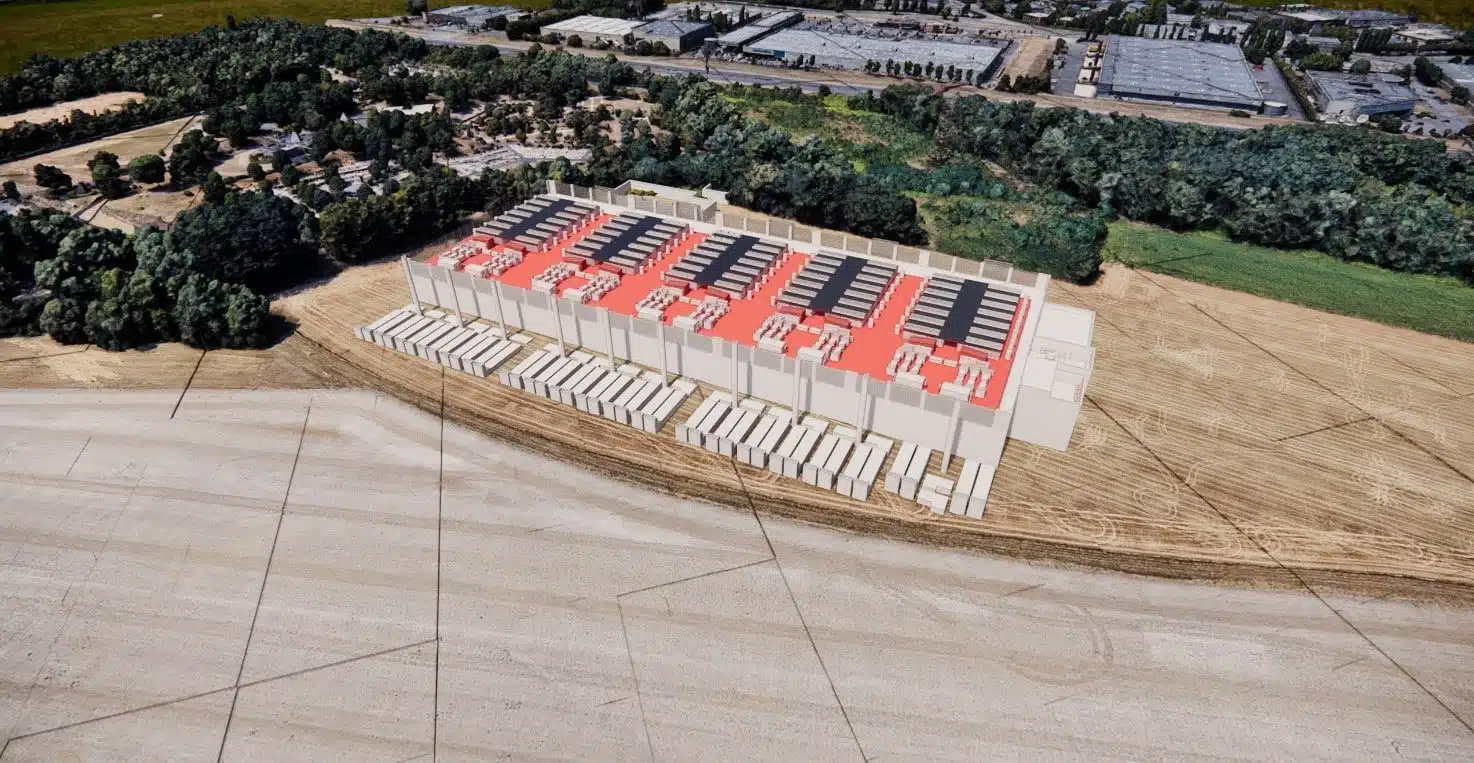
Efficiency does not depend only on the white room: the chillers, dry coolers and cooling towers on the roof play a key role. A poorly thought-out layout causes recirculation, warmed air intakes and turbulence, forcing the systems to over-consume. Our CFD approach maximises the EER (Energy Efficiency Ratio) by optimising the layout and quantifying the performance gap between scenarios. In many cases, a judicious reconfiguration or partitioning improves the cooling efficiency by up to 10%, i.e. several dozen MWh per year — a concrete lever to sustainably reduce the PUE and maximise the return on investment.