EOLIOS, the engineers of urban comfort
Urban quality of life often lies in the small details that shape our daily lives. Among them, pedestrian comfort plays a fundamental role.
It is an essential component of urban mobility, influencing not only residents' walking experience, but also their safety, their well-being and their willingness to favour travelling on foot.
On this page, we look at the decisive criteria of pedestrian comfort as well as the mapping tools that make it possible to assess and improve this crucial aspect of urban spaces. We explore comprehensive resources and case studies that show how a methodical, scientific approach can turn our urban developments into welcoming places for pedestrians.
By combining sophisticated analyses with proven practices, EOLIOS is committed to redefining the standards of pedestrian comfort to foster cities that are more accessible, safer and more liveable for everyone.
How is pedestrian comfort computed?
The influence of wind on pedestrian comfort
Heavily built-up areas, such as the La Défense district, create regions where the wind reaches higher speeds, owing to the height of the buildings and their high density. The Venturi effect is responsible for these high-speed zones: as the cross-section available to the wind is reduced by the buildings, the wind is accelerated.
High wind speeds can be a problem for the comfort and safety of the users of these buildings (terraces, balconies…), but also for pedestrians (or even cyclists) moving through these dense districts. It is therefore reasonable to ask from what criterion the wind speed becomes uncomfortable, or even dangerous.
Assessing wind-comfort levels
The Beaufort scale classifies wind strength according to speed and how exposed people perceive it: a scale running from 0 to 12. We do not present it beyond force 9, which covers the most extreme cases (from storms to hurricanes); most of the criteria presented below consider the wind to be dangerous from force 8 onwards.
The initial aim of all the criteria presented is to ensure that new urban developments are designed so as to minimise the negative impacts of wind on the comfort and safety of residents and users: they guarantee a better quality of life for city dwellers.
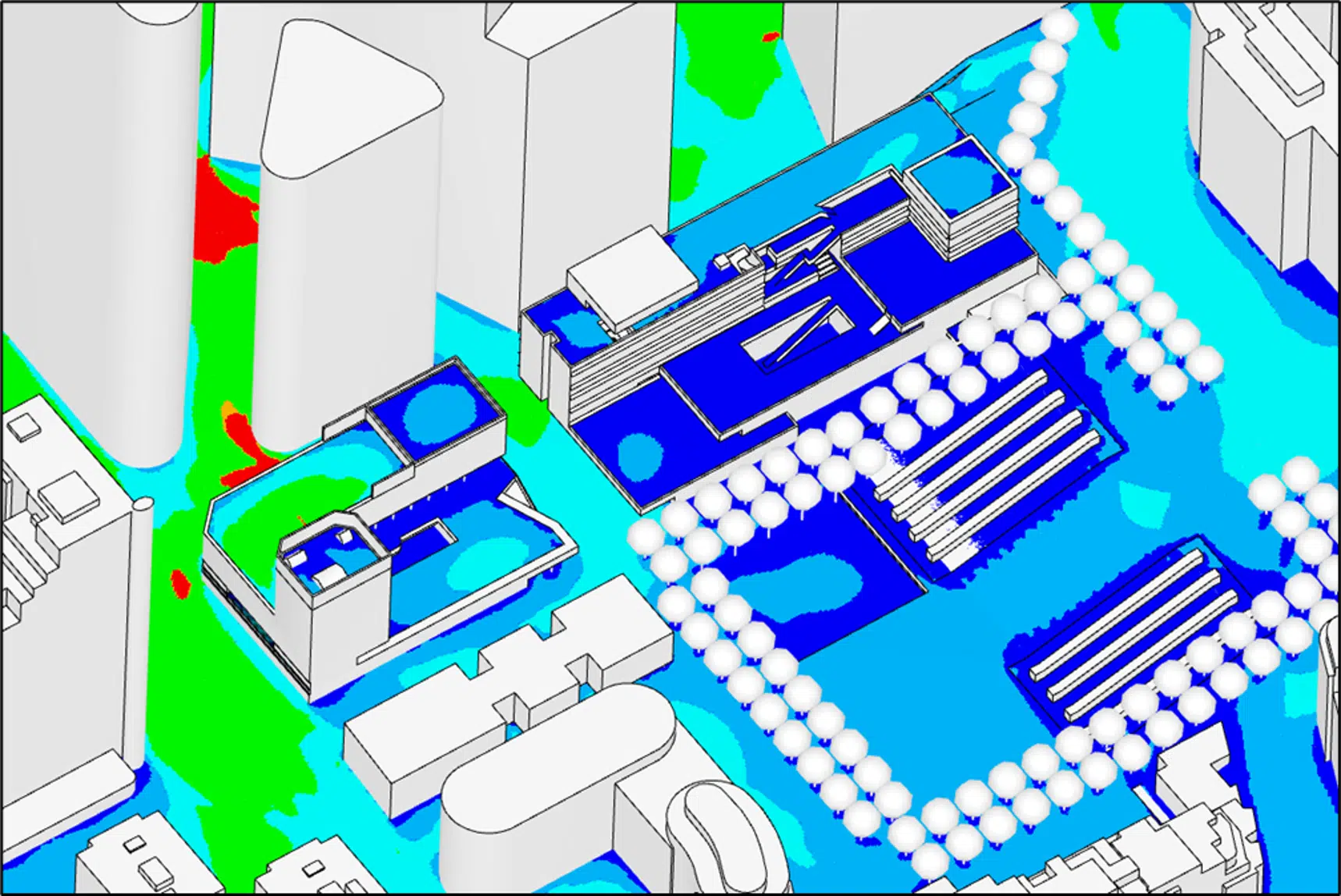
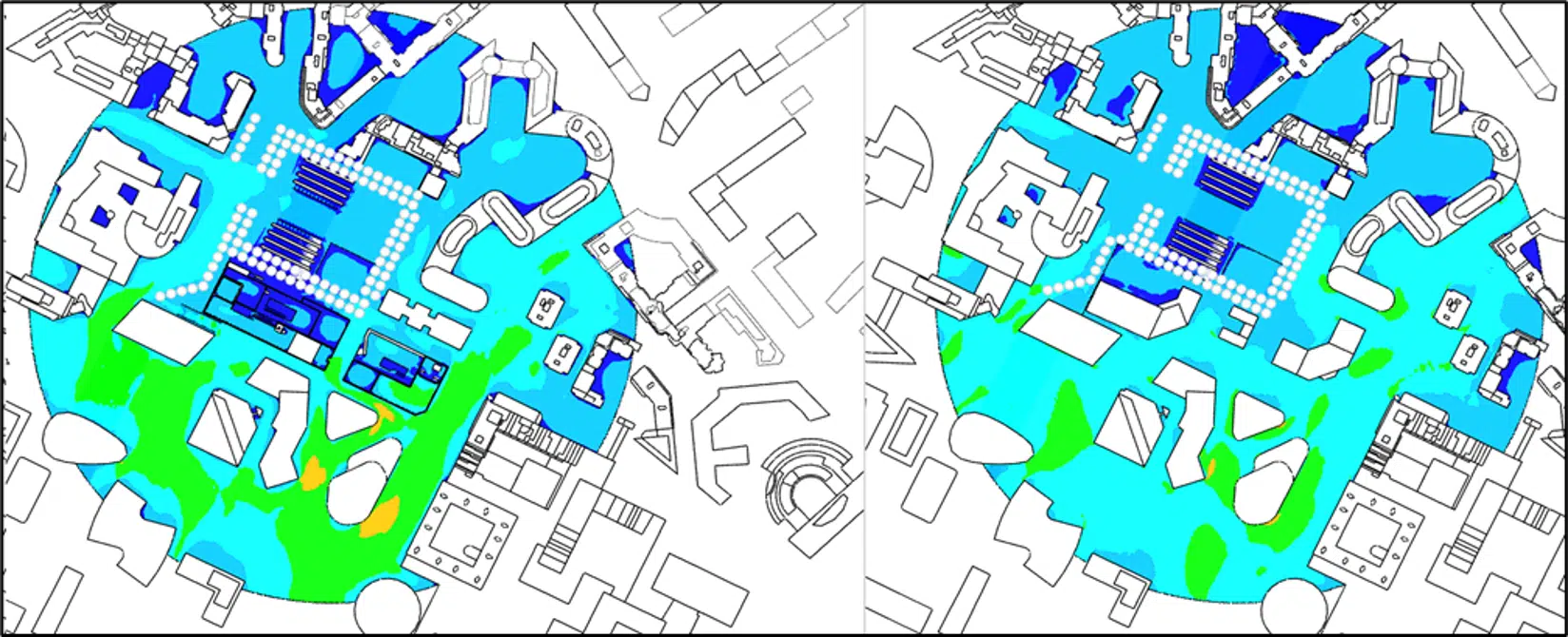
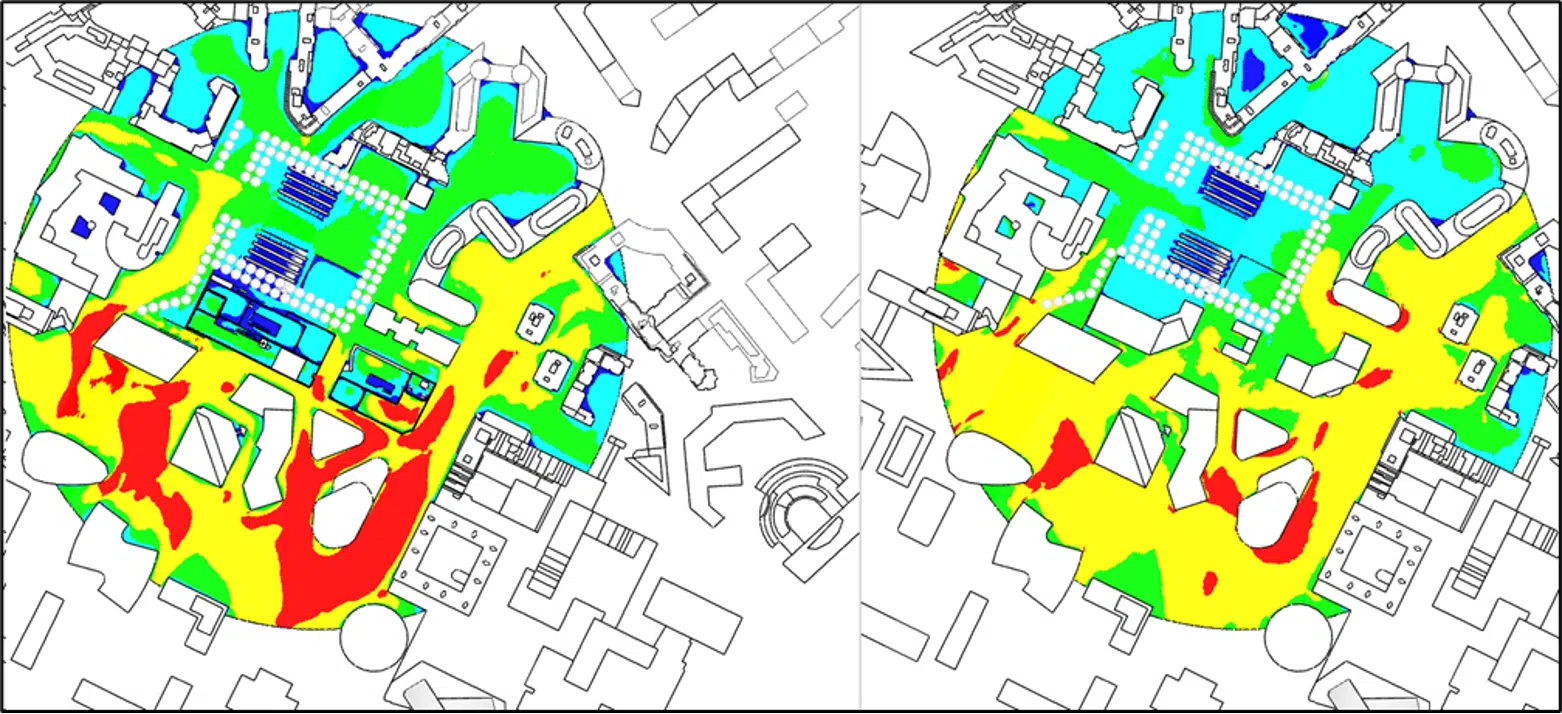
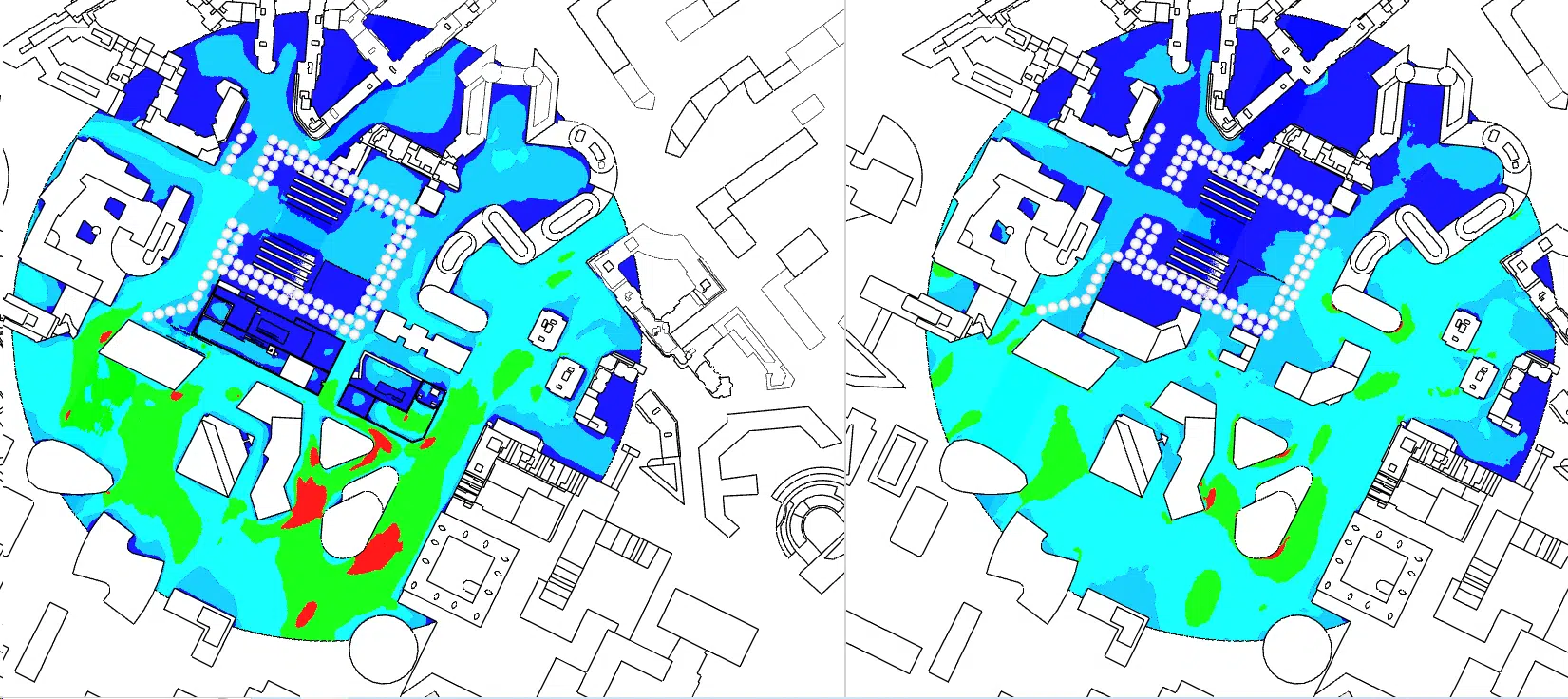
For each criterion, two maps are shown for the school project in Courbevoie: the left-hand map relates to the project, the right-hand map to the baseline (existing, before the project).
The London LDDC criterion
The London criterion, attributed to the London Docklands Development Corporation (LDDC), appeared in the 1980s. At the time, the rapid development of urban areas, notably in London, raised growing concerns about living conditions in these densely populated environments. The London criterion was designed to provide urban-planning standards, with particular emphasis on managing wind effects. It sets a threshold speed for different types of activity: each activity has a different comfort threshold.
For example, a person sitting outside on a bench or terrace will more readily feel uncomfortable as the wind speed rises than someone on the move (walking, running, or even a cyclist). At very high speeds, the criterion indicates that the wind becomes uncomfortable or dangerous for any type of activity.
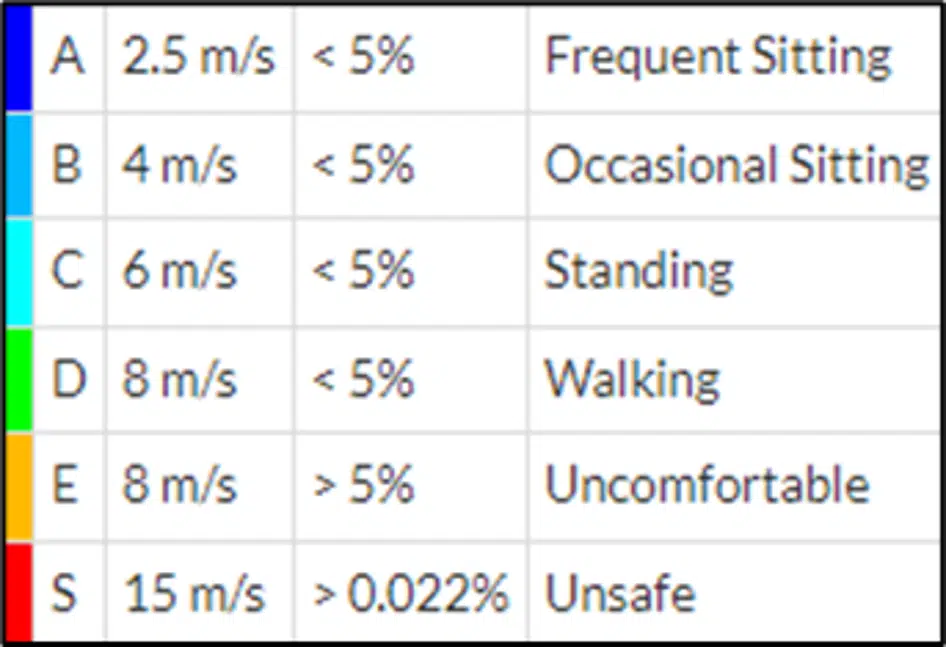
All the criteria presented in this article are read in the same way. Here is the London criterion in detail:
The London LDDC criterion
- Long-term sitting: speeds exceed 2.5 m/s less than 5% of the time.
- Short-term sitting: the wind speed exceeds 4 m/s less than 5% of the time.
- Strolling: speeds > 6 m/s less than 5% of the time.
- Brisk walking: speeds > 8 m/s less than 5% of the time.
- Uncomfortable: 8 m/s exceeded 5% of the time or more.
- Dangerous: the speed reaches 15 m/s with a frequency of at least 0.022%.
For each criterion, the maps for the school project in Courbevoie are shown: the left-hand map relates to the project, the right-hand one to the baseline (before the project) or existing state.
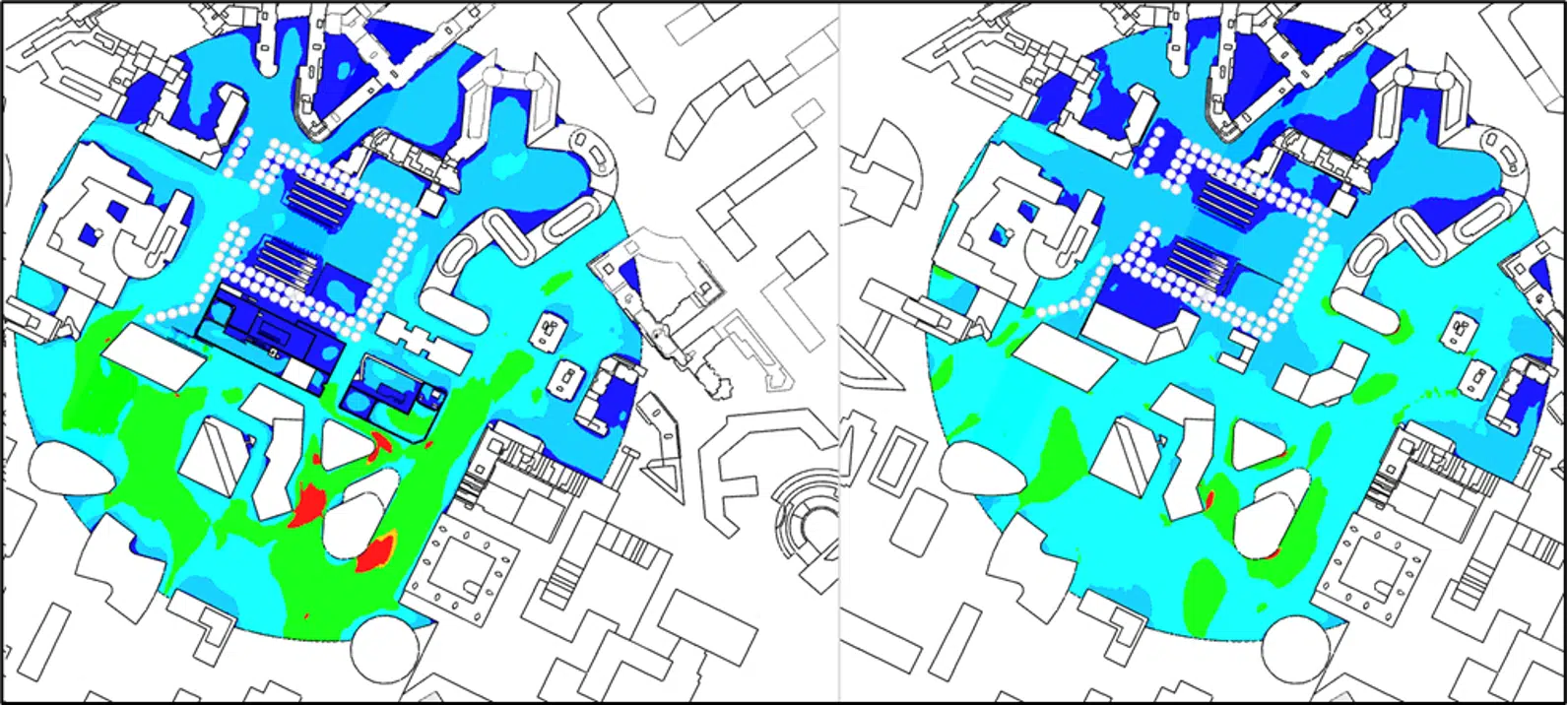
Lawson criteria
The Lawson criterion was first proposed by T.V. Lawson in 1978 in the paper “The wind content of the built environment”. Like the previous criterion, it is based on a threshold that depends on the activity carried out by the user. There are several versions.
Lawson LDDC criterion
The Lawson LDDC criterion indicates a wind-comfort state for different activities. Of the three Lawson criteria presented here, it is the most widely used.
Lawson LDDC criterion
- Outdoor dining: speeds > 2 m/s less than 5% of the time.
- Seated pedestrian: > 4 m/s less than 5% of the time.
- Standing pedestrian: > 6 m/s less than 5% of the time.
- Walking pedestrian: > 8 m/s less than 5% of the time.
- Brisk walking: 10 m/s exceeded less than 5% of the time.
- Uncomfortable: the speed exceeds 10 m/s more than 5% of the time.
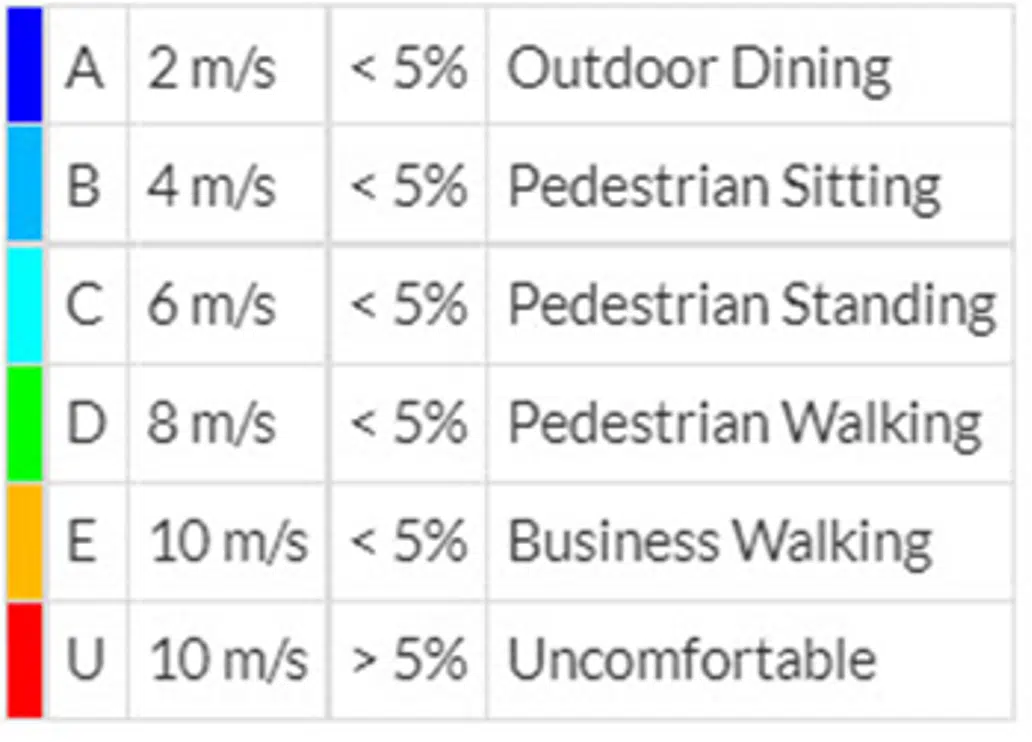
Lawson criterion (simple)
The Lawson criterion gives other thresholds for the comfort of outdoor activities. It is close to the London LDDC criterion, but with different threshold speeds.
Lawson criterion
- Long-term sitting: speeds > 1.8 m/s less than 2% of the time.
- Short-term sitting: > 3.6 m/s less than 2% of the time.
- Strolling: > 5.3 m/s less than 2% of the time.
- Brisk walking: > 7.6 m/s less than 2% of the time.
- Uncomfortable: 7.6 m/s exceeded 2% of the time or more.
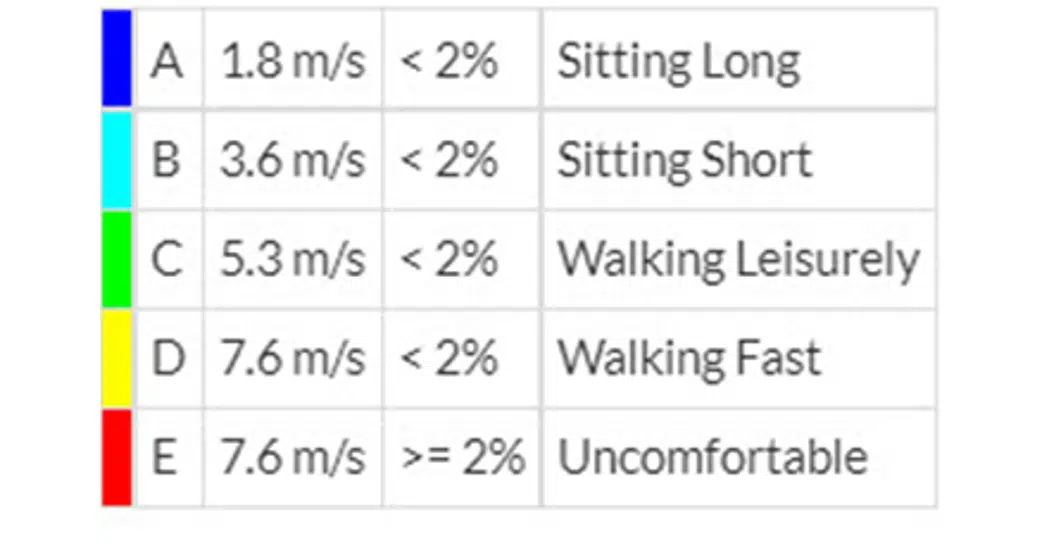
Lawson criterion 2001
This last Lawson criterion also includes the danger character of certain speed values, complementing the comfort thresholds.
Lawson criterion 2001
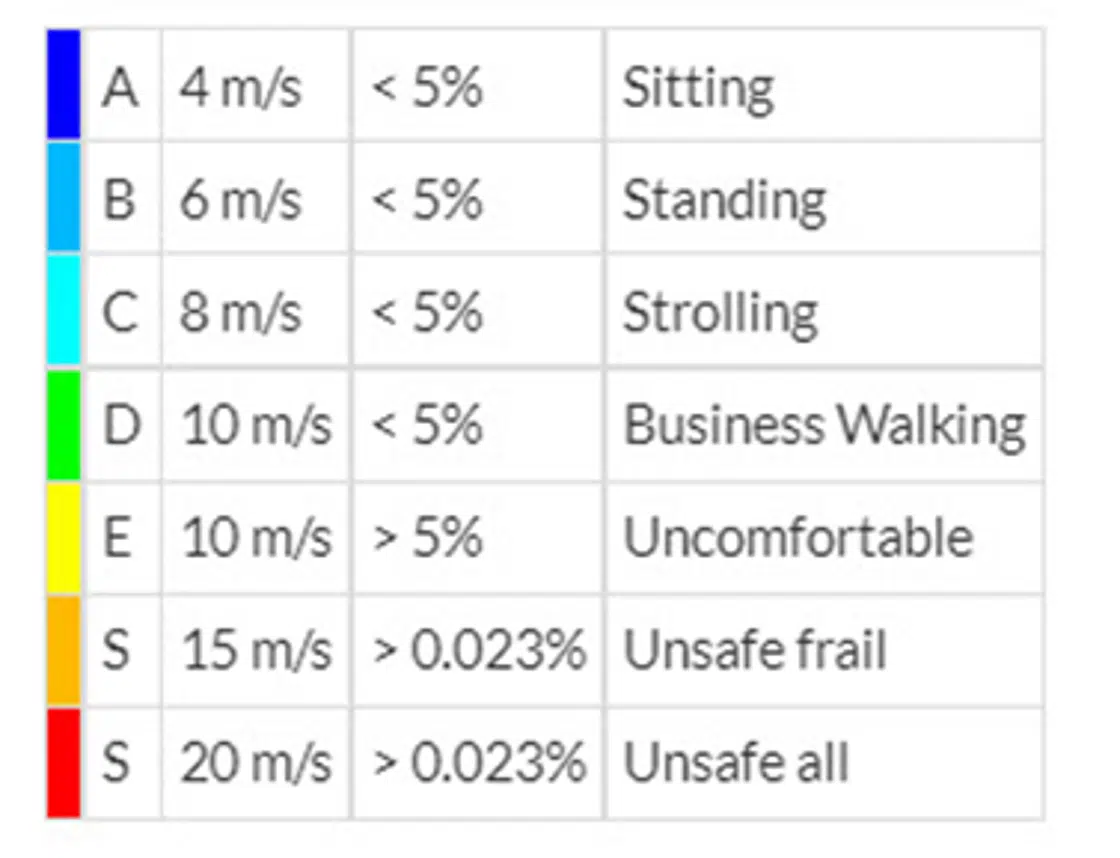
- Sitting: speeds > 4 m/s less than 5% of the time.
- Standing: > 6 m/s less than 5% of the time.
- Walking: > 8 m/s less than 5% of the time.
- Brisk walking: > 10 m/s less than 5% of the time.
- Uncomfortable: 10 m/s exceeded 5% of the time or more.
- Unsafe: > 15 m/s reached 0.023% of the time or more.
- Dangerous: > 20 m/s reached 0.023% of the time or more.
Mapping
For two of the Lawson criteria (Lawson LDDC and Lawson), here are the maps for the school project in Courbevoie.
Davenport, NEN 8100 and choosing the criterion
Davenport criterion
This criterion was established by Professor A.G. Davenport in the 1970s to study the effect of wind on the tallest buildings in the world. He worked notably on various Manhattan districts (New York), including that of the World Trade Center. He sets out his criterion in several papers. Like the previous two, it sets a tolerable wind-speed threshold per activity; it is close to the Lawson (simple) criterion but with different values and safety criteria, bringing it closer to the London LDDC criterion.
Davenport criterion
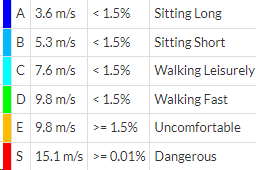
- Long-term sitting: speeds > 3.6 m/s less than 1.5% of the time.
- Short-term sitting: > 5.3 m/s less than 1.5% of the time.
- Strolling: > 7.6 m/s less than 1.5% of the time.
- Brisk walking: > 9.8 m/s less than 1.5% of the time.
- Uncomfortable: 9.8 m/s exceeded 1.5% of the time or more.
- Danger threshold: speeds > 15.1 m/s at least 0.01% of the time.
NEN 8100 criterion
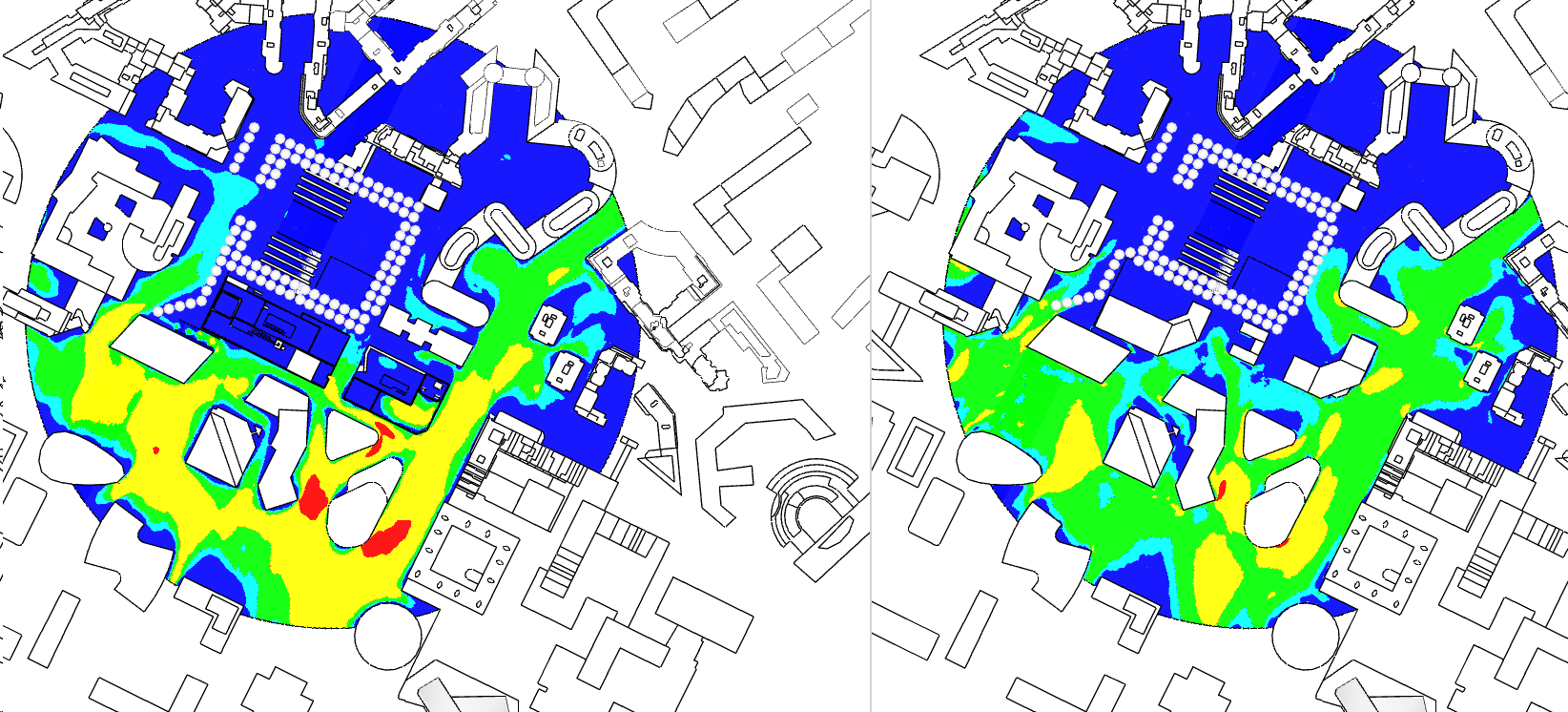
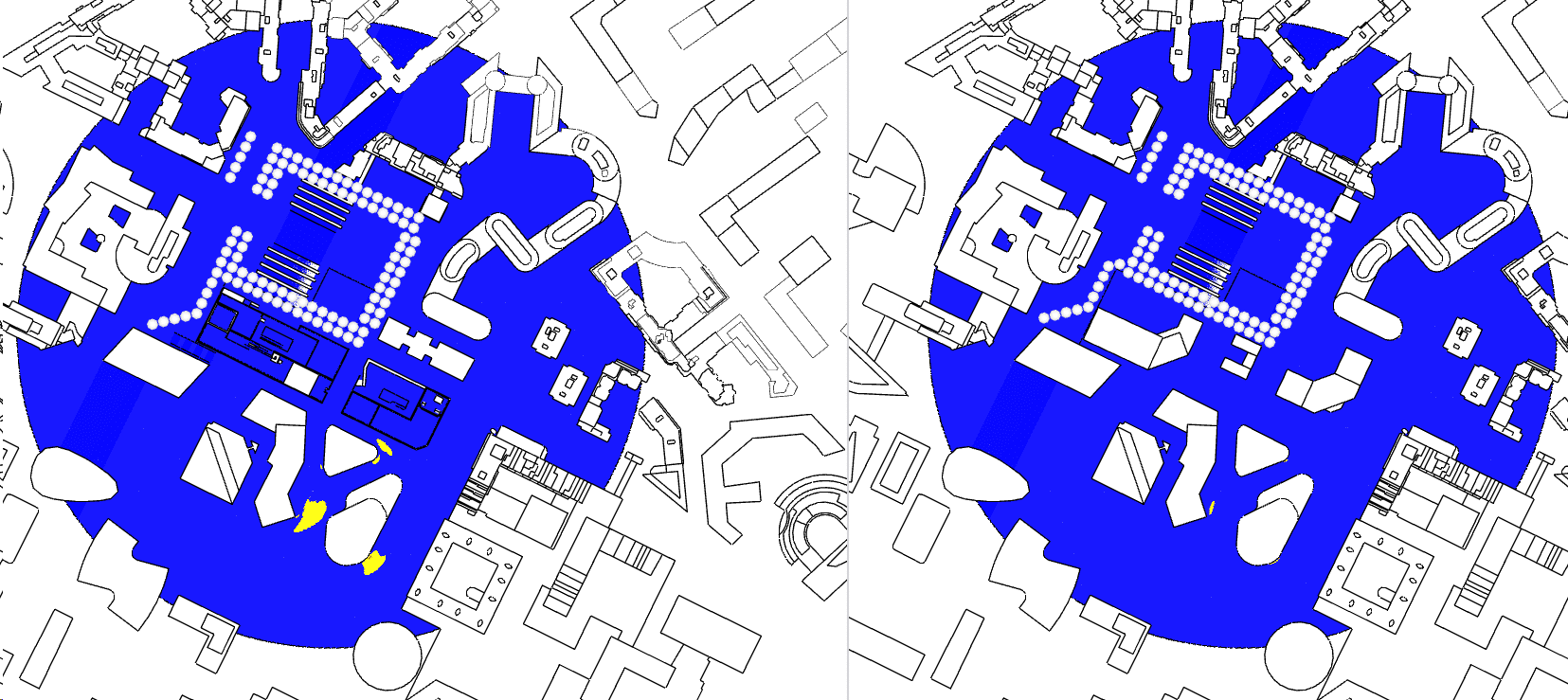
The NEN 8100 criterion was first proposed in 2005 by the Dutch standards institute (NEN). It sets a tolerance threshold speed of 5 m/s regardless of the activity, and is based on the probability of exceeding that speed. It is extended into a second criterion on the danger threshold speed, set at 15 m/s.
NEN 8100 — comfort (threshold 5 m/s, the probability varies)
- Long-term sitting: 5 m/s exceeded less than 2.5% of the time.
- Short-term sitting: 5 m/s exceeded less than 5% of the time.
- Strolling: 5 m/s exceeded less than 10% of the time.
- Brisk walking: 5 m/s exceeded less than 20% of the time.
- Uncomfortable: 5 m/s exceeded 20% of the time or more.
NEN 8100 — safety (threshold 15 m/s)
- No risk: 15 m/s exceeded less than 0.05% of the time.
- Limited risk: 15 m/s exceeded less than 0.3% of the time.
- Dangerous: 15 m/s exceeded more than 0.3% of the time.
Which criterion to choose?
Wind comfort and safety criteria vary according to the pedestrian activities and the standards used. It is important to choose the criterion appropriate to the study at hand: some standards focus on comfort, others on safety (sometimes both). For example, the NEN 8100 standard addresses either comfort or safety, while others (London LDDC, Davenport) take both into account.
It is essential to stress that when an area is considered dangerous, it is generally uncomfortable: excessive wind can cause objects to fall, difficulty walking or discomfort due to turbulence. The safety aspect is therefore directly linked to comfort: a dangerous area is necessarily uncomfortable, whatever the activity.
The thresholds also vary with the activity: for seated people they are set lower than for people on the move. Other factors also play a part: exposure time, the presence of obstacles, wind speed. All these elements must be taken into account from the design stage of buildings and public spaces, to create environments that protect users while ensuring their well-being and safety.
References
References
- [1] T.V. Lawson, The wind content of the built environment. J Ind Aerodyn, 3: 93-105, 1978.
- [2] A.G. Davenport, An approach to human comfort criteria for environmental wind conditions, Colloquium on Building Climatology, Stockholm, 1972.
- [3] A.G. Davenport, Approaches to the design of tall buildings against wind, Int. Conf. on Planning and Design of Tall Buildings, Lehigh University, 1972.
- [4] NEN, Wind comfort and wind danger in the built environment, NEN 8100 (Dutch standard), 2006.
Choice of criterion (London, Lawson, Davenport, NEN 8100), CFD comfort and safety mapping: our engineers support you.