
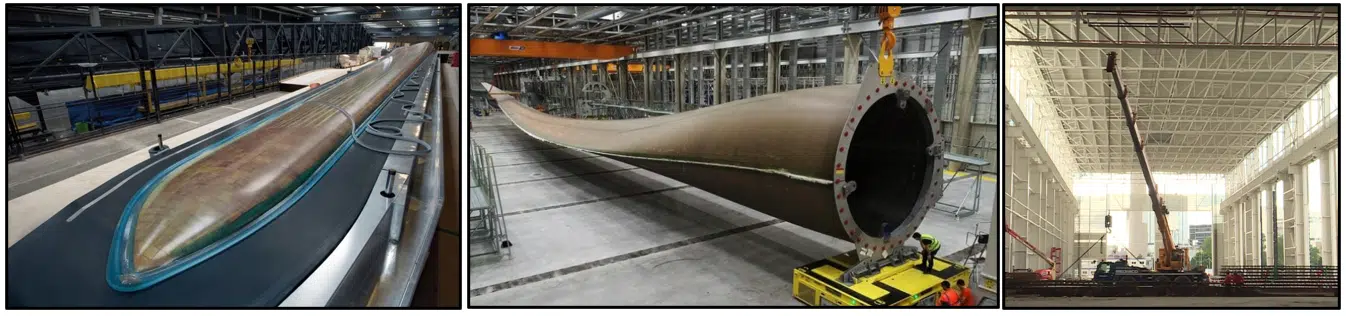
CFD study for climate control in extreme conditions of a wind-turbine production plant: comfort, air quality and humidity control.
EOLIOS's engineers carried out the CFD studies of a wind-turbine production plant (blade-manufacturing workshop), in Denmark, to ensure climate control in extreme conditions.
The air-distribution system determines the success of the installation: it influences the perception of comfort (warm/cold) and the indoor air quality (extraction of pollutants). It is also one of the leading sources of energy consumption. Air distribution and thermal comfort are governed by the ISO 7730 standard.
The aim: to simulate through numerical computation the thermo-airflow behaviour of the phenomena of the future wind-turbine design centre, limiting the air velocities in the occupied zones to values below 0.2 m/s.
In brief. A CFD study of the climate control of a wind-turbine blade plant in Denmark, in extreme conditions. EOLIOS simulates the thermo-airflow behaviour of the workshop to hold the distribution comfort in the sense of ISO 7730 (air velocities below 0.2 m/s under 4 m) and develops a dedicated methodology for evaporation and for maintaining the relative humidity required by the process.
A wind-turbine blade is a very long composite part, moulded by resin infusion over glass- or carbon-fibre reinforcements. The quality of the lay-up and the curing of the resin depend closely on the temperature and humidity of the workshop: a drift of a few degrees or humidity points changes the resin viscosity, the gel time and, ultimately, the mechanical properties of the blade.
To these process requirements are added health constraints (volatile-organic-compound emissions during infusion, sanding dust), safety, and above all size: a blade hall commonly exceeds several tens of metres in length and height. This volume makes the environment very sensitive to thermal stratification and draughts, which only tools such as CFD can anticipate finely.
A vacuum-moulding process where the liquid resin impregnates a dry stack of fibres. Success depends on a controlled viscosity and gel time, hence on a stable temperature and humidity in the workshop.
The chemical reaction that hardens the resin and fixes the mechanical properties of the part. Its kinetics depend on temperature: an uncontrolled environment degrades the homogeneity and repeatability of production.
Key point. The working window of a resin is narrow. Holding temperature and humidity across the whole hall, despite its height, directly conditions the quality of the blades produced.
To meet the requirements relating to air quality, thermal comfort, energy efficiency and humidity control, it is necessary to understand the mechanisms that shape the flow structure and to master the physical phenomena behind the heat and moisture transfers.
CFD provides a numerical solution of the equations governing the physics of the flow, studying the behaviour of the fluids as well as the heat and moisture transfer. The distribution comfort in the occupied zone is characterised by: the absence of strong temperature stratification, good indoor air quality, and the absence of draughts (target < 0.2 m/s below 4 m). The rising of the warm air in these large volumes relates to the thermal draught effect.
The international standard governing thermal comfort in moderate environments. It links temperature, humidity, air velocity and activity to the comfort indices (PMV/PPD) and sets the thresholds, including the draught limit in the occupied zone.
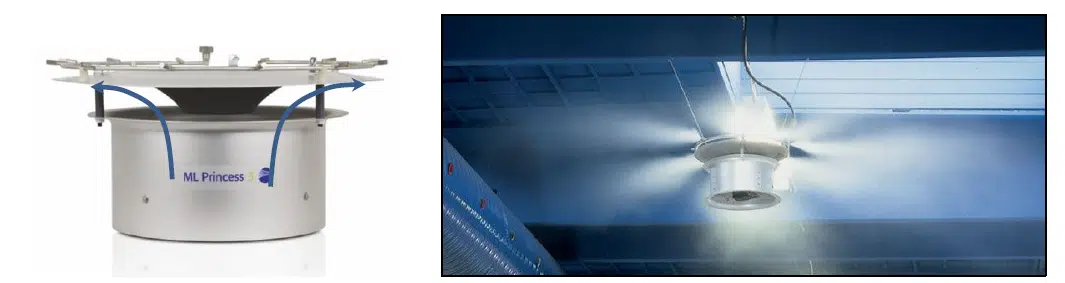
The air-distribution systems (destratification fans, supply) are "sub-modelled" in CFD in order to be faithfully integrated into the workshop, then the simulation reproduces the climatic conditions in the production workshop.
A simplified representation of a piece of equipment (destratification fan, supply diffuser) by its airflow effects rather than its detailed geometry. It faithfully integrates the distribution into the global model without weighing down the computation.
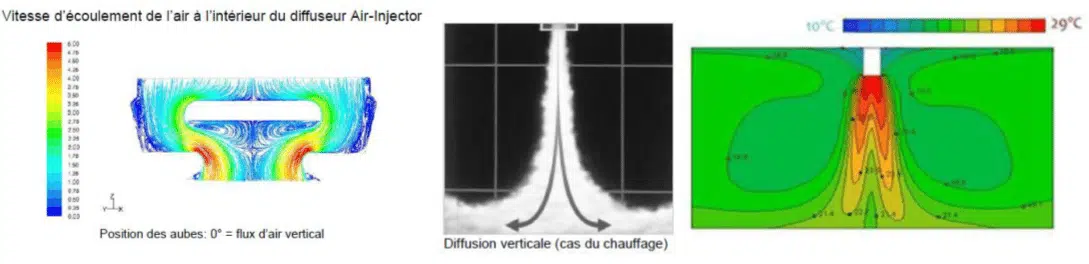
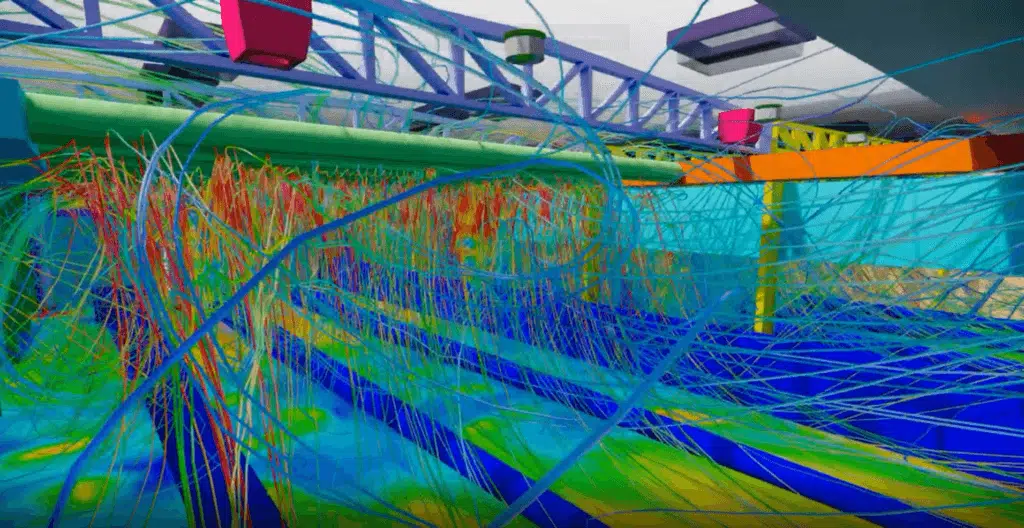
Modelling a workshop of this size calls for a rigorous method: every assumption (flow rates, supply temperatures, internal gains) is traced and validated before the results are used. The simulation does not replace the field survey, it extends it by exploring scenarios impossible to test at full scale.
The division of the air volume into computation cells. A fine mesh better resolves the gradients near diffusers and walls, at the cost of a higher computation time; the art lies in refining it where it matters.
Values imposed at the model boundaries (flow rates, temperatures, pressures, heat fluxes). They reflect the real operation of the systems and directly condition the fidelity of the results.
Maintaining a specific level of relative humidity is essential to the wind-turbine manufacturing process. EOLIOS developed a dedicated methodology, reusing the thermal calculation (gains / losses) with the simulated values of the project.
Assumptions: no moisture source other than the systems; zero specific-humidity gradient (impermeable surfaces); walls opaque to vapour migration; vapour-liquid interface at thermodynamic equilibrium (phase change at saturation, 100 % RH). The relative humidity is calculated from the temperature, the pressure and the specific humidity.
The ratio between the water vapour contained in the air and the maximum it can hold at a given temperature. Too low, it harms the process; too high, it favours condensation. Maintaining it is a key objective of the study.
The CFD simulations helped to optimise the design of the blade-production workshop by predicting the climatic conditions for different engineering scenarios. They made it possible to improve the overall efficiency of the processes and to reduce costs, by visualising the fluid dynamics in the workshop and by simulating ventilation, cooling and pollutant extraction.
Key point. In a large industrial volume, holding a distribution comfort (< 0.2 m/s) while controlling the process relative humidity requires trade-offs. CFD tests the distribution scenarios before the works to reconcile comfort, air quality and energy.
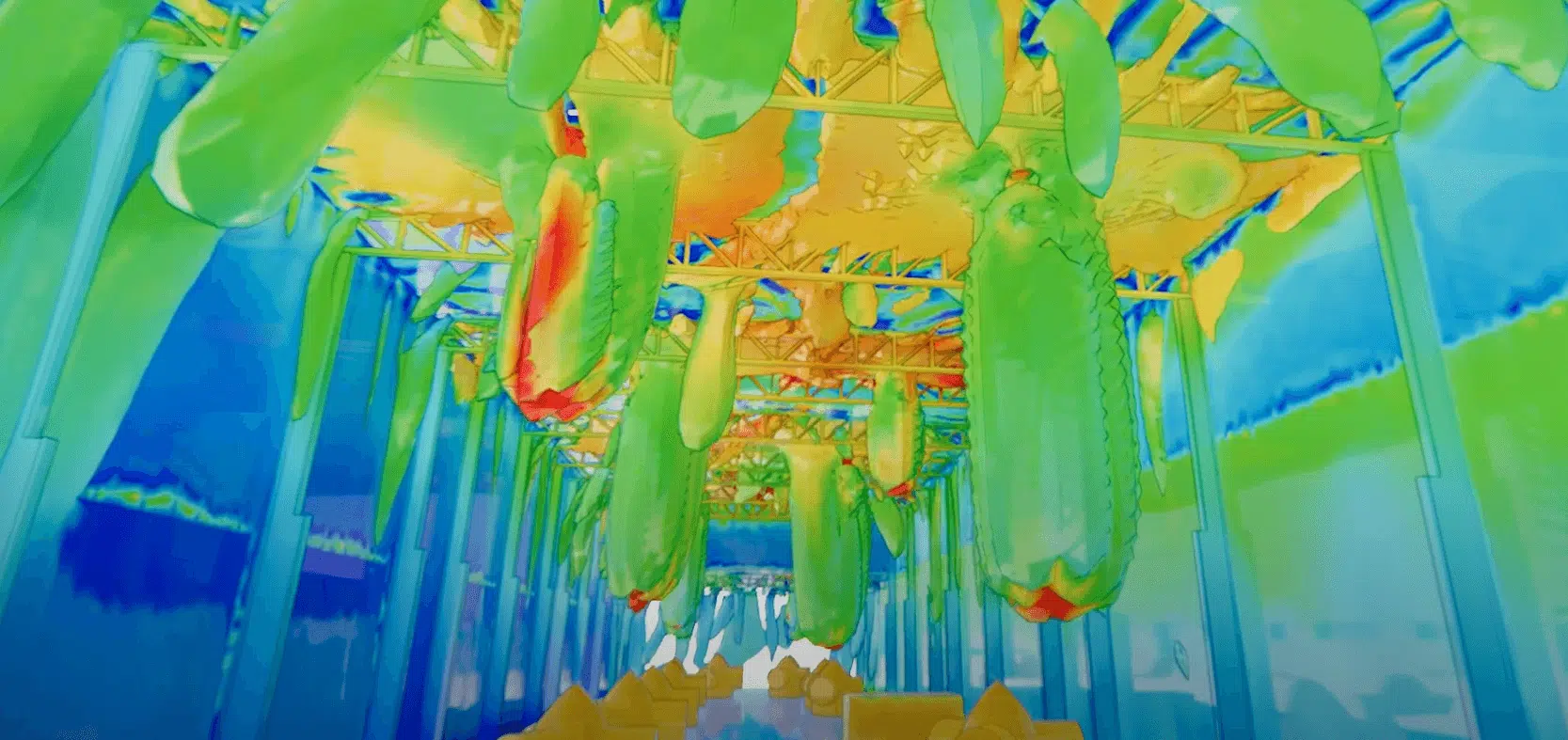
Heating, humidifying and mixing a very large volume has a cost. The challenge is not only to hold the set-points, but to hold them with the strictly necessary flow rate and energy. CFD, coupled with the thermal calculation, makes it possible to compare the levers and to avoid both over-ventilation and under-sizing.
The action of breaking the thermal stratification of a large volume to bring back down the warm air accumulated under the roof. It homogenises the temperature and reduces the heating needs in the occupied zone.
Cooling by outdoor air when it is cooler than the environment, without resorting to mechanical cooling. Under a northern climate, it covers a large part of the year and sharply reduces the energy bill.
Key point. In a blade hall, distribution comfort, humidity control and energy sobriety are decided together. Objectifying the flows through simulation makes it possible to arbitrate without over-sizing.
Distribution comfort, humidity and energy efficiency: the answers to the questions industrials and clients ask before a CFD study.
In a workshop of this size, the air stratifies and draughts are hard to anticipate. CFD simulates velocities, temperatures and humidity at every point to hold comfort and air quality, as on our medical-warehouse project.
It governs thermal comfort in moderate environments by linking temperature, humidity, air velocity and activity to the PMV/PPD indices. It notably sets the draught limit in the occupied zone, targeted here at below 0.2 m/s under 4 metres.
EOLIOS developed a dedicated methodology coupling the thermal calculation (gains and losses) with the simulated values, with a phase change at saturation. The relative humidity is deduced from the temperature, the pressure and the specific humidity, to hold the level required by the process.
It is a simplified representation of the destratification fans and supply diffusers by their airflow effects rather than their detailed geometry. It faithfully integrates the distribution into the global model while keeping a manageable computation.
Velocity, temperature and humidity maps for different engineering scenarios, making it possible to optimise the workshop design, improve process efficiency and reduce costs before construction.
Explore our expertise, projects and technical papers to go further than the FAQ.
CFD study for climate control in extreme conditions of a wind-turbine blade production plant: modelling of the distribution systems, evaporation and relative-humidity methodology, and prediction of the climatic conditions for different scenarios, in service of comfort (ISO 7730), air quality and energy efficiency.
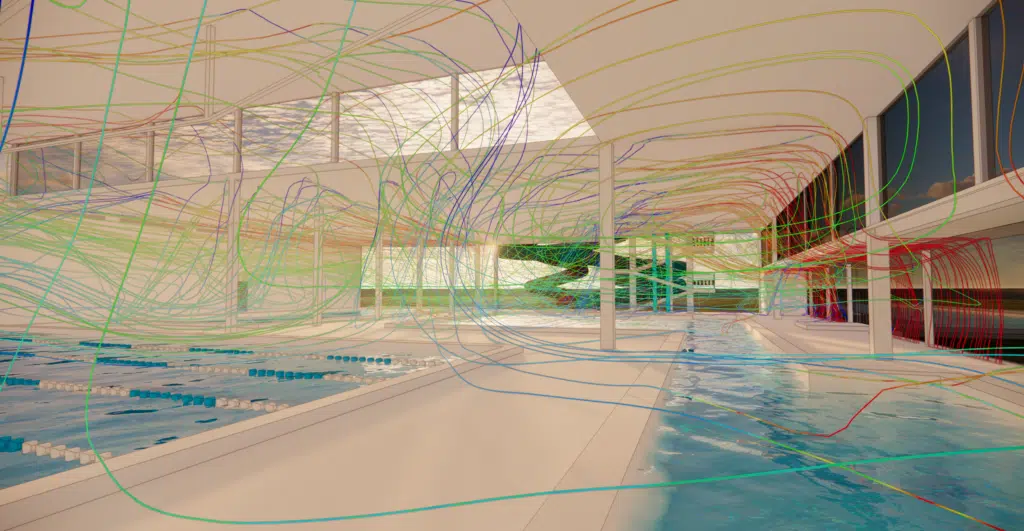 PoolAquatic Center — Hauts-de-Seine
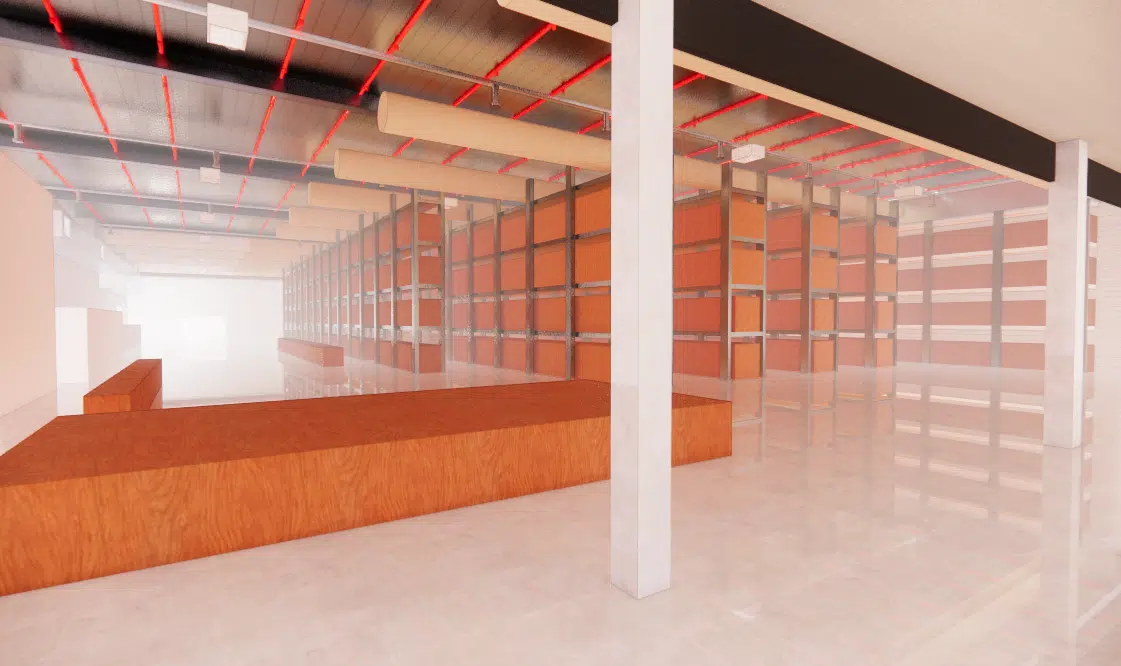 WarehouseHVAC engineering — Medical warehouse
 HotelSharaan by Jean Nouvel
 MuseumGallery of Palaeontology — MNHN
 PoolSwimming pool — Montreuil
 IndustryPharmaceutical plant — HVAC
 Natural ventilationPrototype — Natural-ventilation chimney
 Cold roomCold room — Leipzig
 Sport / ArenaPalais Omnisports de Paris-Bercy
 Cold roomCold room — Resurfacing
 Atrium · 🔒Glass-roof comfort — Atrium
The simplest thing is to talk it through together. Our engineers reply with an initial technical read.