
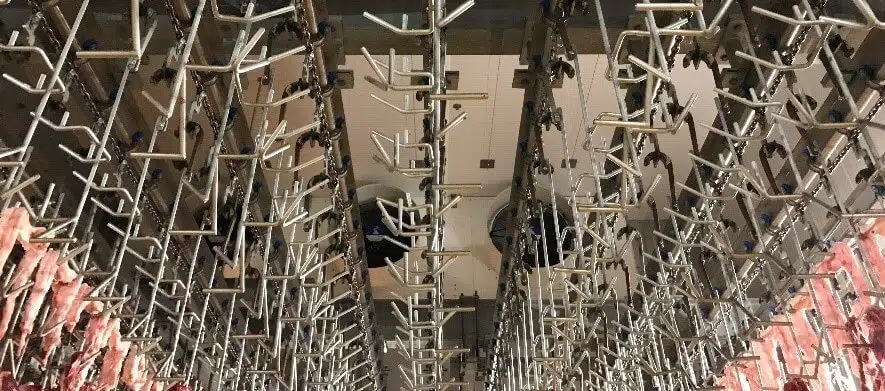
CFD study of the climatic conditions of a meat-chilling cold room: optimising air distribution for the cooling of foodstuffs.
EOLIOS drew up an assessment of the climatic conditions of a meat-chilling cold room: the air mixing could be improved to promote the cooling of the foodstuffs. The aim of the study is to optimise the air distribution in the room, using CFD simulation.
The cold rooms of the meat industry aim to place the products in suitable temperature conditions and to maintain a favourable relative humidity, both to reduce weight loss and to limit microbial spoilage.
The whole challenge: to reconcile sufficient mixing to allow cooling and homogenisation, with low enough air agitation to avoid excessive water loss.
In brief. A CFD study of a meat-chilling cold room, in an ambient at 0 °C, to reach a 4 °C core temperature. The simulation reveals two recirculation loops that leave carcasses insufficiently mixed at the centre, with heat stagnation. EOLIOS designs a bespoke distribution system to homogenise the mixing right to the heart of the carcasses, without increasing water loss.
The chilling is characterised by a massive removal of heat accompanied by slight evaporation. It aims to quickly lower the surface temperature of the carcasses, preventing the proliferation of germs and reducing water loss by evaporation. The ambient temperature is around 0 °C and the carcasses stay there 4 to 6 hours.
The air has a dual function: to provide the mixing and to convey the cold. Good cooling must make it possible to obtain a low core temperature (target: 4 °C), which depends on the initial temperature of the foodstuff, its mass, the chilling and storage temperature, and which determines the shelf life.
The rapid cooling phase after slaughter: the carcasses spend a few hours in a cold ambient to lower their surface temperature, slow microbial growth and limit water loss before storage.
The temperature at the centre of the foodstuff, the slowest to drop. It is this, and not the surface temperature, that governs food safety and shelf life; reaching it requires an airflow that penetrates to the heart of the carcasses.
A good arrangement of the carcasses promotes ventilation and the penetration of the cold. Conversely, many shelves without carcasses (especially in the axis) are unfavourable: the air tends to concentrate in the empty zones. The rows of carcasses create greater resistance, reducing the effectiveness of the mixing in these zones.
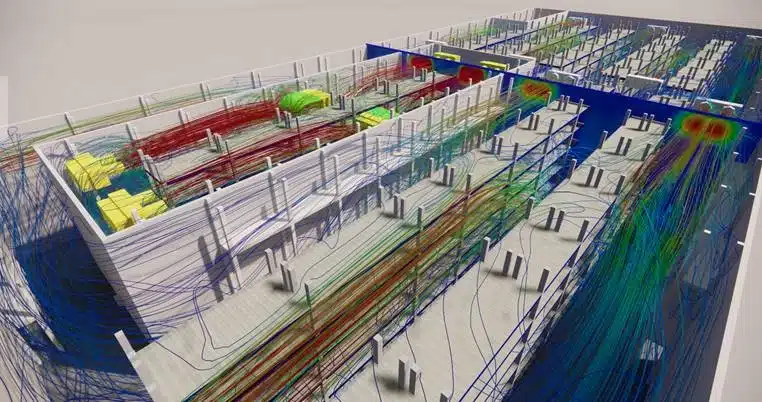
The air movements are made up of two opposing loops driven by the distribution from the evaporator fans. These loops generate high velocities on a vertical axis at the centre of the room, and at floor level. By contrast, at the heart of the carcass zone (centre of the recirculation loops), the air velocities are much lower. The rising of the air, driven by density differences, also relates to the thermal draught effect.
The closed circuit described by the air driven by the evaporator fans. Useful for mixing the volume, it leaves a slow zone at its centre where the air stagnates: this is where the carcasses are least well cooled.
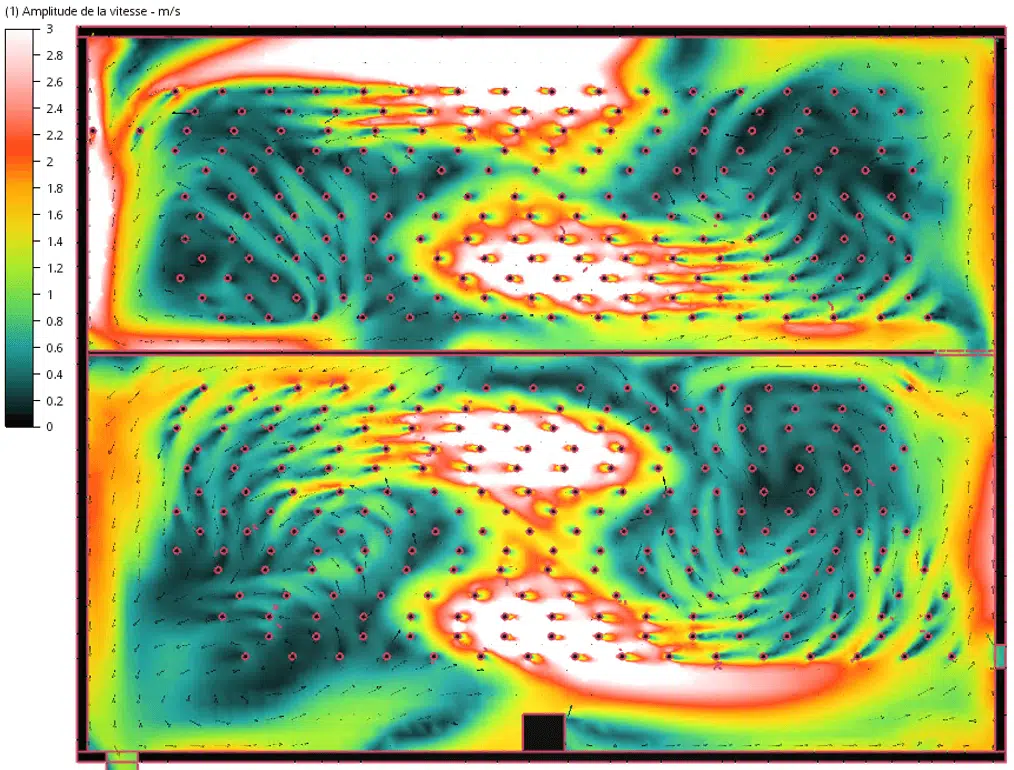
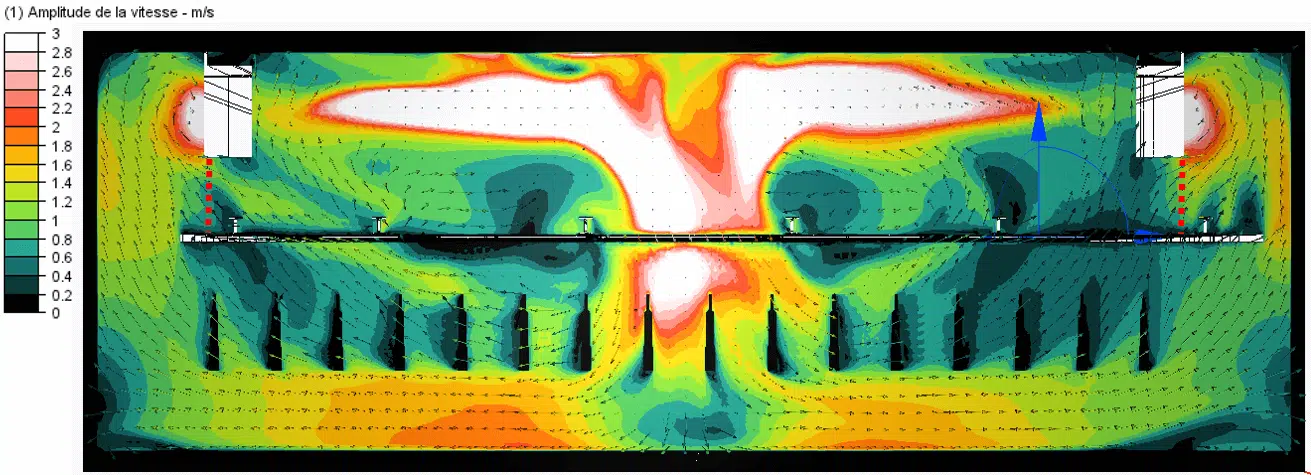
Not all the carcasses are mixed at the same speed: those located at the centre of the loops end up insufficiently mixed. This reduced mixing causes a stagnation of heat at the surface of the carcasses, decreasing the convective exchanges. The recirculation phenomena also cause a looping-back of heat in the low-velocity zones, hence a slight local rise in temperatures.
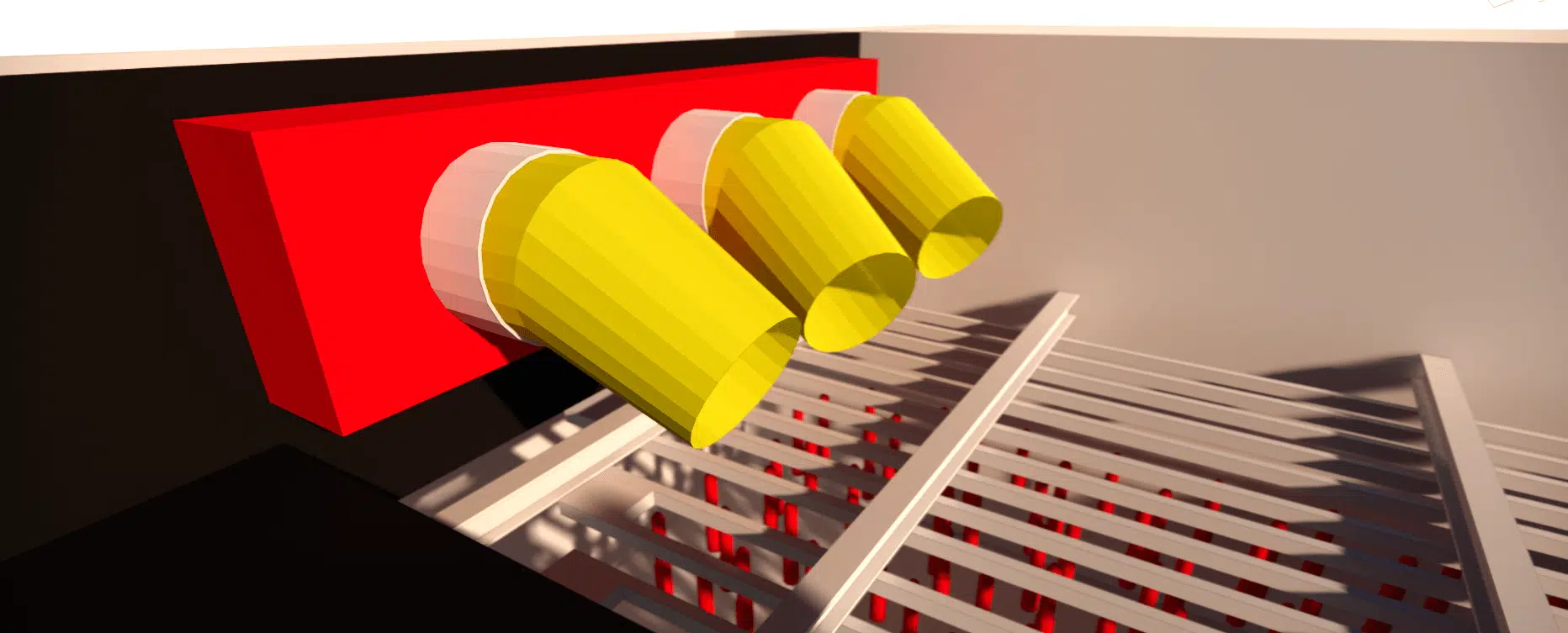
In the end, EOLIOS designed a bespoke system to improve the cooling conditions of the foodstuffs in the cold room, guaranteeing a homogeneous mixing right to the heart of the carcasses.
Key point. In chilling, more mixing is not always better: the core of the carcasses must be reached without drying out their surface. CFD locates the slow zones and targets the distribution where it is lacking, rather than increasing the overall flow rate.
Core cooling, mixing and water loss: the answers to the questions industrials and cold operators ask before a CFD study.
Chilling is the rapid cooling phase after slaughter: the carcasses spend 4 to 6 hours in an ambient at 0 °C to lower their surface temperature and slow microbial growth. CFD checks that the airflow reaches the core of the foodstuffs, as on our other cold-room studies.
The air describes two recirculation loops driven by the evaporator. At their centre, the air velocities drop: the carcasses there are insufficiently mixed, heat stagnates at the surface and the core temperature falls more slowly.
No. Too much air agitation dries out the carcasses and increases weight loss. The challenge is to reconcile enough mixing to cool with a velocity low enough to limit evaporation; the simulation helps to find this balance zone by zone.
A good arrangement promotes the penetration of the cold. Conversely, empty shelves in the axis let the air concentrate in the free zones, while full rows create resistance and reduce the mixing. CFD tests these configurations before operation.
Air-velocity and temperature maps, the identification of the slow zones, and the design of a bespoke distribution system guaranteeing a homogeneous mixing right to the heart of the carcasses, without increasing water loss.
Explore our expertise, projects and technical papers to go further than the FAQ.
CFD study of a meat-chilling cold room (meat industry): analysis of the recirculation loops and the low-mixing zones that slow the core cooling, and design of a bespoke distribution system to homogenise the mixing while limiting water loss.
 PoolAquatic Center — Hauts-de-Seine
 WarehouseHVAC engineering — Medical warehouse
 HotelSharaan by Jean Nouvel
 MuseumGallery of Palaeontology — MNHN
 PoolSwimming pool — Montreuil
 IndustryPharmaceutical plant — HVAC
 Natural ventilationPrototype — Natural-ventilation chimney
 Cold roomCold room — Leipzig
 Sport / ArenaPalais Omnisports de Paris-Bercy
 IndustryPlant — Wind turbine
 Atrium · 🔒Glass-roof comfort — Atrium
The simplest thing is to talk it through together. Our engineers reply with an initial technical read.