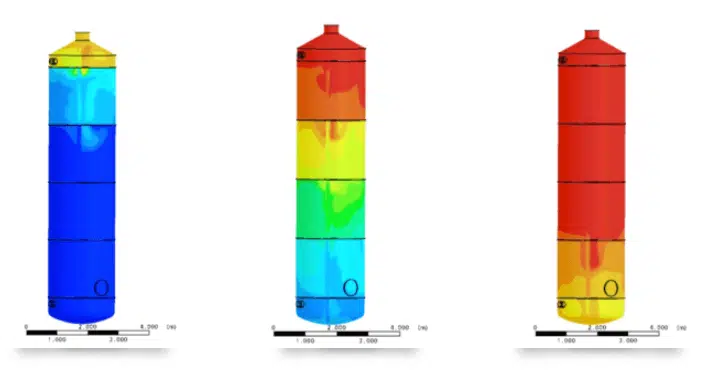
EOLIOS Ingénierie designed an inertia-based thermal storage system to recover the waste heat from a heat pump.
As part of the design of an inertia-based thermal storage system, the EOLIOS Ingénierie team optimised a hot-water storage tank by CFD simulation. The first objective of the study was to examine a full storage / discharge cycle of the water produced by an energy-recovery system from a chiller. Based on the technical characteristics of the heat source, the charging / discharging times could be established according to the various buffer volumes stored.
The essentials. To recover the waste heat of a chiller, EOLIOS optimised by CFD a hot-water storage tank paired with a heat pump. The study simulates a full charging and discharging cycle and targets the quality of the stratification: preserving the thermocline, sizing the trays and the phase-shifting. The tank was optimised with trays that promote stratification, then with a transfer device designed by EOLIOS and filed as a patent.
The thermocline is a layer of water at a certain depth whose temperature differs from the water above and below it. In a hot-water tank, it forms between the hot water at the top and the cooler water at the bottom: it is an invisible layer that separates the two volumes of water by temperature.
The thermocline is essential because it helps keep the hot water at temperature for longer. The aim is heterogeneous storage to optimise the phase-shifting. If this layer is disturbed, the thermal stratification is not perfect, leading to heat losses and unnecessary energy consumption. A well-optimised tank allows the heat pump to operate more efficiently and produce more heat at lower cost.
Thermal stratification stacks the water by density: hot and light at the top, cold and dense at the bottom. It is the same buoyancy driver as the thermal draught effect. Preserving this stratification, by limiting mixing, keeps the hot water available for longer.
The trays that limit the mixing of the water are important because they prevent the formation of overly homogeneous hot and cold layers. They improve the efficiency of the heat pump by reducing heat losses and keeping the water temperature at an optimal level. These trays must be designed according to the tank charging speed: the shorter the time between cycles, the smaller the trays must be to prevent homogenisation. They also depend on the type of heat pump used, some requiring wider trays than others.
Phase-shifting is a technique that regulates the heat flow between the storage tank and the thermal source. It consists of controlling the duration and intensity of the hot-water pumping to maintain an optimal temperature. This process makes it possible to reduce energy consumption and maximise the efficiency of the heat pump. Thermal storage keeps the heat for longer, reduces consumption peaks, allows more favourable tariffs to be used, and helps recover waste heat.
Phase-shifting is the time lag between when the heat is produced, while the waste heat is available, and when it is used. The tank stores during this lag; well sized, it smooths the peaks and lets the heat pump run at its best efficiency.
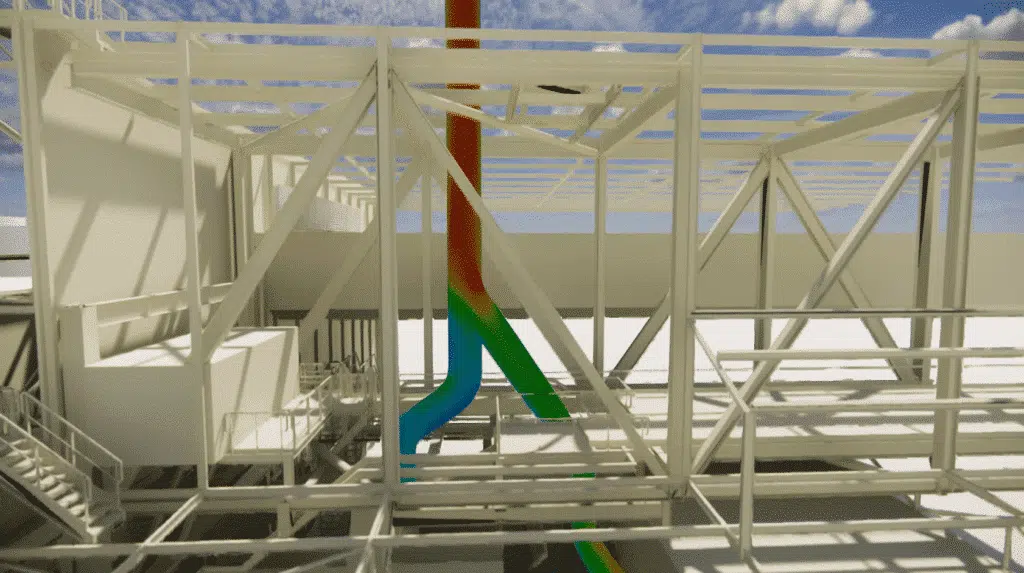
From these initial sizing elements, EOLIOS Ingénierie ran transient CFD simulations of the tank's charging / discharging cycle. These time-resolved studies revealed the temperatures of the water drawn from the tank, so as to optimise the air / water heat pumps supplied by the storage tanks.
The tank design was then optimised by introducing trays that promote thermal stratification, and then by designing a transfer device conceived by the EOLIOS team. This stratification-promoting system is the subject of a patent application by the EOLIOS team.
Waste heat is the thermal energy produced by a process without being its purpose, here the heat rejected by a chiller. Rather than dissipating it, it is recovered and stored for later use, which improves the overall energy balance.
Key takeaway. A good storage tank is judged not by its volume but by its stratification: it is the sharpness of the thermocline that decides how much heat is actually available. Transient CFD is precisely what checks that it holds cycle after cycle.
Thermocline, stratification trays and waste-heat recovery in a storage tank paired with a heat pump.
It is the transition layer that separates the hot water, at the top, from the cold water, at the bottom. The thinner and more stable it is, the better the hot water stays at temperature; if it disperses through mixing, the heat dilutes and is lost.
Well-stratified water returns cold water to the heat pump, which then runs at better efficiency, and delivers hot water at a stable temperature on the use side. Homogeneous storage would degrade both.
They limit the mixing between the hot and cold layers. They are sized according to the tank's charging speed and the type of heat pump: closer cycles, smaller trays; some pumps need wider trays.
It is the lag between the production and the use of the heat. The tank stores the energy during this lag, reduces consumption peaks, allows more favourable tariffs and recovers the waste heat.
The tank's behaviour changes over the charging and discharging cycle. Transient CFD follows this evolution over time, gives the temperatures of the water drawn at each moment and makes it possible to test trays and transfer device before manufacturing.
Explore our expertise, projects and technical papers to go further than the FAQ.
The thermocline is an invisible layer that separates the water in a tank by temperature; it is decisive for keeping hot water for longer and regulating energy consumption. Thermal storage also serves to optimise the efficiency of a heat pump and reduce consumption peaks. Phase-shifting regulates the heat flow between the tank and the source; perfect stratification is needed to maximise efficiency and reduce losses. Below is the summary of the studies that led to the design and optimisation of a storage system based on waste heat.
The simplest thing is to talk it through together. Our engineers reply with an initial technical read.