The laboratory fume hood and its regulatory context
EOLIOS carries out the design-stage pre-qualifications of your fume hoods as well as the containment tests, through CFD modelling.
Control
- Contamination control
- Dispersion of pollutants & gases
- Design of laboratory rooms
Analyse
- Critical failure scenarios
- Bypass & recirculation flows
- Airflow distribution & cooling
Optimise
- Precise grille layout
- Thermal-comfort optimisation
- Air-handling set points
Context
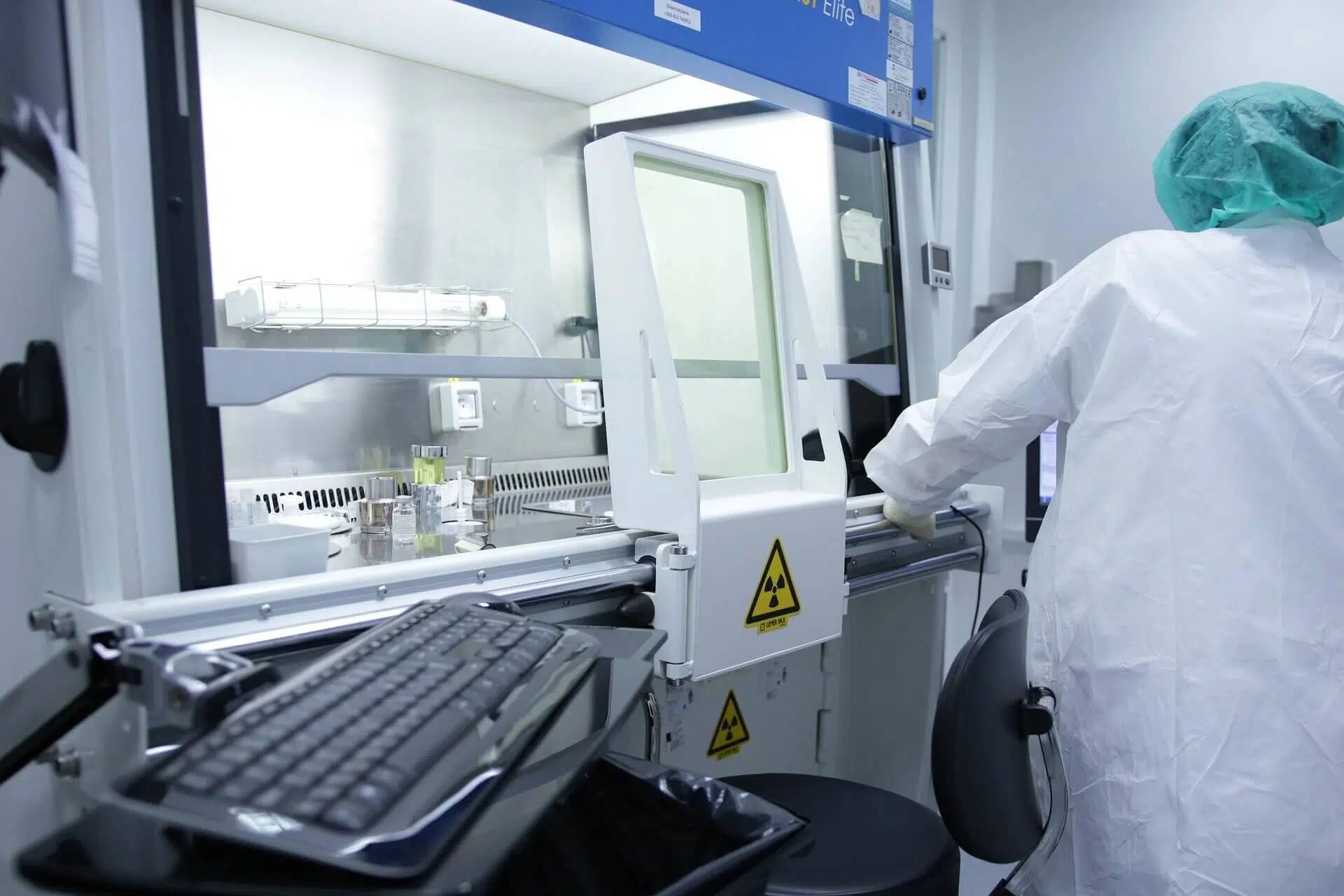
The laboratory fume hood is a local-protection system, used wherever dangerous substances are handled. Its mission is to limit human exposure to harmful substances by capturing and removing the toxic vapours and volatile dust generated in its enclosure, thanks to an air-extraction flow. To maintain their performance over time, fume hoods are subject to periodic checks.
Current French legislation
The assessment of fume-hood operation is governed by the European EN 14175 standard, which details the methodology for assessing performance during qualification, acceptance or routine tests. During a check, face air velocity tests at the fume-hood opening are carried out by hot-wire anemometry; an SF6 tracer-gas containment test is performed, as well as a qualitative smoke flow visualisation.
Former regulation: the XP X 15-203 standard
In France, for fume hoods installed before 2006, the checks had to comply with the French XP X 15-203 standard, which set thresholds for face air velocity and containment levels:
- Face air velocity: 0.4 m/s;
- Containment: tracer-gas concentration in the opening plane below 0.1 ppm at every point.
The EN 14175 standard: new airflow-test parameters
The threshold values to comply with
- Face air velocity: no threshold value in the standard, but 0.4 m/s in France;
- Containment: no threshold in the standard, but the French XP X 15-206 standard, developed as a complement, sets 0.1 ppm for the average concentration of SF6 tracer gas (sulphur hexafluoride);
- a much higher number of tested parameters.
The mandatory checks
- Extracted air flow rate: measured in the extraction duct to check the airflow characteristics and serve as a reference for future checks;
- Face air velocity: measured by thermal anemometry, reference values for the periodic checks.
Containment: the SF6 tracing measurement
The principle of the SF6 gas containment test takes place in three stages:
- generate SF6 tracer gas at specific locations inside the working volume;
- sample the air at various locations, at the opening plane of the fume hood;
- measure the SF6 concentration to quantify the leakage of substances towards the staff.
For the NF EN 14175 standard, the number of measurement points depends on the width of the fume hood; its part 3 specifies the calculation of the test positions. During the tests, the sash is opened to 500 mm.
CFD modelling of laboratories and cleanrooms
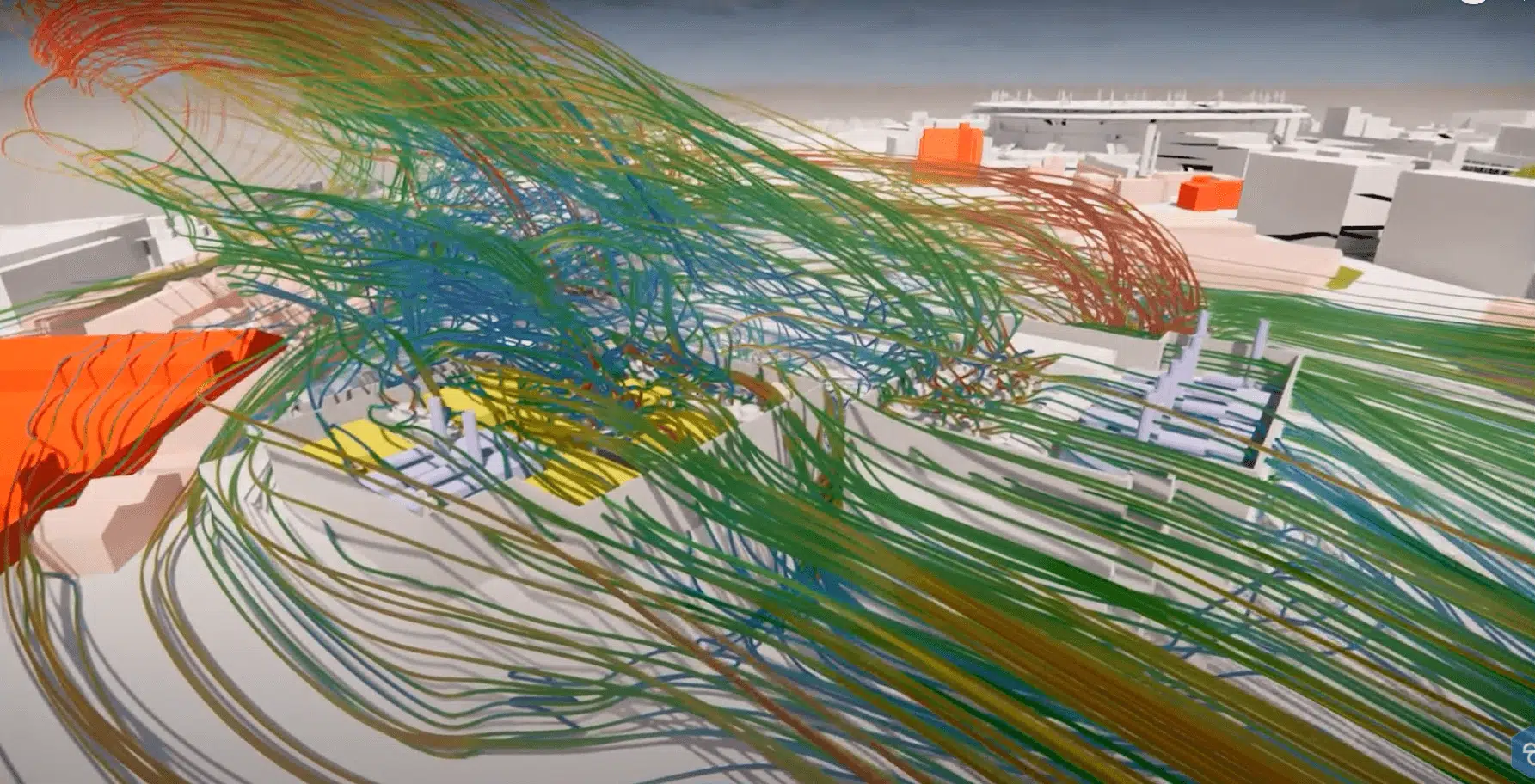
Overall understanding of the thermo-airflow phenomena
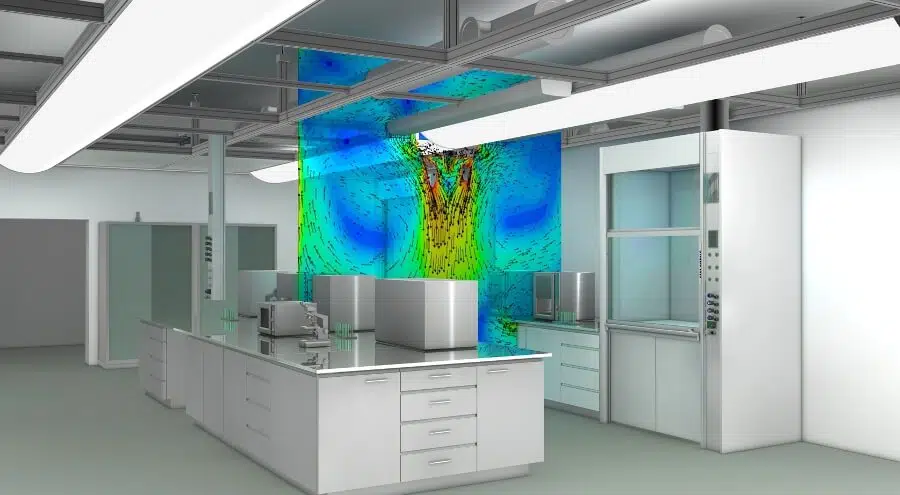
The simulations contribute to a better understanding of the issues in order to develop relevant technical solutions from the design stage. Laboratories can be simulated in their entirety, allowing the simultaneous analysis of the impact of many phenomena. The CFD fume-hood-qualification study notably highlights the presence of parasitic airflows disturbing the fume-hood opening.
Project: CFD simulation of a laboratory equipped with fume hoods
Design of laboratory rooms and cleanrooms
At the start of the design, multiplying experimental prototypes quickly becomes costly and time-consuming. CFD simulation makes it possible to test a large number of prototypes in a short time, in order to quickly gather information for the optimisation of the systems and the placement of the fume hoods.
CFD: a new design protocol
The simulation gives access to many parameters that are difficult to measure experimentally: it instantly provides data at every point, rather than in a localised way. This makes it possible to precisely identify the leaks during containment. Integrating CFD into your protocols means adding an expert eye to the search for solutions: fume-hood qualification is thereby secured and accelerated.
A CFD method for fume-hood qualification
Airflow modelling
For an instantaneous spatial measurement of the air velocity, we use precision fluid mechanics. The flows involved are governed by the Navier-Stokes partial differential equations; insoluble analytically, they are solved numerically by the finite-element method, which provides the closest possible solution. This resolution requires knowing the inlet and outlet conditions in advance — the supply, return and extraction flow rates of the fume hoods —, specified as assumptions and necessarily verified for the conclusions to be valid.
Numerical containment measurement
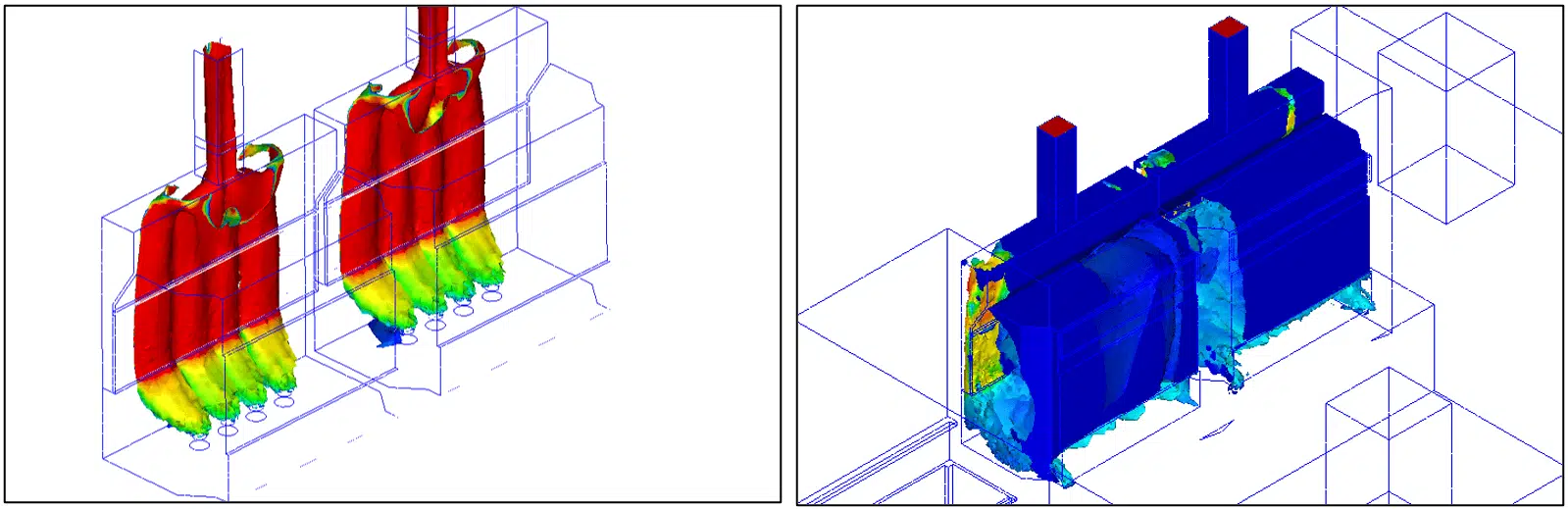
During qualification, it is imperative to control the leak rate of the polluting agents so as not to contaminate the user. To model this agent, we use various methods of simulating a tracer gas in order to guarantee fine precision and reliable results.
Numerical validation of the qualification
To check the compliance of the containment with the standard, we model the diffusion of the tracer in the fume hood under steady-state conditions. An iso-volume method then confirms that all the tracer is indeed contained within the enclosure at the regulatory scale: if the result is verified, the fume hood meets the containment conditions imposed by the legislation.