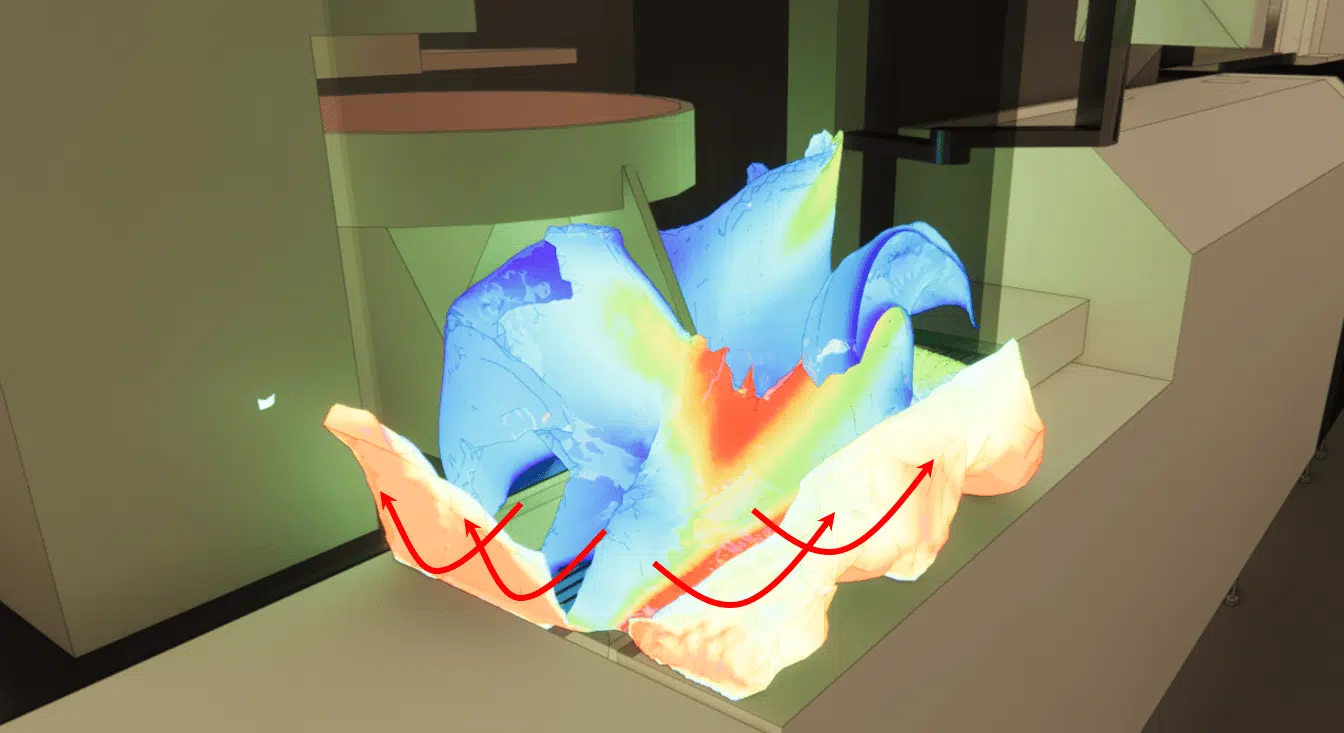
EOLIOS studied through CFD the concentration and distribution of medicine dust in a pharmaceutical cleanroom, in order to assess the contamination risk between production lines and to size an extraction system.
EOLIOS Engineering studied the concentration and distribution of the particles in the production line as well as in the hall. These studies made it possible to assess whether there is contamination between the two production lines and to develop an extraction system for the medicine dust.
The essentials. For IPSEN, EOLIOS studied through CFD the concentration and distribution of medicine dust in an 832 m³ cleanroom. An on-site smoke audit, CFD particle tracing and velocity surveys located the leaks of the production lines and the contamination risk, then sized extraction systems, validated by an acceptance smoke test.
First, in order to reproduce the phenomena observed by the teams on site, our team of engineers carried out a series of on-site surveys to model the equipment as precisely as possible. These surveys are decisive for assessing the various parameters and phenomena that may occur within the room, and provide the airflow trends precisely.
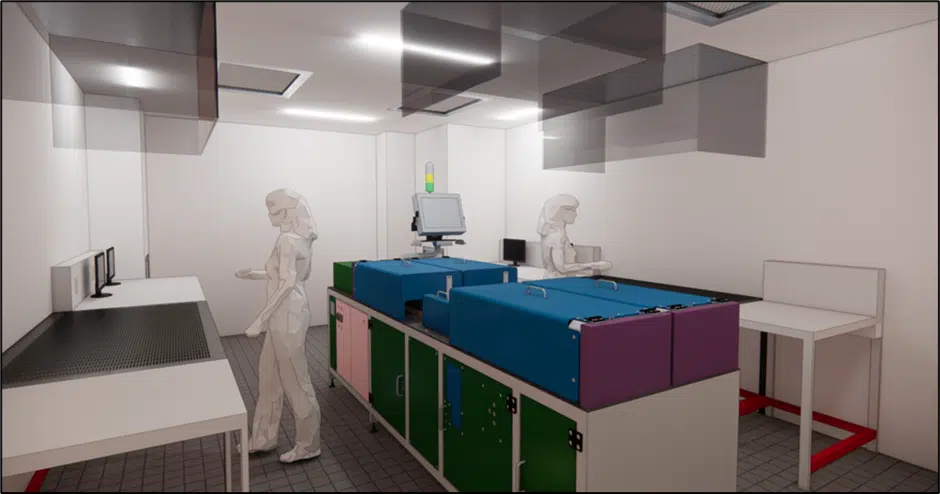
The cleanroom where the production takes place is a room of 832 m³. The presence of 4 openings is noted. The supply is provided by 8 nozzles located in the ceiling; the extract is provided by 16 nozzles located at the back of the room.
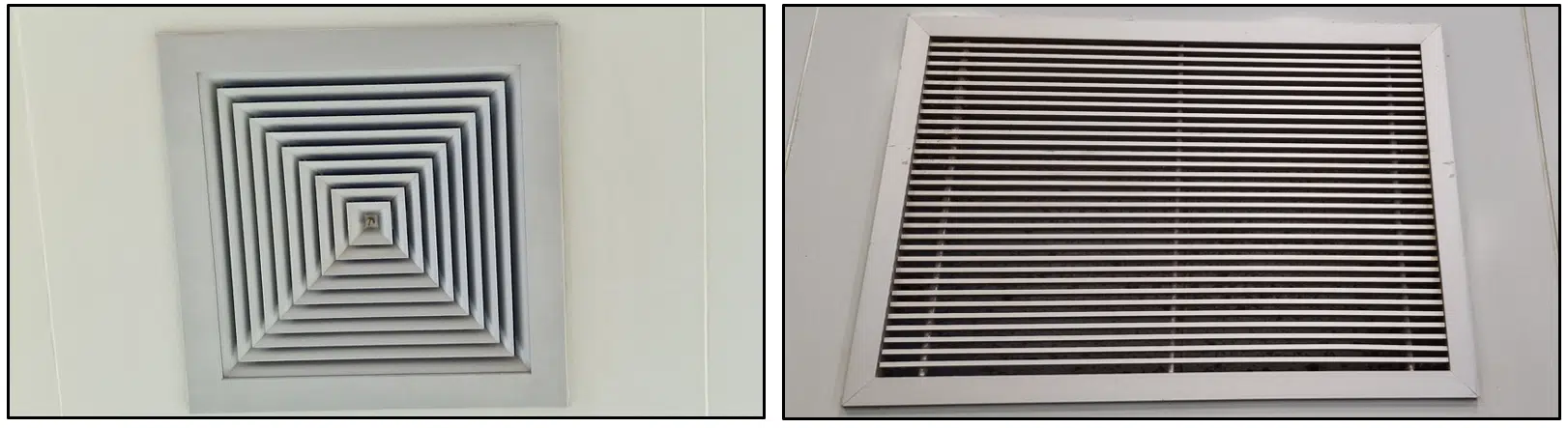
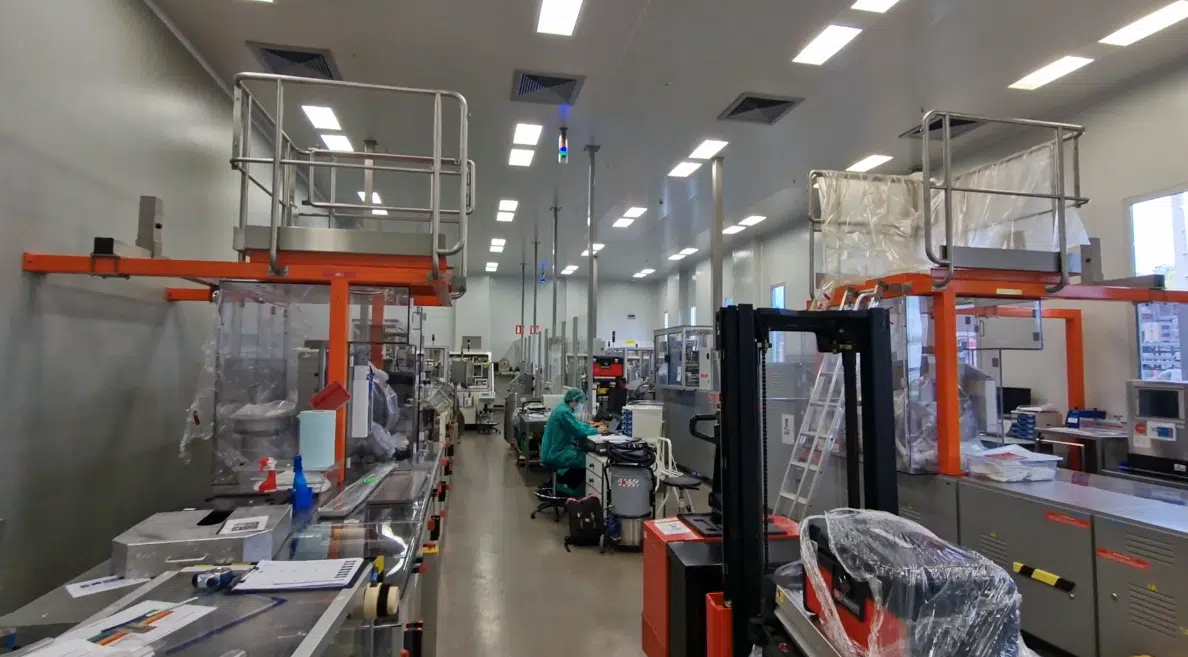
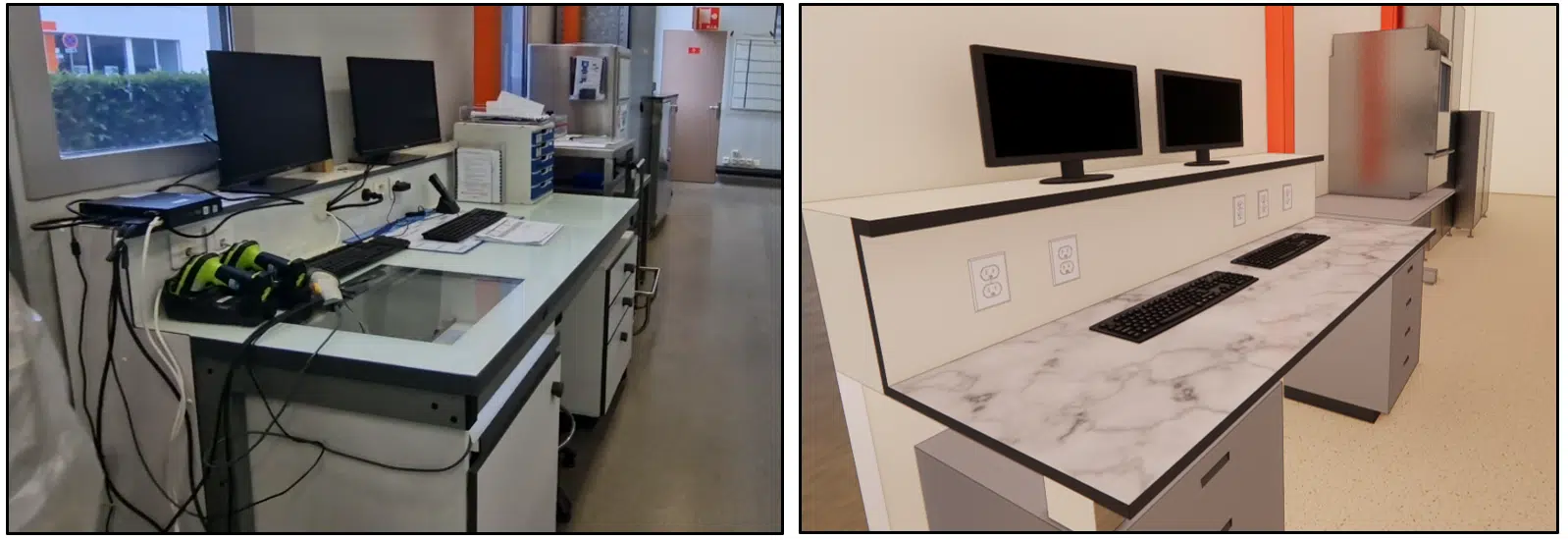
The production line is made up of different modules allowing the product to be boxed. Each element was modelled to scale in order to provide maximum precision. The elements external to the line — but acting as an airflow obstacle and potentially influencing the air movements — were also surveyed to be modelled to scale.
An airflow mask is an obstacle, furniture, machine or partition, that deflects or slows the air and creates behind it low-velocity or recirculation zones where particles can accumulate. It is modelled to scale to reproduce these effects.
The tests carried out aim to assess the overall airflow movements in the production room in order to identify certain particular phenomena: air recirculations, outgoing or incoming leaks of the production lines, and particular air movements between the supply and the extract at the back of the room.
Our thermo-airflow engineers also carried out a series of air-velocity measurements at various points in the room, in order to relate the simulation results to the conditions recorded on site.
During the tests, the outlet of the smoke machine was oriented in the direction of the flow; it was then necessary to wait a few seconds for the flow to stabilise in order to capture the various phenomena as precisely as possible. It is noted that the air at the circulation level does tend to reach the extracts in a laminar way. However, the smoke tends rather to rush through the gap between the partitions separating the two production lines, rather than heading towards the nearest extracts.
A smoke test injects a neutral smoke into the air to make the real flows visible: flow direction, recirculations, leaks. It calibrates the CFD model on the observed behaviour and also serves as an acceptance check after works.
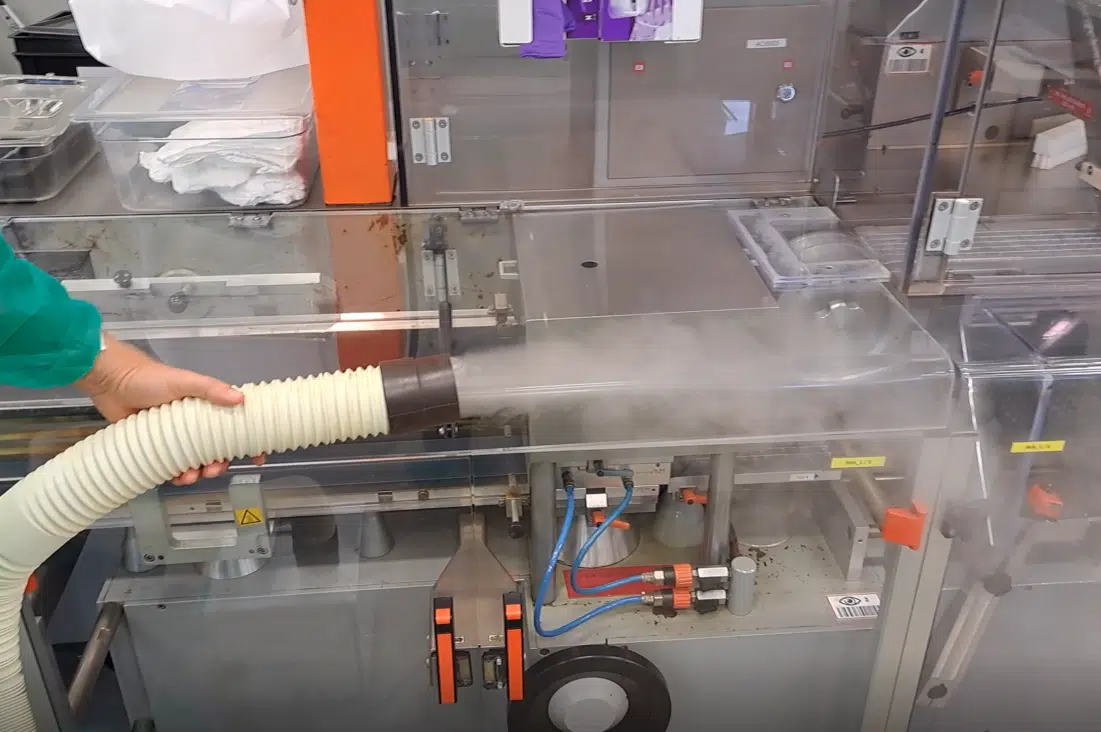
To assess the main air leaks of the production line, the smoke machine was positioned in the enclosure of the pill-dispensing zone, then filled with smoke. The zones where the leaks are highest are then easily distinguished — essentially at the door and the brush.
The velocity plans highlight the overall dynamics of the airflows in the hall: higher velocities on the left side (supply zone) and lower on the right side (extract zone). The overall velocities in the room are of the order of 0.2 m/s, with low-velocity zones behind the equipment forming airflow obstacles — including a recirculation at the opening between the two partitions, already spotted during the smoke test.
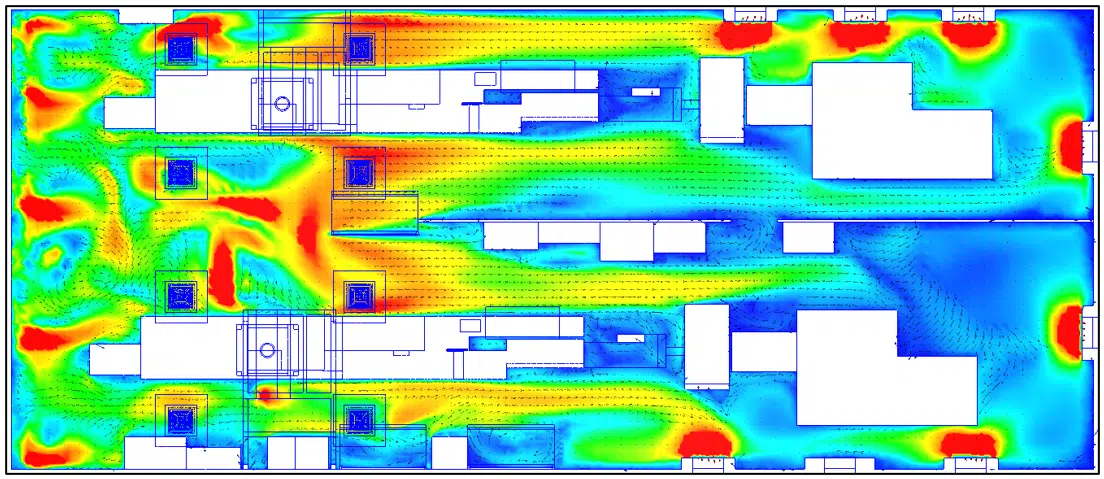
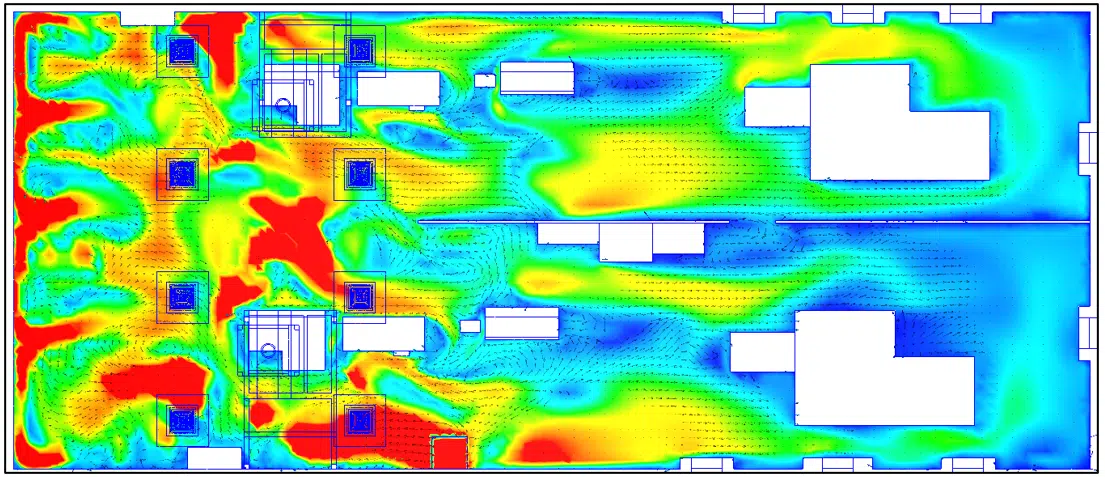
The dust-emission zones were calibrated according to the observations of the technicians on site. 3 main zones are noted: the tank, the rail-filling arm and the sorting brush. The CFD tracing highlights two main dust-leakage zones towards the outside of the machine, highly localised (slight openings at the doors or the gaps between modules). Despite their small proportion, these leaks represent a contamination risk.
Particle tracing numerically follows dust emitted at precise points to visualise its path, its concentration and the leakage points out of the machines. It quantifies the contamination risk and guides the placement of the extractions.
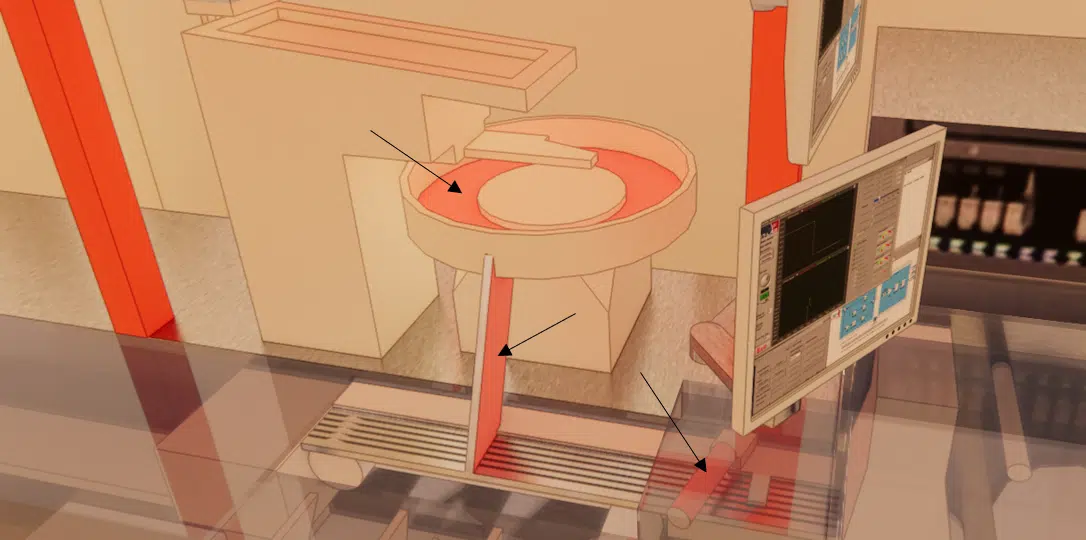
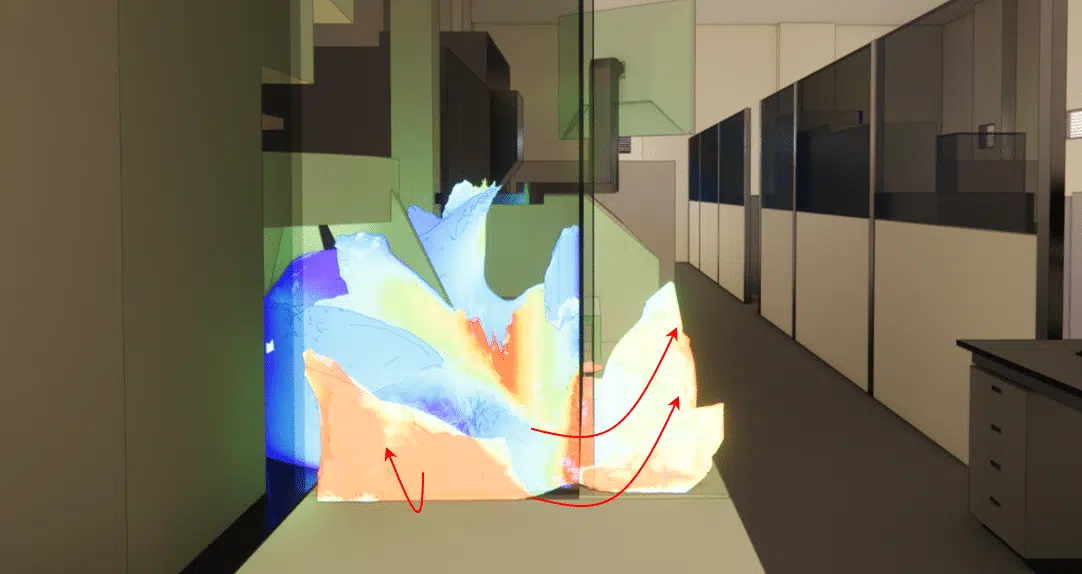
The risks of direct contamination between the two machines are unlikely; on the other hand, an involuntary contamination via the technicians during maintenance cannot be ruled out, given the dust rate emitted around the machine. To overcome this issue, we sized extraction systems at the identified emission zones.
Key takeaway. Here the risk is not direct contamination between machines but the involuntary transport by the operators: a few highly localised leaks are enough. Targeting the extraction at the source is better than treating the whole volume.
EOLIOS carried out an acceptance smoke audit in order to guarantee the optimal sizing of the extraction systems of the medicine-production machine. The objective: to check that the extraction equipment was able to provide an effective extraction of the fine dust produced during the process. Thanks to the smoke, the flows could be visualised and measured, then analysed by our experts.
The results confirmed that the extraction systems in place were correctly sized and effectively managed the smoke produced — an essential confirmation to guarantee the quality of the medicines and avoid any contamination.
Medicine dust, production-line leaks and sizing of the extraction in a cleanroom.
By tracing the dust emitted at the production points and following its dispersion, CFD locates the leaks out of the machines and the zones where the air stagnates. From this the contamination risk and the placement of the extractions are deduced. See also our project cleanroom airflow.
It makes the flow visible: the air is seen reaching the extracts in a laminar way, but also rushing between the partitions. These observations calibrate the CFD model and confirm, at acceptance, that the installed extraction does draw out the dust.
Three main zones emit: the tank, the rail-filling arm and the sorting brush. The tracing shows two main leaks towards the outside, highly localised, at the doors and the gaps between modules.
Because they act as airflow masks: they deflect the air and create recirculations and low-velocity zones, here around 0.2 m/s. Without these obstacles, the simulation would miss the real accumulation zones.
The identified emission zones are targeted, the extraction flow rate is sized, then an acceptance smoke test verifies that the dust is properly captured. The results confirmed a correct sizing.
Explore our expertise, projects and technical papers to go further than the FAQ.
Numerical simulation offers new perspectives to design offices: it makes it possible to anticipate a large number of scenarios and to control the unexpected events linked to a poor design. In the case of pharmaceutical cleanrooms, the multiphysics modelling takes into account all the thermo-airflow phenomena along the line — from overheating to the comfort of the staff, including the guarantee of non-contamination of the production. The audit, carried out over the entire hall, made it possible to effectively locate the air leaks, study the flows and size the extraction systems.
The simplest thing is to talk it through together. Our engineers reply with an initial technical read.